
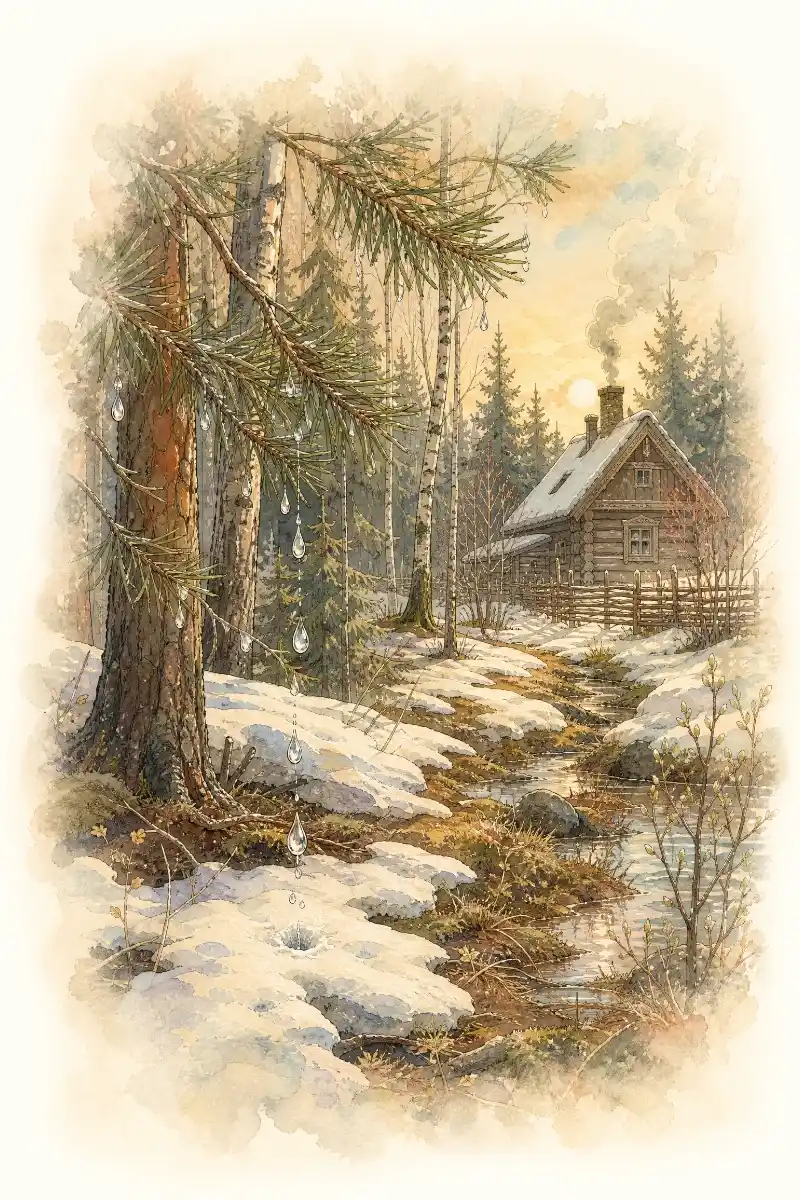
Old Peter knocked the ash from his pipe and looked out of the window. The snow was almost gone from the forest. Only a few white patches remained under the pines, like scraps of a blanket that the earth had thrown off. Ivan and Maroosia sat close together on the bench, waiting.
“Tell us about the snow girl,” said Maroosia.
“The little daughter of the snow,” said Ivan.
Old Peter closed his eyes under his bushy eyebrows. Then he began.
In a certain village, at the edge of a great forest, there lived an old man and an old woman. They were kind and hard-working, but they had no children. Their hut was quiet. In winter, the other children ran out to sled and snowball, and their laughter rang through the village like bells. The old woman would stand at the window and sigh.
“If only we had a little one,” she said. “Even a child made of snow would be a comfort to us.”
The old man said nothing. But one morning, when the frost was sharp and the snow was soft and sticky, he put on his coat and went outside. He took a handful of snow, then another. He shaped a little body, a little head, little arms and legs. The old woman came out and watched. She brought a red coat and a warm hat, and they dressed the snow child. Her eyes were two blue beads. Her lips were red as winter berries. She was beautiful.
Then they went inside and sat by the stove. The old woman wiped her eyes. Suddenly they heard a small sound at the door—like a bell, or a bird tapping on the wood. The door opened, and there stood the snow child. She was alive. Her cheeks were pale, her eyes bright. She smiled.
“Mother,” she said. “Father.”
The old woman cried out with joy. The old man laughed and caught her up in his arms. They named her Snegurochka, the little daughter of the snow.
She grew, but not as other children grow. She grew quickly, like a spring flower, yet she was always pale. She loved the cold. When the wind blew, she laughed. When the snow fell, she danced. She helped the old woman with the house, and she played with the village children. But she was quiet, and sometimes she looked at the sun as if it were a stranger.
Spring came. The snow melted. The streams ran. The birds returned. The village children threw off their heavy coats and ran barefoot on the warm earth. But Snegurochka grew sad. She stayed in the shade. She would not go into the sunlight. The old woman asked what was wrong.
“The sun is too bright,” said Snegurochka. “It makes me afraid.”
Summer came. The days were long and hot. The girls of the village planned to go into the forest to pick berries and dance around a fire. They came to Snegurochka.
“Come with us,” they said. “It will be merry.”
Snegurochka shook her head. “I cannot. The sun burns.”
But they begged and teased, and at last she went. In the forest, under the green leaves, she was happy. She picked berries. She sang. The girls laughed and danced. Then they built a fire. The flames leaped up. One by one, the girls jumped over the fire. They called to Snegurochka.
“Jump! Jump!”
She stood at the edge. The fire was warm. She was afraid. But she did not want to be left out. She took a breath and ran. She jumped.
As she leaped over the flames, she melted. She did not fall. She became a fine white mist. The mist rose up, up, into the sky. It became a cloud. The girls cried out. The cloud drifted over the trees, over the village. And then it was gone.
The old man and the old woman waited. They called her name. But she did not come home. They knew then that she had returned to the snow and the sky. They wept. But sometimes, in winter, when the first snow falls, they look up and smile. For they know that their little daughter is sending them a blanket of snow, white and soft, to cover the earth until spring.
Old Peter stopped. The fire had burned low. Ivan and Maroosia were silent.
“Is that the end?” asked Ivan.
“That is the end,” said Old Peter. “And it is a good end, for the snow always comes back.”