
This is a freakish spirit who delights rather to perplex and frighten mankind than either to serve or seriously hurt them.
The Esprit Follet1 of the French, Shakespeare’s Puck, or Robin Goodfellow2, and Shellycoat, a spirit who resides in the waters, and has given his name to many a rock and stone on the Scottish coast, belong to the class of bogles3.
One of Shellycoat’s pranks is thus narrated:
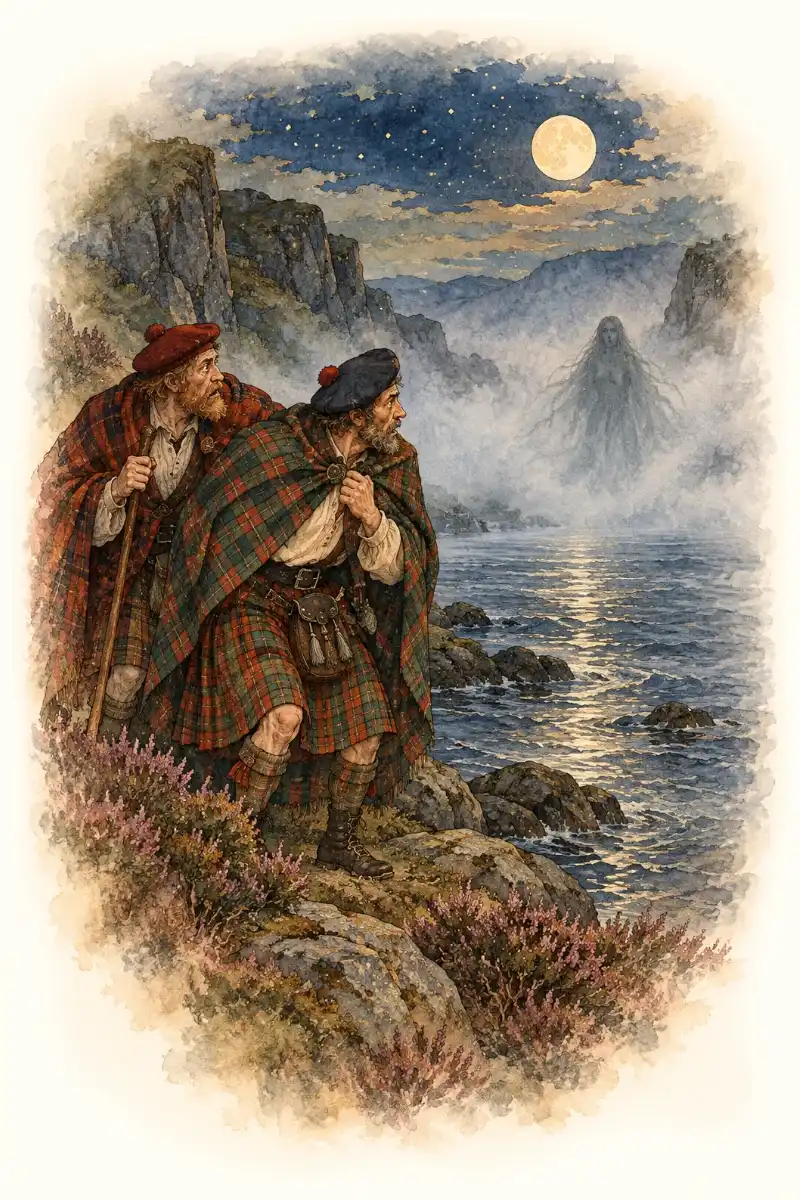
Two men in a very dark night, approaching the banks of the Ettrick4, heard a doleful voice from its waves repeatedly exclaim, “Lost! lost!”
They followed the sound, which seemed to be the voice of a drowning person, and, to their astonishment, found that it ascended the river; still they continued to follow the cry of the malicious sprite, and, arriving before dawn at the very sources of the river, the voice was now heard descending the opposite side of the mountain in which they arise.
The fatigued and deluded travellers now relinquished the pursuit, and had no sooner done so, than they heard Shellycoat5 applauding, in loud bursts of laughter, his successful roguery.
- Esprit Follet — French for “goblin” or “hobgoblin,” a mischievous household spirit. ↩︎
- Puck, or Robin Goodfellow — a mischievous fairy in English folklore, best known from Shakespeare’s A Midsummer Night’s Dream. ↩︎
- Bogle — a Scottish term for a ghost, goblin, or mischievous spirit; in the passage, bogles are a class of such spirits. ↩︎
- Ettrick — a river in the Scottish Borders, known in folklore and literature. ↩︎
- Shellycoat — a Scottish water spirit said to inhabit rivers and coasts, wearing a coat of shells (hence the name); the passage explains that many rocks and stones on the Scottish coast are named after him. ↩︎