
There was once a woman, who lived in the Camp-del-more1 of Strathavon2, whose cattle were seized with a murrain3, or some such fell disease, which ravaged the neighbourhood at the time, carrying off great numbers of them daily. All the forlorn fires and hallowed waters4 failed of their customary effects; and she was at length told by the wise people, whom she consulted on the occasion, that it was evidently the effect of some infernal agency, the power of which could not be destroyed by any other means than the never-failing specific5 — the juice of a dead head from the churchyard6 — a nostrum7 certainly very difficult to be procured, considering that the head must needs be abstracted from the grave at the hour of midnight.
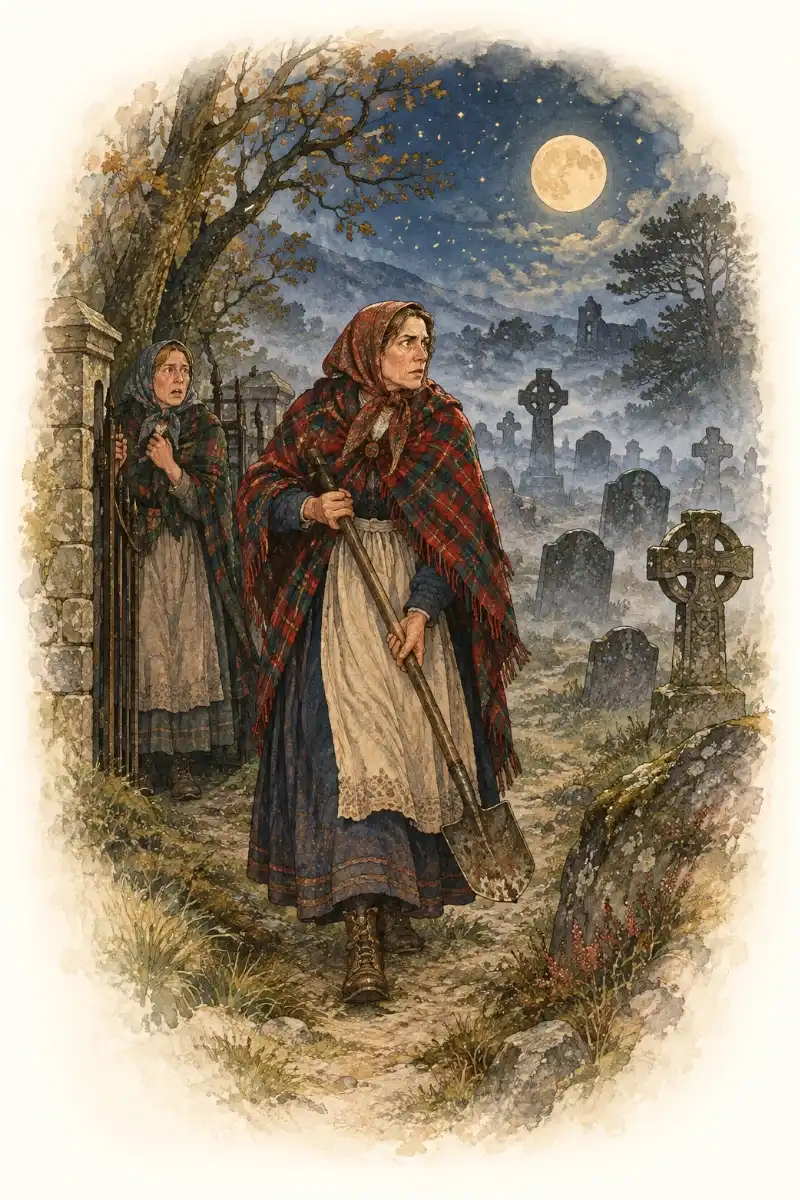
Being, however, a woman of a stout heart and strong faith, native feelings of delicacy towards the sanctuary of the dead had more weight than had fear in restraining her for some time from resorting to this desperate remedy. At length, seeing that her stock would soon be annihilated by the destructive career of the disease, the wife of Camp-del-more resolved to put the experiment in practice, whatever the result might be.
Accordingly, having with considerable difficulty engaged a neighbouring woman as her companion in this hazardous expedition, they set out a little before midnight for the parish churchyard, distant about a mile and a half from her residence, to execute her determination.
On arriving at the churchyard her companion, whose courage was not so notable, appalled by the gloomy prospect before her, refused to enter among the habitations of the dead. She, however, agreed to remain at the gate till her friend’s business was accomplished.
This circumstance, however, did not stagger the wife’s resolution. She, with the greatest coolness and intrepidity, proceeded towards what she supposed an old grave, took down her spade8, and commenced her operations. After a good deal of toil she arrived at the object of her labour. Raising the first head, or rather skull, that came in her way, she was about to make it her own property, when a hollow, wild, sepulchral9 voice exclaimed:
“That is my head; let it alone!”
Not wishing to dispute the claimant’s title to this head, and supposing she could be otherwise provided, she very good-naturedly returned it and took up another.
“That is my father’s head,” bellowed the same voice.
Wishing, if possible, to avoid disputes, the wife of Camp-del-more took up another head, when the same voice instantly started a claim to it as his grandfather’s head.
“Well,” replied the wife, nettled at her disappointments, “although it were your grandmother’s head, you shan’t get it till I am done with it.”
“What do you say, you limmer10?” says the ghost, starting up in his awry habiliments11. “What do you say, you limmer?” repeated he in a great rage. “By the great oath, you had better leave my grandfather’s head.”
Upon matters coming this length, the wily wife of Camp-del-more thought it proper to assume a more conciliatory aspect. Telling the claimant the whole particulars of the predicament in which she was placed, she promised faithfully that if his honour would only allow her to carry off his grandfather’s skull or head in a peaceable manner, she would restore it again when done with. Here, after some communing, they came to an understanding; and she was allowed to take the head along with her, on condition that she should restore it before cock-crowing12, under the heaviest penalties.
On coming out of the churchyard and looking for her companion, she had the mortification to find her “without a mouthful of breath in her body”; for, on hearing the dispute between her friend and the guardian of the grave, and suspecting much that she was likely to share the unpleasant punishments with which he threatened her friend, at the bare recital of them she fell down in a faint, from which it was no easy matter to recover her.
This proved no small inconvenience to Camp-del-more’s wife, as there were not above two hours to elapse ere she had to return the head according to the terms of her agreement. Taking her friend upon her back, she carried her up a steep acclivity13 to the nearest adjoining house, where she left her for the night; then repaired home with the utmost speed, made dead bree14 of the head ere the appointed time had expired, restored the skull to its guardian, and placed the grave in its former condition.
It is needless to add that, as a reward for her exemplary courage, the “bree” had its desired effect. The cattle speedily recovered, and, so long as she retained any of it, all sorts of diseases were of short duration.
- Camp-del-more — a place-name in Strathavon (a district in Banffshire, Scotland); the woman is named after the place where she lives. ↩︎
- Strathavon — a valley of the River Avon in Scotland, historically part of Banffshire. ↩︎
- Murrain — an infectious, often fatal disease affecting cattle; in the passage, the woman’s cattle are seized with “a murrain, or some such fell disease.” ↩︎
- Forlorn fires and hallowed waters — traditional folk remedies in Scottish folklore: “forlorn fires” were fires kindled in times of cattle plague (often by rubbing sticks together), and “hallowed waters” were blessed or charmed waters used to cure sick animals. ↩︎
- Specific — a specific remedy, a medicine for a particular disease; here, “the never-failing specific — the juice of a dead head from the churchyard.” ↩︎
- Churchyard — the burial ground around a church; in the passage, the woman must get a skull from the churchyard at midnight. ↩︎
- Nostrum — a quack or secret remedy; here used ironically for the gruesome cure. ↩︎
- Spade — a digging tool; she “took down her spade, and commenced her operations.” ↩︎
- Sepulchral — relating to a tomb or burial; here, “a hollow, wild, sepulchral voice.” ↩︎
- Limmer — a Scottish insult: a rogue, a rascal, a loose woman; the ghost calls her “you limmer.” ↩︎
- Awry habiliments — crooked, disordered clothes; the ghost starts up “in his awry habiliments,” i.e., in his shroud or grave-clothes. ↩︎
- Cock-crowing — the time when roosters crow, i.e., dawn; she must restore the skull “before cock-crowing.” ↩︎
- Acclivity — a steep slope or incline; she carries her friend “up a steep acclivity.” ↩︎
- Bree — Scottish for “broth” or “gravy”; here “dead bree” means a broth made from the skull (or its juice), used as the cure. ↩︎