
Discover the haunting Polish legend of the enchanted amber, a timeless tale of magic, greed, and tragic consequences. Set in the village of Wierzbica, this folklore classic follows the poor Kuźma family, whose fortunes are forever changed when a mysterious stranger gifts them a magical amber that grants any wish—so long as it harms no one. What begins as a blessing quickly turns to sorrow as wealth breeds isolation, jealousy, and ultimately, devastating loss. This cautionary story explores the dark side of human desire and the heavy price of power. Perfect for lovers of Slavic mythology, fairy tales, and supernatural folklore, the legend of the enchanted amber remains one of Poland’s most captivating and moral-rich stories. A must-read for anyone fascinated by magical realism and the enduring wisdom of Eastern European folk traditions.
Once, in the mists of a bygone age, there lived a poor family named Kuźma1 in the humble village of Wierzbica2. Theirs was a life of relentless toil and bitter want, and their only salvation lay in the forge3 — a sweltering pit of fire and iron where they hammered out tools for the neighbouring folk. The smithy itself was a ramshackle hovel, leaning wearily against the elements, and it stood just a stone’s throw from the home of the blacksmith Antoni.
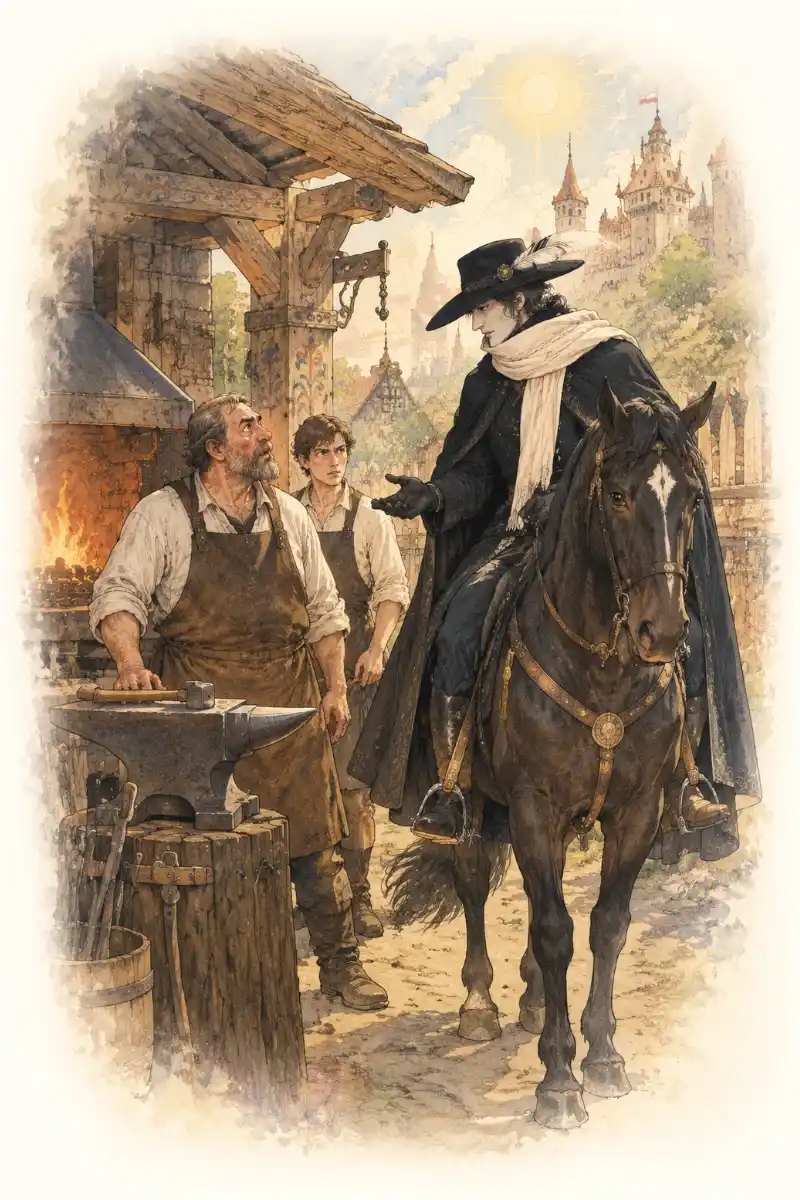
But fate, as it often does, had other plans for the Kuźma family. One sweltering afternoon, as Antoni and his son Michał laboured over the anvil4, a lone horseman appeared on the dusty road. He was cloaked entirely in black, his boots gleaming with silver spurs5, and upon his head sat a magnificent cavalry6 hat with narrow, rakish brims. A white scarf was draped carelessly across his shoulders, fluttering like a ghost in the breeze. His mount was a beast of shadow and sinew, and his presence seemed to darken the very air around him.
The stranger requested a new shoe for his horse and, while the work was done, struck up a conversation with the blacksmith. He spoke with uncanny knowledge of the family’s poverty — of their empty bellies and threadbare clothes — and both Antoni and his son listened with growing bewilderment, their hammers frozen mid-swing. How could a man from the open road know so much of their private suffering?
When the work was finished, the horseman paid not with coin, but with a wondrous nugget7 that blazed in the sunlight like captured fire — like liquid gold forged by the gods themselves. It was amber8, but not of the common sort; it pulsed with an inner light, humming with a power that was both ancient and alive.
“Guard this with your very soul,” the stranger commanded, his voice low and grave. “It grants any wish your heart desires — so long as that wish brings no harm to another soul.”
Then, as swiftly as he had appeared, he spurred his horse and vanished into the wilderness, leaving Antoni and Michał standing slack-jawed and speechless before their forge.
The family gathered around the glowing stone, their eyes wide with wonder and suspicion. They tested it first with simple desires — a feast of roasted meats and honeyed pastries, garments of fine wool and silk — and each wish manifested before their very eyes. The amber was no trick; it was a blessing, a miracle from the heavens.
Within two years, the Kuźmas had transformed from wretched paupers into the wealthiest family in all of Wierzbica. They donned splendid attire, dined on delicacies that would make kings envious, and rode through the village in a gleaming carriage drawn by a pair of magnificent horses. Their modest hovel had been rebuilt into a fine manor, and their forge had expanded into the largest workshop in the region. But with wealth came suspicion, and with suspicion came isolation.
One Sunday, as the family emerged from the local church, the village poor surrounded them, pleading to know the source of their sudden fortune. The Kuźmas answered with stony silence. Fearful of envy and the evil eye, they began to hide their riches, withdrew from old friends, and locked themselves behind closed doors. The amber, once a blessing, had become a curse of loneliness.
Then tragedy struck. First, the matriarch9 of the family fell gravely ill and passed away, leaving a void that no amount of gold could fill. A year later, Antoni himself followed his wife to the grave, his heart broken and his spirit weary. On his deathbed, he bequeathed10 the magical amber to his daughter, Aniela, who secretly hid it from her brother Michał, fearing he would use its power for selfish or wicked ends.
But Michał’s greed festered. He began to harass his sister, demanding she reveal the stone’s hiding place, his words turning to blows when she refused. His rage consumed him, and his heart grew as dark as the stranger’s cloak had been.
One fateful Sunday, Michał’s fury boiled over. He stormed out of the house and found his beloved Kasia in the company of Józef Rybczak. Mad with jealousy, he lunged at his rival, fists flying. The brawl was brutal and ugly, but Michał, realizing the shame of his actions, retreated homeward. There, he found Aniela in quiet conversation with Kazimierz Roguś, the young man who had won her heart and whose love she returned.
Michał, desperate to drown his sorrows, offered Roguś a drink. Roguś, wary of the volatile young man, only feigned to sip. But before peace could settle, the door burst open. Two of Kasia’s brothers stormed in alongside Józef, their faces twisted with vengeance. In the chaos, Aniela’s apron strings11 came undone, and the magical amber tumbled to the floor, gleaming like a fallen star.
In that moment of terror and rage, Michał lunged for the stone and screamed his wish into the air:
“Let death take them all!”
A thunderous crack split the silence — a sound like a cannon’s roar or the earth splitting open. Michał collapsed to the ground, his face drained of all colour, his breath stilled forever. The amber’s power had turned upon its master, for his wish had been born of malice, and such darkness could only consume the one who wielded it.
The household scrambled to summon a priest, but it was too late. Michał was gone. Aniela wept bitterly, clutching her apron, and as she reached for a handkerchief, she felt a strange crunch beneath her fingers. There, nestled in the fabric, lay the amber — shattered into a thousand tiny fragments. But even as she watched through her tears, the pieces began to stir, to quiver, and to draw together like iron filings to a magnet. Slowly, miraculously, they coalesced12 into a single golden-brown mass, whole once more, pulsing with that same ancient light.
The enchanted amber had survived its master’s fall. But Aniela knew, with a heavy heart, that its power came at a price that no mortal should ever dare to pay. And so, she kept it hidden, vowing never to speak a wish again — lest the magic of the stone claim another soul she loved.
- Kuźma — a Polish surname (from the name Kuźma, Kozma); in the passage it is the family name. ↩︎
- Wierzbica — a Polish village name (from wierzba, “willow”); in the passage it is the family’s village. ↩︎
- Forge / smithy — a blacksmith’s workshop with a fire and anvil; the family’s “only salvation lay in the forge.” ↩︎
- Anvil — a heavy iron block on which metal is hammered; Antoni and Michał “laboured over the anvil.” ↩︎
- Spurs — metal spikes worn on a rider’s boots to urge the horse on; his boots gleam “with silver spurs.” ↩︎
- Cavalry hat — a military-style hat with a narrow brim; the stranger wears “a magnificent cavalry hat with narrow, rakish brims.” ↩︎
- Nugget — a lump of precious metal or mineral; the horseman pays “with a wondrous nugget.” ↩︎
- Amber — fossilized tree resin, often golden-yellow; here it “pulsed with an inner light.” ↩︎
- Matriarch — the female head of a family; “the matriarch of the family fell gravely ill.” ↩︎
- Bequeathed — left (property) to someone by will; Antoni “bequeathed the magical amber to his daughter.” ↩︎
- Apron strings — the ties of an apron; “Aniela’s apron strings came undone,” and the amber falls out. ↩︎
- Coalesced — came together to form one mass; the fragments “coalesced into a single golden-brown mass.” ↩︎