
Discover the epic Polish founding legend of Lech, Czech, and Rus—the three legendary brothers who gave birth to the Slavic nations. This timeless tale of brotherhood, faith, and destiny tells how the Slavic people, driven by famine, embarked on a perilous journey across ancient Europe in search of a new homeland. Follow the wise Prince Lech as he separates from his brothers and, guided by a divine sign—a magnificent white eagle against a crimson sunset—founds the city of Gniezno and the nation of Poland. This captivating legend explains the origins of Poland’s iconic white eagle emblem and the founding of the country’s first capital. Perfect for fans of Slavic mythology, European history, and epic tales of nation-building, the legend of Lech, Czech, and Rus is a must-read for anyone fascinated by the ancient roots of Eastern European culture and heritage.
In the twilight of antiquity, when the world was yet young and the destinies of nations were being woven upon the loom of fate, the Slavic tribes dwelt in prosperity and harmony across the vast expanse of the eastern lands. At their head stood three brothers of noble bearing and indomitable spirit: Lech, Czech, and Rus. These were no ordinary rulers—they were warriors whose valor was matched only by their wisdom, and their people flourished beneath their just and benevolent reign.
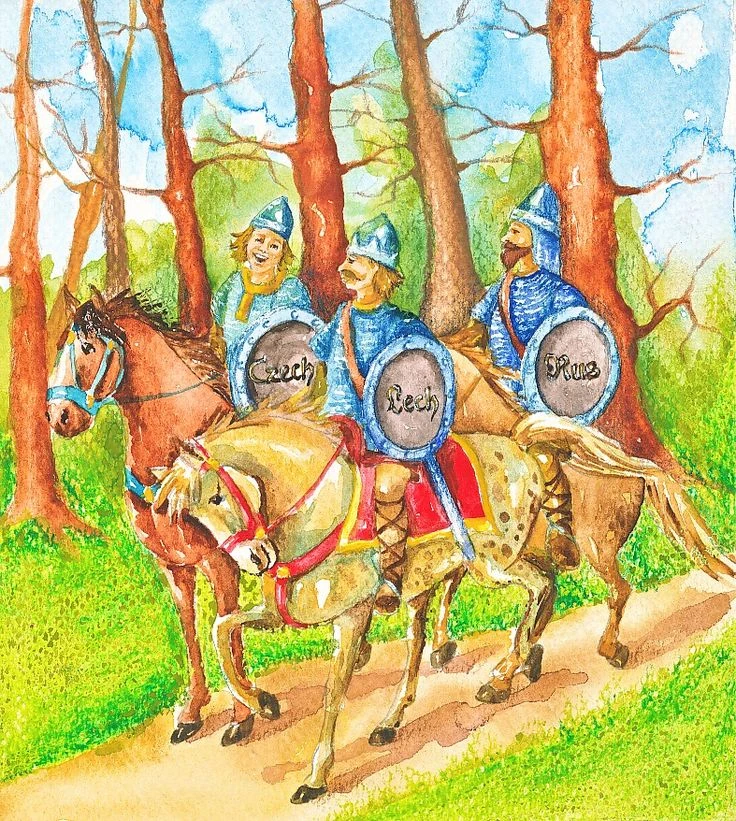
Yet even the most bountiful lands have their limits. The Slavic tribes multiplied with such swiftness that soon the specter of famine began to haunt their dreams. The fields could no longer feed the swelling throng, and the forests could not sustain the endless hunt. The brothers, seeing the plight of their people, convened a great council, summoning their kinsmen and trusted allies to deliberate upon the fate of their nation.
Though the plan met with resistance from some—for men are ever reluctant to abandon the homes of their fathers—the dire circumstances left them little choice. The people resolved to leave their ancestral lands and venture forth into the unknown, seeking a new homeland where their children might thrive. For many days, preparations were made: carts were loaded with provisions, weapons were sharpened, and the old and the young alike steeled themselves for the arduous journey.
At last, the great exodus began. Families abandoned their hearths, wives and children rode upon creaking wagons, and the elders were carried along so as not to slow the march. Before and behind the vast caravan marched the warriors, their watchful eyes scanning the horizon for threats. The road was perilous—through dark forests where wild beasts lurked, across treacherous rivers that slowed their progress, and ever mindful of hostile tribes that might descend upon them without warning.
But through every trial, the people placed their faith in their princes. Though fear gnawed at their hearts, they trusted in the wisdom of Lech, Czech, and Rus. Night after night, they offered prayers to their gods, beseeching them for guidance and deliverance.
Weeks passed, and at last the weary travelers beheld a sight that lifted their spirits: endless, fertile plains stretching to the horizon, crisscrossed by gleaming rivers that sparkled beneath the sun like silver serpents. When the time came to make camp, Rus spoke to his brothers, his voice resolute:
“My people are weary of this long wandering. My heart tells me that this land is good—here we shall build our homes and raise our children. These plains shall be our inheritance.”
Lech and Czech embraced their brother, vowing that they would meet again, for the bond of blood is not so easily severed. Then the remaining brothers turned their faces toward the south, where the sun stood at its zenith, for Czech loved the warmth and radiance of the golden orb.
After many days, they beheld a vision that stole their breath: towering mountains rising from the earth, their peaks crowned with snow and bathed in celestial light. They made camp at the foot of these majestic heights, and Czech gazed upon the summits with wonder.
“I have always loved the warmth of the sun,” he declared, “and where could one be closer to its radiance than upon these lofty peaks? The lands here are rich and fertile. Go forth, brother, alone if you must—for I and my people shall remain here.”
Lech’s heart was heavy with sorrow at the parting, but he understood that his destiny lay elsewhere. Before he departed, he reminded Czech of the sacred oath the three brothers had sworn—that one day, when their nations were established and their peoples at peace, they would meet again.
And so Lech continued his journey, his people following him into the unknown. After many more days of travel, they made camp once more. Lech surveyed the surrounding countryside, and his heart swelled with hope. Here were rivers teeming with fish, forests alive with game, and soils so fertile they would make any farmer weep with joy. Seeing his people exhausted and yearning for rest, Lech addressed them with the authority of a true leader:
“Our wandering is at an end. Here we shall build our settlement. In the depths of my soul, I know this to be true—this is the land that has been waiting for us, the home that destiny has prepared.”
Though the people trusted their prince, they were a devout folk, and they longed for a sign from the heavens to confirm that their long pilgrimage was indeed complete. And in that very moment, as if in answer to their silent prayers, a piercing cry rang out above their heads. All eyes turned upward, and there, soaring through the crimson sky, they beheld a magnificent eagle—its feathers as white as driven snow, its wings spread wide against the burning tapestry of the setting sun.
The great bird descended upon the crown of a mighty oak, settling into its nest as though it had been waiting for them all along. The sight was one of breathtaking beauty: the snow-white eagle silhouetted against the fiery red of the western sky. The people fell to their knees, for they recognized this as the sign they had sought—a divine confirmation that their journey had found its end.
On that very spot, a great city rose from the earth, its form shaped in the image of an eagle’s nest. They called it Gniezno, a name drawn from the Polish word gniazdo—meaning “nest”—in honor of the celestial messenger that had guided them home. And the white eagle upon a field of crimson became the eternal emblem of Lech’s lineage, and in time, the proud coat of arms of the entire Polish nation.
Thus did the three brothers part ways, each founding a great nation upon the lands that destiny had chosen for them. Rus journeyed eastward, to the vast plains that would become the cradle of the Russian people. Czech claimed the mountain heights of the land that would bear his name. And Lech, guided by the white eagle, founded the kingdom of Poland, whose people have carried the symbol of that sacred bird through the ages, a proud testament to the day their ancestors found their promised home.
Thus ends the legend of Lech, Czech, and Rus—a tale of brotherhood, faith, and the founding of nations, whose echoes still resound through the ages.