
In that distant age, when the wise and good King Gylfi1 ruled over Sweden, a wanderer came to him from lands unknown — a woman no one could name. She enchanted Gylfi so deeply with her wondrous songs that he offered her, as reward, as much land as four oxen could plow in a single day and a single night. Gylfi did not know that Gefjun2 — for so the wanderer was called — belonged to the race of the great gods, the Æsir3, and was endowed with their marvelous power. Before coming to Gylfi, she had long dwelt in the land of the giants, Jötunheim4, where she had borne four mighty sons who took the form of colossal oxen. When Gefjun led them from Jötunheim and yoked them to a plow, they tore a great piece of land from Sweden and dragged it into the sea. There it formed an island that stands to this day, called Sælund5 — Zealand.
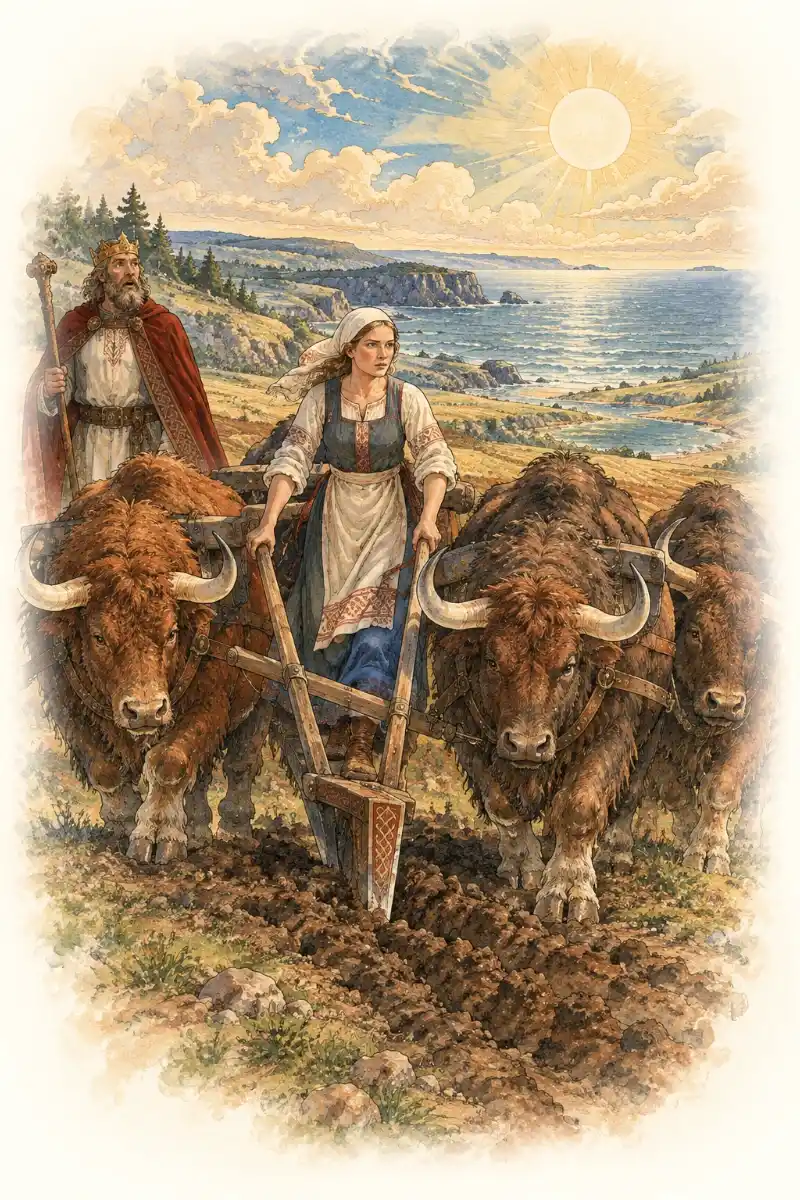
Astonished, Gylfi began to question Gefjun about her origins; and when he heard that she was of the race of the Æsir, he fell into deep thought.
“How great and wise must these Æsir be, if all in the world is done according to their will!” he said to himself. “But who will tell me whence comes their power? Are there not gods even greater and wiser above them, whom they serve, and who grant them their might in return?”
So Gylfi pondered, and the more he pondered, the stronger grew his desire to learn the truth. At last he resolved to leave his palace and wander the world until he found the Æsir and received from them answers to his questions. So that no one might know who he was, Gylfi — who, like many other wise men, had mastered the secrets of sorcery — transformed himself into an old man, donned a wretched beggar’s cloak, took a staff in his hand, and set out under the guise of a poor wanderer. Long did the King of Sweden roam the world; he saw many peoples, and journeyed south and north, west and east. But to whomever he turned, whomever he asked, no one could tell him where Asgard6 lay — the wondrous country of the Æsir — or how one might reach it.
So Gylfi would have returned home having learned nothing, but the great gods themselves, to whom all things are known, had learned of his journey and resolved to satisfy his curiosity. And so it happened that one day, as Gylfi walked alone through the fields — weary and having all but lost hope of finding those he sought — a castle of extraordinary size and beauty rose before him as if from beneath the earth. Its roof reached toward the very sky and blazed brightly in the sun. Looking closer, Gylfi saw that instead of tiles it was laid with great round shields forged of pure gold.
“Surely I have come to Asgard,” he thought. “No earthly king could be so rich. Here dwell the gods, and my wanderings are ended.”
He drew near the castle and saw upon its threshold a man who was tossing nine knives so deftly from one hand to the other that seven of them were always in the air. Noticing Gylfi, he set the knives aside and asked the King of Sweden who he was and what he sought here.
“I am a poor wanderer, and my name is Gangleri7,” the other answered with a low bow. “For several days now I have lost my way, and I no longer know where I have strayed or how to return to my own land. I am weary and faint from hunger and thirst.”
“Well then, Gangleri, enter this castle and be a guest within it,” said the man with the knives. “I will lead you to our kings. They are kind, and from them you shall receive all that you need.”
He rose and bade Gylfi follow.
“I may enter,” thought the false wanderer fearfully, glancing about with unease, “but shall I ever leave?”
They passed through a whole series of richly adorned halls. Each was as vast as a city square, and in each stood long tables at which sat a great multitude of people of many tribes and nations. These people ate and drank, or played at dice, and did not even notice the King of Sweden and his guide. At last, when Gylfi’s eyes were weary from all he had seen, they entered a hall even greater and more magnificent than the rest. In its midst stood three thrones, and upon them sat three men of stately bearing.
“These are our three kings,” said the man with the knives. “He who sits upon the lowest throne is called Har; he upon the middle throne, Jafnhar; and he upon the highest, Thridi8.”
Then Har signaled for Gylfi to approach and asked him who he was and why he had come. The other repeated in a trembling voice that he was a poor wanderer, that his name was Gangleri, and that he had lost his way.
“Fear us not, stranger,” said Har graciously, noticing his confusion. “Enter any hall, sit at any table, eat and drink what you will, and then lie down to sleep. In the morning you shall be guided and shown where to go to find your country.”
Har’s kind speech emboldened the false Gangleri, and gathering his courage, he said:
“I have eaten and drunk nothing for several days. I have traveled a long road. But stronger than hunger and thirst, stronger than weariness, curiosity torments me. Permit me first to ask you a few questions.”
“Ask, stranger,” answered Har, “and may I never rise alive from this place if even one of your questions remains unanswered.”
“Ask, stranger,” the other two kings repeated after him. “Ask, and you shall learn all that you wished to know.”
And Gylfi began to ask. Hour followed hour; the sun began to sink toward the west, and still he asked and asked, and to each question he received an answer at once. So he heard of how the world was created, how the giants, the gods, and men came to be, how the moon and sun move across the sky; he heard of the glorious deeds and feats of the Æsir, and of the fierce struggle they wage against the giants, the hrímthursar9; he heard of the terrible children of the god Loki10 — of the wolf Fenrir11 and of the prophecy of the seeress Völva12; and at last he heard of the final day of the world, of the twilight of the gods. And when he had heard this, suddenly a terrible crash of thunder sounded, and he saw that he stood once more alone, in an open field.
And then Gylfi understood that the kings with whom he had spoken were gods, and he resolved to return home to tell people of all that he had learned during his journey to the land of the Æsir. His tale was passed from father to son, from grandfather to grandson, and at last has come down even to our own day.
And this is what Gylfi learned…
- Gylfi — in Norse mythology, a legendary Swedish king; hero of the Gylfaginning (“The Beguiling of Gylfi”), the first part of Snorri Sturluson’s Prose Edda. ↩︎
- Gefjun — a Norse goddess associated with fertility; in the myth she plowed the island of Zealand (Sælund) out of Sweden with four oxen-sons. ↩︎
- Æsir — the principal group of gods in Norse mythology (Odin, Thor, etc.). ↩︎
- Jötunheim — in Norse mythology, the land of the giants (jötnar). ↩︎
- Sælund (Zealand) — the island in the Baltic Sea (Denmark); in the myth, created by Gefjun. ↩︎
- Asgard — in Norse mythology, the celestial home of the Æsir. ↩︎
- Gangleri — the name under which Gylfi traveled (literally “the weary wanderer”). ↩︎
- Har, Jafnhar, Thridi — the names of the three kings (“High,” “Equally High,” “Third”); in the Prose Edda they are pseudonyms of Odin. ↩︎
- hrímthursar — in Norse mythology, the frost-giants (rime-giants). ↩︎
- Loki — in Norse mythology, a trickster god, father of monsters. ↩︎
- Fenrir — in Norse mythology, the monstrous wolf, son of Loki. ↩︎
- Völva — in Norse mythology, a seeress; her prophecy is the Völuspá (“Prophecy of the Seeress”) in the Poetic Edda. ↩︎