
At first there was nothing: neither earth, nor sand, nor cold waves. There was only the one black abyss, Ginnungagap1. To the north of it lay the realm of mists, Niflheim2, and to the south — the realm of fire, Muspelheim3. Quiet, bright, and hot it was in Muspelheim — so hot that no one but the children of that land, the fire giants, could live there; in Niflheim, by contrast, eternal cold and darkness reigned.
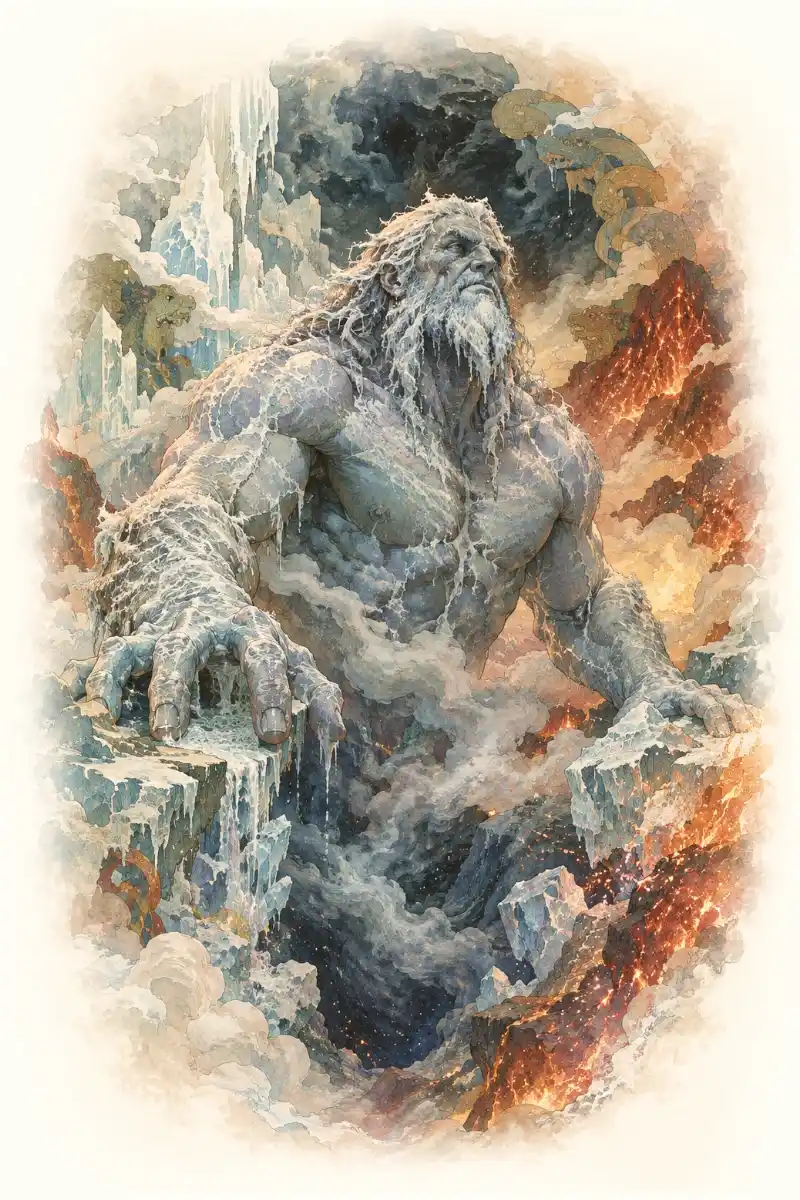
But then, in the realm of mists, the spring Hvergelmir4 began to seethe. Twelve mighty rivers, the Élivágar5, took their beginning from it and rushed swiftly southward, plunging into the abyss of Ginnungagap. The cruel frost of the realm of mists turned the water of these rivers to ice, but the spring Hvergelmir surged on without cease; the blocks of ice grew and drew ever nearer and nearer to Muspelheim. At last the ice came so close to the realm of fire that it began to melt. Sparks flying out of Muspelheim mingled with the melted ice and breathed life into it. And then, over the boundless icy expanses, from the abyss of Ginnungagap, there suddenly rose a gigantic figure. It was the giant Ymir6, the first living being in the world.
On that same day, beneath Ymir’s left arm there appeared a boy and a girl, and from his feet was born the six-headed giant Thrudgelmir7. Thus was the race of giants begun — the Hrímthursar8, cruel and treacherous as the ice and flame that created them.
At the same time as the giants, from the melting ice there arose the gigantic cow Audhumla9. Four rivers of milk flowed from the teats of her udder, giving food to Ymir and his children. There were no green pastures yet, and Audhumla grazed upon the ice, licking the salty blocks of ice. By the end of the first day, hair appeared on the summit of one of those blocks; on the second day — a whole head; and by the end of the third day, out of the block came a mighty giant, Buri10. His son Bor11 took the giantess Bestla12 as his wife, and she bore him three sons — the gods Odin, Vili, and Vé13.
The brother gods did not like the world in which they lived, nor did they wish to endure the dominion of the cruel Ymir. They rose up against the first of the giants, and after a long and fierce struggle they slew him.
Ymir was so enormous that in the blood that gushed from his wounds all the other giants drowned, and the cow Audhumla drowned as well. Only one of Ymir’s grandsons — Bergelmir14 — managed to build a boat, in which he saved himself together with his wife.
Now no one hindered the gods from shaping the world according to their will. They made the earth from Ymir’s body, in the form of a flat circle, and placed it in the midst of the vast sea that had formed from his blood. The gods named the earth “Midgard15,” which means “the middle country.” Then the brothers took Ymir’s skull and made from it the vault of heaven; from his bones they made mountains, from his hair trees, from his teeth stones, and from his brain the clouds. Each of the four corners of the heavenly vault the gods curled into the shape of a horn, and into each horn they placed a wind: into the northern — Nordri, into the southern — Sudri, into the western — Vestri, and into the eastern — Austri16. From the sparks that flew out of Muspelheim, the gods made the stars and adorned the heavenly vault with them. Some stars they fixed motionless; others, so that time might be known, they placed so that they moved in a circle, completing it in one year.
Having created the world, Odin and his brothers resolved to people it. One day, on the seashore, they found two trees: an ash and an alder. The gods felled them and made a man from the ash and a woman from the alder. Then one of the gods breathed life into them, another gave them reason, and the third — blood and rosy cheeks. Thus appeared the first people, and their names were: the man — Ask, and the woman — Embla17.
Nor did the gods forget the giants. Beyond the sea, to the east of Midgard, they created the land of Jötunheim18 and gave it into the possession of Bergelmir and his descendants.
In time the gods grew more numerous: many children were born to the eldest of the brothers, Odin. They built for themselves a country high above the earth and called it Asgard19, and themselves the Æsir20. But of Asgard and the Æsir we shall tell you later; for now, listen to how the moon and the sun were created.
- Ginnungagap — in Norse mythology, the primordial void, the great abyss. ↩︎
- Niflheim — in Norse mythology, the realm of mist and cold (in the north). ↩︎
- Muspelheim — in Norse mythology, the realm of fire (in the south). ↩︎
- Hvergelmir — in Norse mythology, the spring from which the rivers flow. ↩︎
- Élivágar — in Norse mythology, the twelve icy rivers. ↩︎
- Ymir — in Norse mythology, the first giant, from whose body the world was made. ↩︎
- Thrudgelmir — in Norse mythology, the six-headed giant, son of Ymir. ↩︎
- Hrímthursar — in Norse mythology, the frost-giants (rime-giants). ↩︎
- Audhumla — in Norse mythology, the cosmic cow that nourished Ymir. ↩︎
- Buri — in Norse mythology, the first god, grandfather of Odin. ↩︎
- Bor — in Norse mythology, son of Buri, father of Odin. ↩︎
- Bestla — in Norse mythology, the giantess, wife of Bor. ↩︎
- Odin, Vili, Vé — in Norse mythology, the brother gods, sons of Bor. ↩︎
- Bergelmir — in Norse mythology, Ymir’s grandson, who survived in a boat. ↩︎
- Midgard — in Norse mythology, “the middle country,” the world of men. ↩︎
- Nordri, Sudri, Vestri, Austri — in Norse mythology, the four winds (north, south, west, east). ↩︎
- Ask and Embla — in Norse mythology, the first man and woman, made from trees. ↩︎
- Jötunheim — in Norse mythology, the land of the giants. ↩︎
- Asgard — in Norse mythology, the celestial home of the Æsir. ↩︎
- Æsir — the principal group of gods in Norse mythology. ↩︎