
In the cathedral city of Rostov, young Alyosha Popovich sat at his father’s table—the old archpriest Levontius—when news came rushing in like a spring flood across the steppe. Glory, that fickle bird, had spread her wings and flown far and wide.
They were singing of him in Kiev and whispering in Chernigov; the rumor reached the forests of Lithuania and the tents of the Golden Horde; even in great Novgorod, they blew the trumpets in his honor. For it was Alyosha Popovich the Younger who had crushed the countless heathen horde, delivered the golden-domed capital from ruin, and cleared the straight road to Kiev of every foul enemy.
That shining rumor flew eastward, all the way to the heroic outpost where the old guardians of Rus’ kept their watch. There, the veteran Cossack Ilya Muromets heard the tale, stroked his gray beard, and spoke with the weight of ages:
“You know a falcon by its flight, and a bold youth by his riding. So it seems a new hero has been born among us—this Alyosha Popovich the Younger. As long as such men ride the Russian earth, our line shall never fail, from this century to the next!”
Without another word, Ilya saddled his shaggy dun stallion, Burushka, and took the straight road to the capital.
Upon reaching the princely court, he dismounted and strode into the white-stone palace. There, he bowed with the old courtesy—low to all four corners of the hall, and lower still to the Prince and Princess:
“Long life to you, Prince Vladimir, the Red Sun, and to your gracious Princess Apraksia! I come to offer my congratulations on your great victory. Though no bogatyrs were in Kiev when the heathen horde descended, the city was saved nonetheless—the foe was beaten, the roads were cleansed, and Rus’ was freed from her enemies. And all that glory belongs to young Alyosha Popovich. He is green in years, yes, but he has the heart of a lion and the cunning of a wolf. Yet you, Prince, have not honored him. You have not called him to your halls. You have slighted not just Alyosha, but every knight who serves this land. Hear an old man’s counsel: throw a feast—a great banquet of honor for all the mighty Russian heroes. Summon young Alyosha to that table. Before us all, give him the praise he has earned. Let him know his service is seen, so that no bitterness takes root in his heart, and so that he will ride for you again.”
Prince Vladimir, the Red Sun, inclined his head and answered:
“I shall host such a feast, and I shall invite Alyosha. I will give him his due honor. But who shall carry my summons? Who shall be my envoy? None better than Dobrynya Nikitich. He has walked the path of embassy before; he is learned, courteous, and knows the proper words for every ear.”
So Dobrynya mounted his horse and rode to Rostov. He found Alyosha, bowed low to the young hero, and spoke with honeyed gravity:
“Come, bold and gallant youth, ride with me to fair Kiev, to the gentle Prince Vladimir. There is bread and salt to share, mead and ale to quaff, and the Prince himself shall welcome you with open hands.”
But Alyosha folded his arms and answered coldly: “I was in Kiev not long ago, and no one invited me to their table. No one offered me a cup. Why should I return to a place that shut its doors in my face?”
Dobrynya bowed again, lower still:
“Nurse no worm of resentment in your breast, Alyosha. Saddle your horse and ride with me to the feast of honors. Prince Vladimir will reward you openly, with precious gifts and golden words. And I am not the only one who calls you—the great Ilya Muromets himself bids you come. So, too, does Vasily Kazimirovich, and Dunai Ivanovich, and even little Potanya the Lame. And I, Dobrynya, ask you in all good faith. Let go of your anger toward the Prince, and join us in joyful fellowship.”
Alyosha’s eyes softened. “If it were only the Prince’s summons, I would not stir from this spot. But if Ilya Muromets and the mighty heroes call me brother—then that is an honor I cannot refuse.”
He rose, saddled his good horse, and with his brave druzhina at his back, rode out for Kiev. But he did not enter by the road nor through the main gates. Instead, he spurred his steed and leaped over the city walls, landing with a thunderous clatter in the very courtyard of the princely palace. There, he and his men vaulted from their saddles as one.
Old Ilya Muromets, together with Prince Vladimir and Princess Apraksia, descended the red porch to greet the guest with full ceremony. They took Alyosha by the arms and led him into the great dining hall, to the place of highest honor—the red corner—seating him between Ilya and Dobrynya.
Then Prince Vladimir paced the length of the chamber and gave his command:
“Young squires, faithful servants, fill a goblet with green wine, tempered with aged meads. Let it be no small measure—a full pail and a half. Present this to Alyosha Popovich. Fill a second for Ilya Muromets, and a third for Dobrynya Nikitich!”
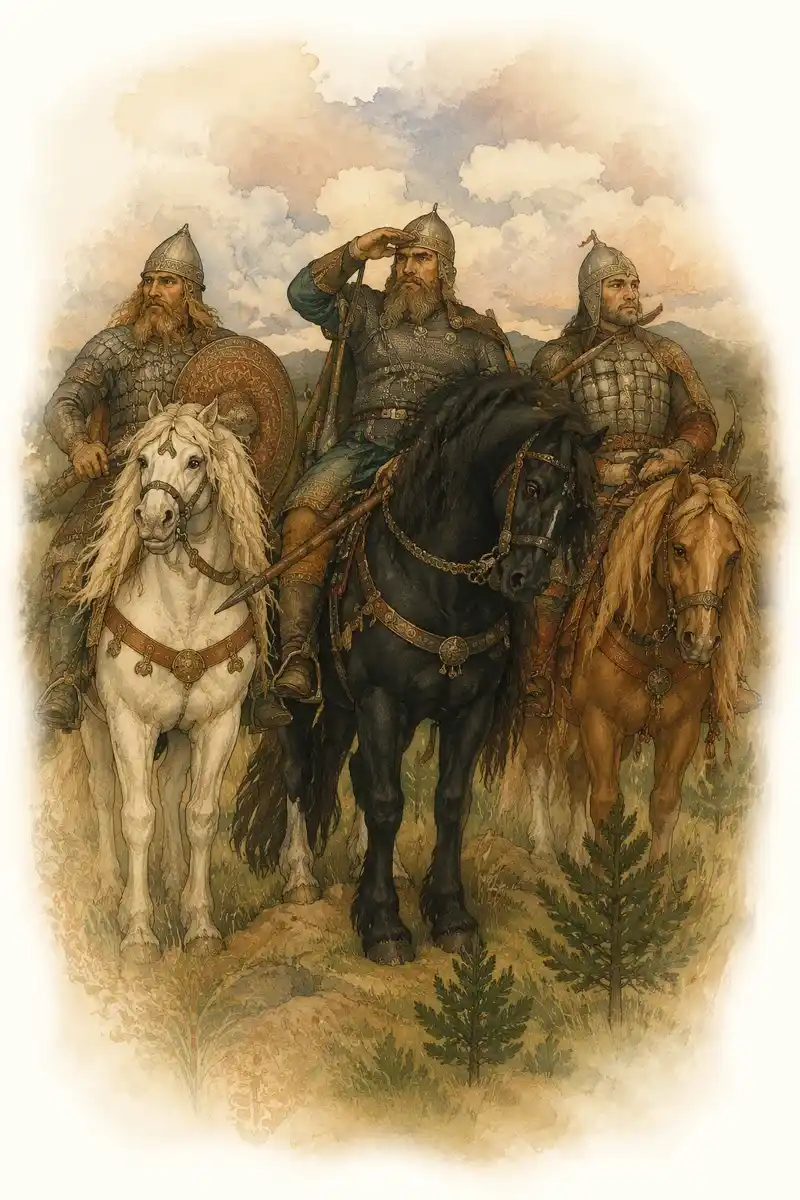
The three heroes rose to their swift feet, drained their goblets in a single breath, and in that sacred moment, swore brotherhood before all the court. They named Ilya Muromets the eldest brother, Dobrynya Nikitich the middle, and Alyosha Popovich the youngest.
Three times they embraced, and three times they kissed upon the cheek.
Then Prince Vladimir and Princess Apraksia began to shower Alyosha with rewards. They granted him a fine city with its outlying towns, a great village with its hamlets, and a treasury of gold to spend as he pleased. “Take these silks and precious garments,” they said, “for you have earned them.”
But young Alyosha rose to his feet and raised his voice:
“I did not fight alone against that countless heathen horde. My loyal druzhina bled beside me. Reward them, I beg you—give them land and silver. As for me, I want no city with its suburbs, no village with its fields, no garments of gold. I give thanks for the bread, the salt, and the honor you have shown me this day. But grant me only this, O Prince Vladimir of Kiev—let me and my sworn brothers, Ilya Muromets and Dobrynya Nikitich, wander and rejoice through Kiev without toll or tribute. Let our merrymaking ring so loud that they hear the echo in Rostov and Chernigov! And when the feast is done, we shall ride to the outpost and stand guard over the Russian land, turning back any foe who dares approach.”
With that, Alyosha clapped his hand, stamped his foot, and cried out in wild glee: “Eh, never fret, good people—let the revels begin!”
And the mighty heroes raised their cups and sang the praises of Alyosha Popovich. So ended the great banquet of honor, and so began the brotherhood that would guard Rus’ for many years to come.