
Discover the enchanting Russian bylina of “Solovey Budimirovich,” a tale of opulence, courtship, and the building of a legendary city. When the wealthy merchant Solovey Budimirovich sails thirty lavishly adorned ships up the Dnieper to Kiev, his vessel—decked with jewels, sables, and silver anchors—surpasses all others in splendor. Received with honor by Prince Vladimir and Princess Apraksia, Solovey asks only for a plot of land in the garden of the beautiful Zabava Putyatishna, where he raises three golden-topped towers overnight. When Zabava sneaks into his tower and beholds the celestial beauty of his chamber, she boldly proposes marriage—but Solovey gently rebukes her forwardness, then properly sends matchmakers to win her hand. Their union leads to the rebuilding of Kiev with golden towers and white-stone cathedrals, making the city the fairest in all Rus’. This classic bylina celebrates wealth used for beauty and honor, the proper customs of courtship, and the glory of a city transformed by love. Perfect for fans of Slavic folklore, romantic epics, and tales of wonder and prosperity, this beautifully translated story will delight readers of all ages.
From beneath an old and lofty elm, from beneath a willow bush, from beneath a white pebble, the Dnieper River flowed forth. Fed by countless streams and rivulets, it coursed across the Russian land and bore thirty ships to Kiev. All the ships were beautifully adorned, but one surpassed them all—the ship of the master Solovey Budimirovich.
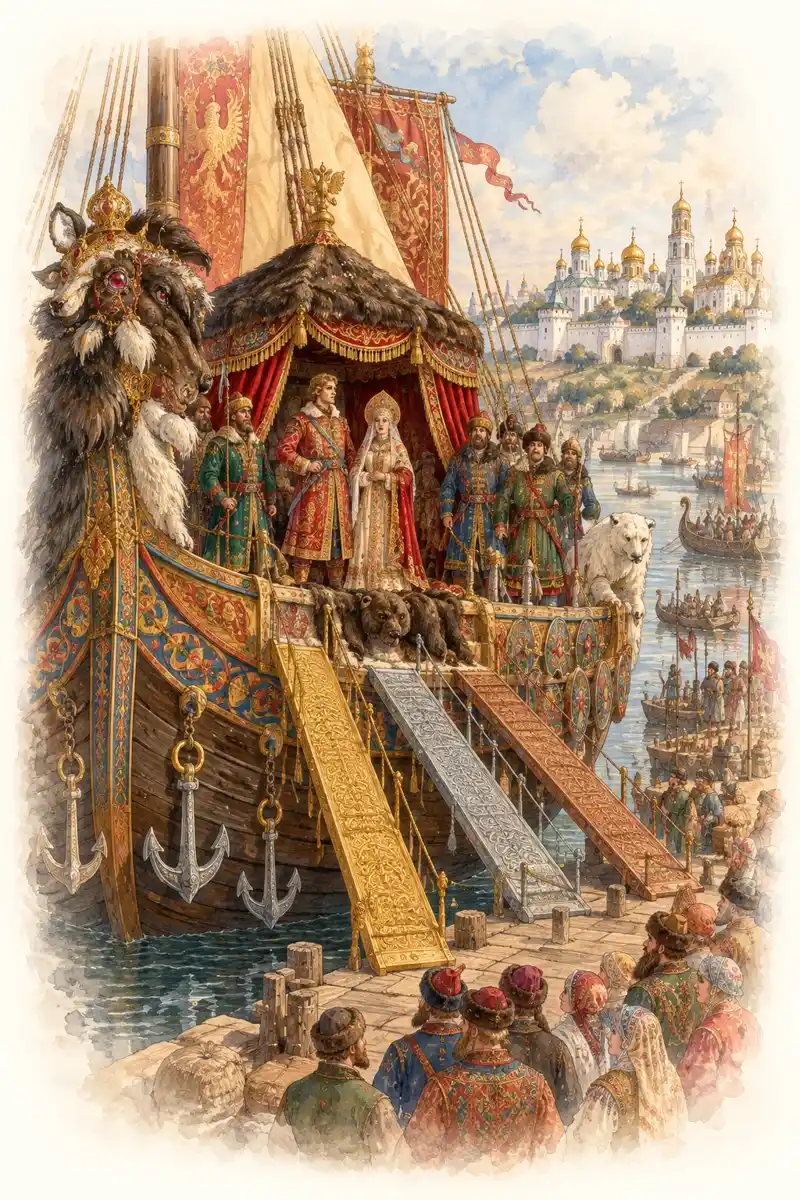
Upon its prow was carved a wild aurochs’ head. In place of eyes, precious jacinths were set; in place of brows, black sables were laid; in place of ears, white ermines; in place of a mane, black-brown foxes; in place of a tail, white bears.
The sails were of precious brocade, the ropes of silk.
The anchors were of silver, and the rings upon the anchors of pure gold.
The ship was adorned with every splendor!
Amidships stood a tent, covered with sables and velvet, its floor strewn with bearskins.
In that tent sat Solovey Budimirovich with his mother, Ulyana Vasilyevna.
Around the tent stood his druzhina. Their garments were costly, of fine cloth; their belts were silk; their caps were downy. On their feet were green boots, studded with silver nails and fastened with gilded buckles.
Solovey Budimirovich paced the deck, shaking his curls, and spoke to his druzhina:
“Now then, brothers—shipmen! Climb to the upper yards and look—is the city of Kiev visible? Choose a good harbor, that we may bring all our ships together in one place.”
The shipmen climbed the yards and cried:
“Near, near is the glorious city of Kiev! We see the ship’s harbor!”
So they came to Kiev, dropped anchor, and secured the ships.
Solovey Budimirovich ordered three gangplanks thrown to the shore. One plank was of pure gold, another of silver, and the third of copper.
By the golden plank Solovey led his mother ashore; by the silver plank he walked himself; and by the copper plank his druzhina ran out.
Solovey Budimirovich called his stewards:
“Unlock our cherished chests, prepare gifts for Prince Vladimir and Princess Apraksia. Fill a bowl with red gold, a bowl with silver, and a bowl with pearls. Bring forty sables and countless foxes, geese, and swans. Take from the crystal chest precious brocade with patterns—I shall go to Prince Vladimir.”
Solovey Budimirovich took his golden gusli and went to the Prince’s palace.
Behind him walked his mother with her maidservants; behind his mother they carried the precious gifts.
Solovey came to the Prince’s courtyard, left his druzhina on the porch, and entered the hall with his mother.
As the Russian custom demands—courteous and respectful—Solovey Budimirovich bowed to all four corners, and to the Prince and Princess especially, and presented rich gifts to all.
To the Prince he gave a bowl of gold; to the Princess, precious brocade; and to Zabava Putyatishna, large pearls. The silver he distributed to the Prince’s servants, and the furs to the bogatyrs and the boyars’ sons.
Prince Vladimir was pleased with the gifts, and Princess Apraksia even more so.
The Princess ordered a feast in honor of the guest. At that feast they honored Solovey Budimirovich and his mother.
Prince Vladimir began to question Solovey:
“Who are you, good youth? Of what clan and tribe? How shall I reward you—with cities and villages, or with golden treasury?”
“I am a merchant, Solovey Budimirovich. I need no cities with villages, and I have plenty of golden treasury myself. I have come to you not to trade, but to live as a guest. Grant me, Prince, a great favor—give me a good place where I might build three towers.”
“If you wish, build on the trading square, where the women bake pies, where the little boys sell rolls.”
“No, Prince, I do not wish to build on the trading square. Give me a place closer to yourself. Allow me to build in Zabava Putyatishna’s garden, among the cherry trees and the hazelnut groves.”
“Take whatever place you like—even in Zabava Putyatishna’s garden.”
“Thank you, Vladimir, Red Sun.”
Solovey returned to his ships and summoned his druzhina.
“Now then, brothers, let us take off our rich caftans and put on workmen’s aprons. Let us pull off our morocco boots and put on bast shoes of linden bark. Take saws and axes, and go to Zabava Putyatishna’s garden. I myself will direct you. And we shall raise in the hazelnut grove three towers with golden tops, so that the city of Kiev shall stand fairer than all other cities.”
A clatter and ringing arose in the green garden of Zabava Putyatishna, as if forest woodpeckers were tapping on the trees…
And by dawn’s first light, three towers with golden tops stood ready. And what beautiful towers! Their summits intertwined with one another; their windows latticed together; one entrance porch was of latticework, another of glass, and the third of pure gold.
Zabava Putyatishna woke in the morning, threw open her window onto the green garden, and could not believe her eyes: in her beloved hazelnut grove stood three towers, their golden cupolas blazing like fire.
The Princess clapped her hands and summoned her nurses, nannies, and maidens.
“Look, nurses—perhaps I am dreaming and seeing this in a dream: yesterday my green garden stood empty, and today towers blaze within it.”
“Go and see for yourself, Mother Zabavushka—your happiness has come to your very courtyard.”
Zabava dressed hastily. She did not wash, did not braid her hair, slipped her bare feet into shoes, tied a silken kerchief, and ran to the garden.
She ran along the path through the cherry trees to the hazelnut grove. She reached the three towers and walked quietly.
She approached the latticework porch and listened. In that tower, something was knocking, ringing, clinking—it was Solovey’s gold being counted and poured into bags.
She ran to the second tower, to the glass porch. In that tower, voices spoke softly: there lived Ulyana Vasilyevna, the own mother of Solovey Budimirovich.
The Princess stepped away, fell to thinking, blushed, and on tiptoe crept to the third tower with the porch of pure gold.
The Princess stood and listened, and from the tower poured a song—ringing, like a nightingale singing in the garden. And behind the voice, strings rang with a silvery chime.
“Shall I enter? Shall I cross the threshold?”
The Princess was both afraid and eager to look.
“Let me,” she thought, “peek with just one eye.”
She opened the door a crack, peeked through the opening, and gasped: in the sky there was a sun, and in the tower a sun; in the sky there were stars, and in the tower stars; in the sky there were dawns, and in the tower dawns. All the beauty of the heavens was painted on the ceiling.
And on a chair of precious walrus ivory sat Solovey Budimirovich, playing his golden gusli.
Solovey heard the creak of the door, rose, and went to the door.
Zabava Putyatishna took fright; her legs gave way, her heart stood still—she was about to fall.
Solovey Budimirovich guessed, threw down his gusli, caught the Princess, carried her into the chamber, and seated her on a leather chair.
“Why do you frighten yourself so, dear Princess? You have not entered a bear’s den, but come to a courteous youth. Sit and rest; speak a kind word to me.”
Zabava calmed down and began to question him:
“Where did you bring your ships from? Of what clan and tribe are you?”
To everything Solovey gave courteous answers. But the Princess forgot the customs of her forefathers and suddenly said:
“Are you married, Solovey Budimirovich, or do you live unmarried? If I please you, take me in marriage.”
Solovey Budimirovich looked at her, smiled, and shook his curls:
“In all things you please me, Princess—in all things you are to my liking. But one thing I do not like: that you propose yourself in marriage. Your place is to sit modestly in your tower, embroider with pearls, stitch skillful patterns, and await matchmakers. But you propose yourself.”
The Princess burst into tears, fled from the tower, ran to her chamber, threw herself on the bed, and trembled all over with weeping.
But Solovey Budimirovich had not spoken out of malice, but as an elder speaks to a younger. He quickly put on his boots, dressed more finely, and went to Prince Vladimir.
“Greetings, Prince-Sun! Permit me to speak a word, to make a request.”
“Speak, Soloveyushko.”
“You have, Prince, a beloved niece—might she be given to me in marriage?”
Prince Vladimir agreed. They asked Princess Apraksia, they asked Ulyana Vasilyevna, and Solovey sent matchmakers to Zabava’s mother.
And Zabava Putyatishna was betrothed to the good merchant Solovey Budimirovich.
Then the Prince-Sun summoned master craftsmen from all over Kiev and commanded them, together with Solovey Budimirovich, to raise golden towers, white-stone cathedrals, and strong walls throughout the city. Kiev became finer than before, richer than of old.
Fame of it spread throughout native Rus’, and flew to overseas lands as well: there is no city better than Kiev.