
Discover the thrilling Russian bylinas of “Soldier Semyon, the Swift Messenger,” a tale of courage, magic, and the triumph of a humble soldier over treachery. When an old man and his three sons build a road through impassable swamps, the Sun, Wind, and Moon reward them—but the youngest son, Semyon, asks only to become a soldier, despite warnings of hardship. Granted the power to transform into a hare, a deer, and a falcon, Semyon serves faithfully until war breaks out and the Tsar forgets his sword-kladenets at the palace. Promising his daughter’s hand to whoever retrieves the sword fastest, the Tsar sends Semyon, who completes the journey in a single day—only to be murdered by a treacherous boyar who steals the credit. But the Sun, Wind, and Moon revive Semyon with the water of life, and he races back to the capital in time to expose the villain at the wedding feast, winning Princess Marya and becoming the kingdom’s chief commander. This classic bylina celebrates loyalty, humility, and the magical reward of those who serve with faith and truth. Perfect for fans of Slavic folklore, soldier’s tales, and stories of underdog triumph, this beautifully translated epic will captivate readers of all ages.
Once upon a time there lived an old man, and he had three sons. The eldest was named Fyodor, the middle one Stepan, and the youngest Semyon.
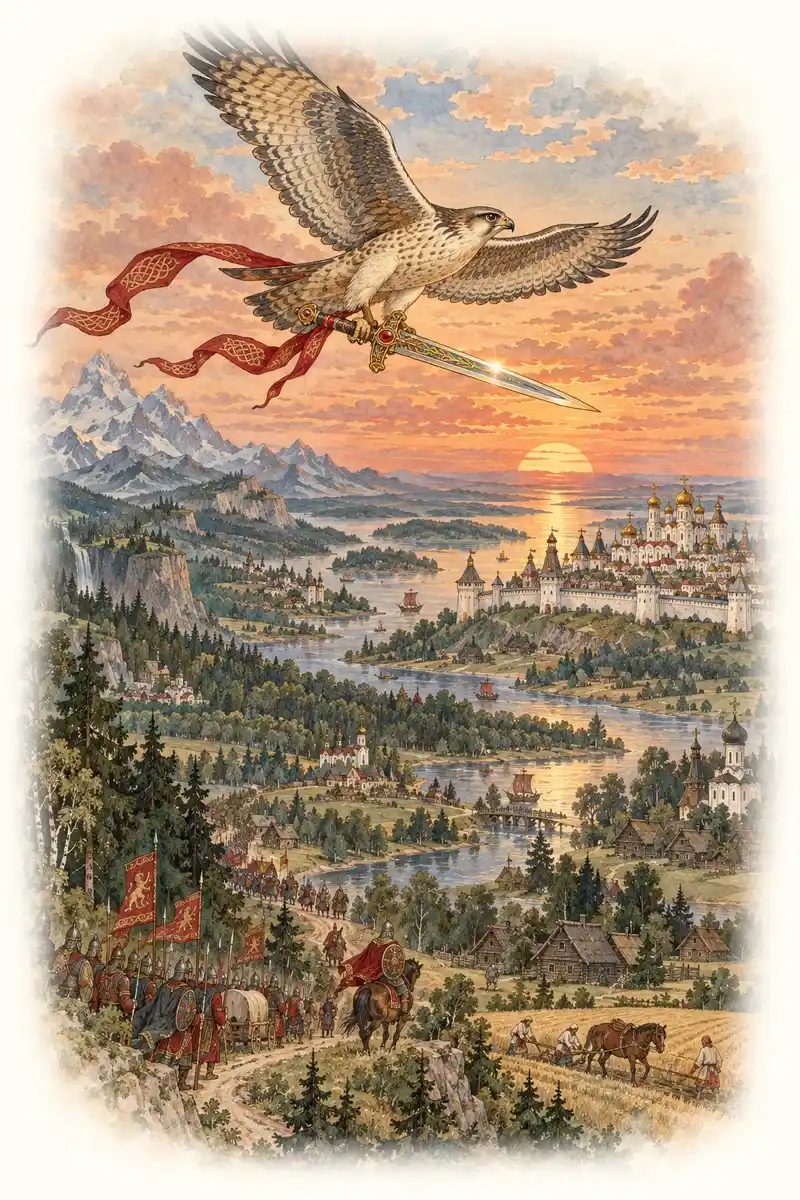
Near their very village ran a great road—but it was a roundabout road, winding around swamps, bogs, and black mires. To travel straight from the village to the capital took three days; but to go around the swamps, bogs, and black mires took three years.
The old man resolved to help the people—to lay a straight road through. He commanded his sons to drain the water from the swamps and bogs, to lay maple bridges across the black mires, so that neither foot-traveler nor horseman need wet a foot, and so that instead of three years, in three days one might reach the capital by the straight road.
They set to work: one son dug ditches and drained the water, another felled timber, and the third built the bridge and laid the decking. The father helped them all and advised how best to do it. Whether they toiled long or short, they built a bridge a hundred versts long.
Life became good for travelers and wayfarers. They walked and rode, and all were glad and joyful.
“Thank you,” they said, “to those who conceived and built this bridge—they have brought great relief to the people.”
And the old man and his sons returned to their peasant labors. They felled timber, uprooted stumps and roots, and sowed grain, as before.
At that time, the Sun, the Wind, and the Moon came together above the bridge. They listened to the people’s talk and said:
“All the people praise the old man and his sons for their good deed, yet the old man still lives poorly—barely scraping by from bread to kvass. We must help him out of his need.”
They summoned the old man and said:
“For your care for the world, we will reward you. Ask for whatever you wish.”
The old man bowed to the Sun, the Wind, and the Moon.
“Thank you—I, an old man, need nothing. If people remember me with a kind word, that is good enough. Ask my sons: their whole lives lie ahead of them.”
They asked the eldest brother, Fyodor:
“You cleared the road and built the bridge. Ask for whatever reward you wish—it shall be fulfilled.”
Fyodor thought and said:
“I did not work alone, but with my father and brothers, and I do not know what they need.”
“And what do you ask for yourself?”
The eldest brother answered:
“If only the grain would grow well, not beaten down by hail, not spoiled by frost—I need nothing more.”
“All shall be as you say,” said the Sun, the Wind, and the Moon. “Go, plow and sow—you will always have bread.”
They asked the middle brother, Stepan:
“You with your father and brothers laid the road through the bogs and swamps and built the bridge. Ask for whatever reward you wish—it shall be fulfilled.”
Stepan thought and thought: “If I ask for money, the money will be spent, and I will be left with nothing. Better to learn a trade.” And he said:
“Most of all, I love the carpenter’s craft. If only I could learn that mastery—to work swiftly and well! I would build izbas and houses—I would always be fed.”
“Go,” said the Sun, the Wind, and the Moon, “you shall be the most skilled carpenter, and all will honor and respect you.”
They summoned the youngest brother, Semyon:
“And what reward shall we give you for draining the bogs and swamps with your father and brothers, and building the bridge? Fyodor wished to remain a plowman, Stepan a craftsman—and what labor draws your heart?”
Semyon answered:
“Most of all I long to become a soldier.”
“You are still very young,” said the Sun, the Wind, and the Moon, “you have been nowhere, seen nothing. Soldiering will seem hard to you. You might regret it later.”
And they turned Semyon into a gray hare:
“Run and see for yourself the life of a soldier.”
Semyon ran as a gray hare and looked at the soldiers. They were taught to march in formation: “One, two! One, two!” They were made to turn all at once: “Left! Right! About-face!”
They were taught to leap over ditches and trenches. They were taught to swim swift rivers, to fire muskets, and to thrust with bayonets: “One, two! One, two!” They were woken before dawn and drilled until late evening.
Semyon returned home.
The Sun, the Wind, and the Moon turned him back into a fine youth and asked:
“Did you see how hard it is to serve as a soldier?”
“I saw,” answered Semyon. But he stood his ground: “I long to become a soldier.”
The Sun, the Wind, and the Moon turned him into a swift-footed deer:
“Run straight south for three days, do not turn aside—look once more at the soldiers.”
Semyon ran as a swift-footed deer straight south for three days and saw a great army on the march. Each soldier carried a heavy burden. The sun scorched them and thirst tormented them; rain soaked them and cold chilled them. They walked—now knee-deep in mud, now raising dust in columns. The regiments marched from morning until evening: “One, two! One, two!” All stepped as one man.
Semyon returned home.
The Sun, the Wind, and the Moon turned him back into a fine youth and said:
“Those regiments you saw are marching to war. Did you see how hard a soldier’s campaigns are? Perhaps you have changed your mind and will ask for something else?”
But Semyon repeated one thing:
“I want to become a soldier.”
Then the Sun, the Wind, and the Moon turned him a third time—into a bright falcon:
“Fly and see how soldiers fight, how they do battle.”
Semyon flew as a bright falcon. He flew for three days and saw a battle, a bloody fight.
Those soldiers who had been on the march had now locked chest to chest with the enemy army. They fired their muskets like thunder, smoke spread all around. They thrust with bayonets, cut with sabers. A leg cut off—they stood on the other; an arm cut off—they fired with the other. And the foreign armies wavered and fled.
Semyon returned home.
The Sun, the Wind, and the Moon turned him back into a fine youth and asked:
“Did you see how hard it is for soldiers in war? Will you go into the army now?”
And Semyon’s heart burned hotter than before:
“I want to serve as a soldier, to defend my land from the enemy.”
“Well, let it be as you say,” said the Sun, the Wind, and the Moon. “And if you ever need to scout the enemy or hasten somewhere, remember the hare and strike yourself on the ground—and you will become a hare. Then turn head over heels—and you will become a man again. Remember the deer, strike the ground—you will become a deer. Remember the falcon and strike the ground—you will fly as a falcon.”
And Semyon became a soldier. He served a year or two—and then war broke out: a foreign king attacked the kingdom with a great army. All the soldiers prepared for the campaign, and the Tsar himself led the regiments to war.
They marched many weeks and met the enemy. The enemy hordes were very close. The battle must begin.
At that moment the Tsar remembered his sword-kladenets—the sword was not there; he had forgotten it at home. And without that wondrous sword-kladenets, how could the Tsar go into battle?
And the Tsar called out to all the regiments:
“Whoever brings my sword-kladenets from the palace fastest, I will marry him to my daughter, Princess Marya, for faithful service, and grant my son-in-law a third of the kingdom in my lifetime, and after my death, the whole kingdom shall go to him.”
Many volunteers came forward. Some boasted:
“We will return in a month and bring the sword.”
Others undertook to return in two weeks. And one boyar promised to fetch the sword-kladenets in ten days. Soldier Semyon said:
“If they sent me, I would manage it in a single day.”
Word of this reached the Tsar. The Tsar rejoiced, summoned soldier Semyon, and handed him a letter:
“Go, give this letter to Princess Marya; she will give you the sword-kladenets. If you bring it in time—you shall be my son-in-law.”
Early in the morning Semyon set out on the road. He walked a verst, disappeared from sight, and remembered the hare. He struck the ground and galloped off as a gray hare. He leaped from hill to hill, running with all a hare’s speed. Then he turned into a swift-footed deer and ran even faster.
He ran and ran as a deer, grew tired, turned into a bright falcon, and by midday arrived at the capital.
He circled above the city, descended near the Tsar’s palace, and flew through the window into the chamber of Princess Marya.
She saw the falcon and rushed to catch it, but the falcon turned head over heels and stood before Princess Marya as a handsome youth. He handed her the letter:
“The Tsar-Sovereign sent me for the sword-kladenets.”
Princess Marya read the letter and at once brought the sword-kladenets. She fed and watered soldier Semyon, and began to question him:
“How did you manage to turn into a bright falcon? Show me.”
Semyon struck the floor and flew about the chamber as a bright falcon. He made a circle and descended beside the princess. She managed to pluck one falcon feather. The falcon turned head over heels and became a fine youth again. A second time he struck the floor—and ran about the chamber as a gray hare. She snipped a tuft of hare’s fur. A third time Semyon struck the floor and stood before the maiden as a swift-footed deer. Princess Marya stroked the deer and snipped a tuft of deer’s fur. The deer turned head over heels—and became a fine youth again.
Soldier Semyon pleased Princess Marya, and she pleased him as well. But it was not the time for conversation. Semyon remembered his task and began to take leave of the princess. She took his white hands and called him her betrothed. Then the fine youth struck the floor, turned into a bright falcon, seized the sword-kladenets, and flew out of the Tsar’s chambers. Princess Marya sat by the window and watched him go, as long as she could see the bright falcon in the sky.
Whether long or short he flew as a falcon, his wings grew weary; he ran as a gray hare, then as a swift-footed deer, and by evening reached his regiments. Only a verst remained to go. The deer turned head over heels—and became a fine youth. And Semyon was so exhausted he could not take a step forward. He sat down by a deep ravine under a willow bush and immediately dozed off. Through his sleep he thought: “Let me sleep an hour or two—I will still arrive in time.” He settled down and fell into a deep sleep.
Soldier Semyon slept, sensing no misfortune, no calamity above him.
At that very time it happened that the boyar who had promised to fetch the sword-kladenets in ten days was passing by. He looked—the Tsar’s messenger was sleeping, and beside him lay the sword-kladenets. At first the boyar marveled, then he snatched his saber, cut off soldier Semyon’s head. He threw the body into the ravine, took the sword-kladenets, and carried it to the Tsar:
“Here, Tsar-Sovereign, I promised to manage it in ten days, but I managed to return in one day—not like that boasting little soldier. He has not even covered twenty versts yet: he was riding here just now; I met him—he will reach the capital in half a year.”
The Tsar marveled, took the sword in his hands:
“That is the very one!” He praised the boyar and asked:
“What news in the capital? Is all well there? And how did Princess Marya receive you? For I sent my letter with the soldier.”
“All is calm in the capital. They await you, Tsar-Sovereign, with victory. And Princess Marya believed me, your boyar, even without the letter—I told her everything in words—and gave me the sword-kladenets and bade me bow to you.”
The next morning the Tsar led his armies against the enemy and utterly routed the enemy hordes in that battle. Half the foreign soldiers were cut down, the other half taken captive. Only the king with his close generals managed to escape.
The Tsar ordered his armies to rest after the victory. Barrels of wine were rolled out, treats were set, and a feast began. Trumpets sounded, drums beat—music played, songs were sung. And when the feast ended, the army set out on the return journey. Everywhere they were met with joy and glorified.
Whether much or little time passed, the Moon saw the slain soldier Semyon in the ravine and said to the Wind and the Sun:
“Semyon served with faith and truth, but perished not in battle, but by someone’s villainous hand. We must revive him, rescue him from misfortune.”
The Sun sent:
“Fly, Wind, beyond thrice-nine lands, to the thrice-tenth kingdom, and fetch from Tsarina Dolgonoska the water of life and the water of death.”
The Wind obtained the water of life and the water of death and returned.
They sprinkled the body with the water of death—the wound closed, the head grew back as it should be. They sprinkled it with the water of life—soldier Semyon sighed, opened his eyes, and rose to his feet:
“Good heavens—have I overslept?”
He looked around, searching for the sword-kladenets.
“You would have slept forever if we had not revived you,” said the Sun, the Wind, and the Moon. “The war ended long ago; the army returned to the capital with victory. You must hasten there too, or it will be too late.”
Soldier Semyon told the Sun, the Wind, and the Moon everything about his service, thanked them for their help, and ran off as a gray hare. Then he turned into a swift-footed deer. He ran and hurried—the road was not short!
How vast our land is—there is no end to it! He ran and ran as a deer, grew tired—and turned into a bright falcon.
He flew over dense forests, over wide fields, over swift rivers, over high mountains. Below him lay villages and cities, spread out in the open.
And then the capital appeared.
The bright falcon descended near the outpost, turned head over heels—and became a fine youth.
And in the city all the houses were decorated. Cannons fired, bells rang, and the people were dressed for celebration. All laughed, made noise, shouted “Hurrah!”
Soldier Semyon asked the townspeople:
“What is the celebration in the city?”
The passersby were amazed:
“You must have come from far away if you know nothing. Our armies recently returned with victory. And now all our people glorify their soldiers and commanders, and most of all they praise the boyar: he brought the sword-kladenets from the palace to the battlefield in a single day. Today the wedding is appointed: that boyar will marry Princess Marya, and all the people are invited to the palace for the merry wedding feast.”
Soldier Semyon asked an old woman to let him stay. He rested a while, then washed, dressed himself, took his gusli, and went to the wedding.
In the Tsar’s courtyard the tables were set out. There were plenty of intoxicating drinks and various dishes. Tables were set in the courtyard for all the guests. And on the red porch, at a special table, in full view of everyone—the Tsar and Tsarina, the bridegroom and bride, and the close boyars.
All at the feast drank, ate, and made merry. Only the bride was joyless. The people whispered:
“Princess Marya is not marrying the boyar willingly: they say she is being forced.”
Soldier Semyon settled at the last table, drank a cup of green wine, and began to play softly on his gusli, singing mournfully:
“Oh, woe is me, and woe again,
The fair maiden has forgotten me,
And was it long ago that the fair maiden
Soothed me with tender speech, called me her betrothed,
Let me, the bright falcon, out of her little window…”
Princess Marya started as she heard the song. She began to look around and saw soldier Semyon. She rose from her place, left the table for a short time, returned, and said:
“Tsar-Sovereign, do not order me executed—order me to speak.”
The Tsar permitted:
“Speak, dear daughter!”
Princess Marya bowed to all four corners, and to her father and mother especially:
“Do you know, Tsar-Sovereign, that my betrothed is not the one sitting beside me, but the one at the far table in the courtyard playing the gusli?”
Then the Tsar and Tsarina, the bridegroom, the boyars, and all the guests were thrown into confusion:
“What is this? What has happened to the bride?”
And Princess Marya said:
“Show us, soldier Semyon, how you could run so swiftly for the Tsar’s sword-kladenets.”
Semyon rose from the table, struck the ground—and ran as a gray hare. He made a circle around the courtyard and leaped onto the red porch. Princess Marya untied her bundle and took out a tuft of hare’s fur:
“Look, father and mother, and all you guests—where did I get this hare’s fur?”
She applied the tuft of fur to the place where she had cut it, and all saw: it was as if it had never been cut.
Semyon turned head over heels—became a fine youth, and again struck the ground—became a deer.
The princess took out a tuft of deer’s fur, and all saw: that was the very one.
Then Semyon turned into a bright falcon. The princess applied the falcon feather: it was as if it had never been plucked.
Soldier Semyon was wed to Princess Marya, and he became the chief commander in that kingdom, and the villainous boyar was thrown into prison.