
Discover the epic Russian bylina of “Svyatogor the Bogatyr,” the tragic tale of the mightiest giant in Slavic folklore, whose strength is so immense that even Mother Earth cannot bear him. Svyatogor rides alone through the Holy Mountains, burdened by his own power—he can uproot forests like grass and turn mountains, yet finds no task worthy of his strength and no companion to share it with. When he encounters the peasant Mikula Selyaninovich carrying a small bag, Svyatogor cannot lift it even with both hands, sinking knee-deep into the earth—for the bag contains the “earth’s pull,” a force no warrior can overcome. Directed by Mikula to a mystical smith who forges human fate, Svyatogor learns of his destined bride—a maiden covered in scabs, living in a dilapidated hut. He strikes at her with his sword, hoping to escape his fate, but the blow heals her instead, transforming her into a great beauty whom he later marries, discovering that “from fate you cannot escape.” This classic bylina explores themes of strength and its limits, the wisdom of the humble plowman, and the inescapable nature of destiny. Perfect for fans of Slavic mythology, tragic epics, and philosophical tales of power and fate, this beautifully translated story will captivate readers of all ages.
High are the Holy Mountains in Rus’, deep are their gorges, terrible are their chasms.
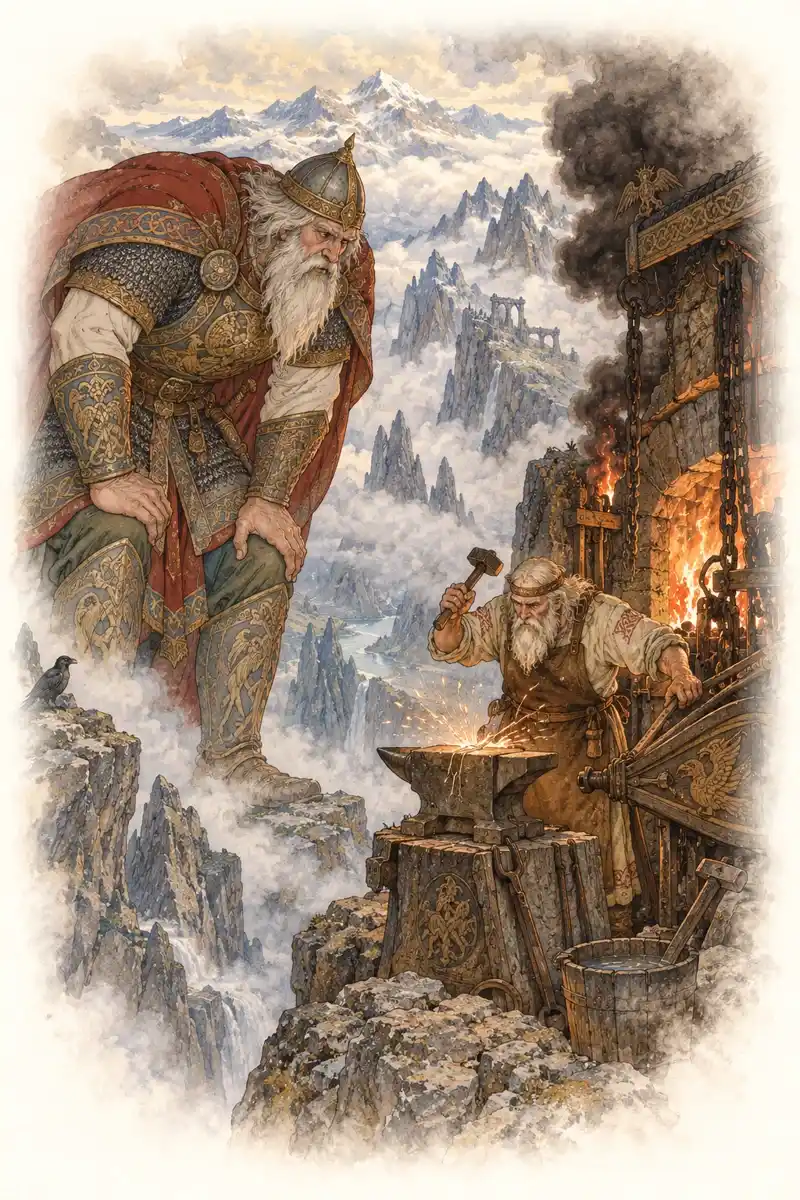
Neither birch, nor oak, nor aspen, nor green grass grows there. No wolf runs there, no eagle flies—not even an ant can find food on the bare cliffs. Only the bogatyr Svyatogor rides among the crags on his mighty horse.
Through chasms the horse leaps, over gorges it bounds, from mountain to mountain it strides.
The old one rides across the Holy Mountains.
Then the damp mother-earth trembles,
Stones crumble into the chasms,
Swift rivers spill their banks.
In stature the bogatyr Svyatogor is taller than the dark forest; with his head he props up the clouds. He gallops across the mountains—the mountains sway beneath him. He rides into a river—all the water spills from it. He rides for a day, then another, then a third—he stops, pitches his tent, lies down, sleeps his fill, and again his horse wanders across the mountains.
Svyatogor the bogatyr is bored, sorrowful—the old one has no one in the mountains to exchange a word with, no one to test his strength against.
He would ride to Rus’, stroll with other bogatyrs, do battle with enemies, shake out his strength—but here is the trouble: the earth will not bear him. Only the stone crags of the Holy Mountains do not crumble beneath his weight, only their ridges do not crack beneath the hooves of his mighty horse.
Svyatogor is burdened by his strength; he carries it like a heavy load. He would gladly give away half his strength—but there is no one to give it to. He would gladly perform the hardest labor—but no labor is found to match his strength. Whatever he takes in hand—it crumbles to dust, flattens to a pancake.
He would uproot forests—but forests are to him like meadow grass. He would turn mountains—but no one needs that…
So he rides alone across the Holy Mountains, bowing his head lower and lower from grief…
“Ah, if only I could find the earth’s pull—I would drive a ring into the sky, tie an iron chain to the ring, pull the sky down to the earth, turn the earth upside down, mix sky with earth—and thus spend a little of my strength!”
But where is it—that pull—to be found?
One day Svyatogor rides through a valley between the crags, and suddenly—a living man walks before him!
An unremarkable little peasant walks, stamping in his bast shoes, carrying a traveler’s bag on his shoulder.
Svyatogor rejoiced: here would be someone to exchange a word with—and he began to overtake the peasant.
The peasant walks on, unhurried, but Svyatogor’s horse gallops at full strength—and cannot catch up with the man. The peasant walks, does not hurry, tosses his little bag from shoulder to shoulder. Svyatogor gallops at full speed—the traveler is still ahead! He rides at a walk—still cannot catch up!
Svyatogor shouted to him:
“Hey, passing fellow, wait for me!”
The peasant stopped and set his little bag on the ground.
Svyatogor rode up, greeted him, and asked:
“What is this burden in your little bag?”
“Take my bag, sling it over your shoulder, and run across the field with it.”
Svyatogor laughed so hard that the mountains shook. He tried to hook the bag with his whip—the bag did not move. He tried to push it with his spear—it did not stir. He tried to lift it with his finger—it would not rise…
Svyatogor climbed down from his horse, took the bag with his right hand—did not move it a hair. The bogatyr seized the bag with both hands, pulled with all his might—lifted it only to his knees. He looked—and he himself had sunk into the earth to his knees; on his face was not sweat but blood; his heart stood still…
Svyatogor threw down the bag and fell to the earth—a rumble rolled through the mountains and valleys.
The bogatyr barely caught his breath:
“Tell me what is placed in your bag? Tell me, teach me—I have never heard of such a wonder. My strength is immeasurable, yet I cannot lift such a grain of sand!”
“Why should I not tell—I will tell: in my little bag lies all the earth’s pull.”
Svyatogor lowered his head:
“So that is what the earth’s pull means. And who are you yourself, and what is your name, passing man?”
“I am a plowman—Mikula Selyaninovich.”
“I see, good man, that Mother Damp Earth loves you! Perhaps you can tell me of my fate? It is hard for me to gallop alone across the mountains; I can no longer live this way in the world.”
“Ride, bogatyr, to the Northern Mountains. By those mountains stands an iron forge. In that forge a smith forges the fate of all. From him you will learn your own fate as well.”
Mikula Selyaninovich heaved the little bag onto his shoulder and strode away.
And Svyatogor leaped onto his horse and galloped to the Northern Mountains.
Svyatogor rode and rode for three days and three nights—for three days he did not lie down to sleep—until he reached the Northern Mountains. Here the crags were even barer, the chasms even blacker, the deep rivers even more turbulent…
Beneath the very clouds, on a bare cliff, Svyatogor saw an iron forge. In the forge a bright fire burned, black smoke poured from the forge, and ringing and hammering echoed all around.
Svyatogor entered the forge and saw: at the anvil stood a gray-haired old man. With one hand he worked the bellows, with the other he struck the anvil with a hammer—and on the anvil nothing was visible.
“Smith, smith, what are you forging, father?”
“Come closer, bend lower!”
Svyatogor bent down, looked, and marveled: the smith was forging two thin hairs.
“What is this, smith?”
“I will forge these two hairs, twist hair with hair—and two people will marry.”
“And to whom does fate decree I be married?”
“Your bride lives at the edge of the mountains in a dilapidated hut.”
Svyatogor rode to the edge of the mountains and found the dilapidated hut. The bogatyr entered it and placed his gift on the table—a bag of gold. Svyatogor looked around and saw: on the bench lay motionless a maiden, covered all over with scabs and crusts, not opening her eyes.
Svyatogor felt pity for her. Why should she lie there and suffer so? Death does not come, and life is not there.
Svyatogor drew his sharp sword, intending to strike the maiden—but his hand would not rise. The sword fell to the oak floor.
Svyatogor leaped from the hut, mounted his horse, and galloped to the Holy Mountains.
And the maiden meanwhile opened her eyes and saw: on the floor lay a bogatyr’s sword, on the table—a bag of gold, and all her scabs had fallen away, and her body was clean, and her strength had increased.
She rose, walked about the little room, stepped over the threshold, bent over the little lake—and gasped: looking back at her from the lake was a beautiful maiden—stately, white, rosy, with clear eyes and fair braids!
She took the gold that lay on the table, built ships, loaded them with goods, and set sail across the blue sea to trade and seek her fortune.
Wherever she arrived, all the people ran to buy her goods and admire the beauty. Her fame spread throughout all Rus’.
She reached the Holy Mountains, and word of her reached Svyatogor as well. He too wished to look upon the beauty.
He looked at her—and the maiden pleased him.
“This is a bride suited to me; I will court her!”
And Svyatogor pleased the maiden as well.
They married, and the wife began to tell Svyatogor of her former life: how she had lain for thirty years covered in scabs, how she had been healed, how she had found the gold on the table.
Svyatogor marveled, but said nothing to his wife. The maiden gave up her trading, stopped sailing the seas, and began to live with Svyatogor on the Holy Mountains.