
In the wealthy city of Novgorod there lived a fine young man named Sadko, known in the streets as Sadko the Gusli-player.
He lived as a landless bachelor, scraping by from bread to kvass—no yard, no homestead, only his ringing, maple-wood gusli and the gift of a singer, which he had inherited from his parents.
And the fame of him rolled like a river through all of Great Novgorod. It was not for nothing that Sadko was summoned to the golden-topped boyar towers and the white-stone merchant mansions to play at feasts and entertain the guests.
Whenever he played and struck up a tune, all the noble boyars, all the foremost merchants would listen to the gusli-player and could not have their fill. By this the young man lived—going from feast to feast. But then it happened: a day passed, and a second, and a third, and Sadko was not invited to any feast, not summoned. It seemed to him bitter and insulting.
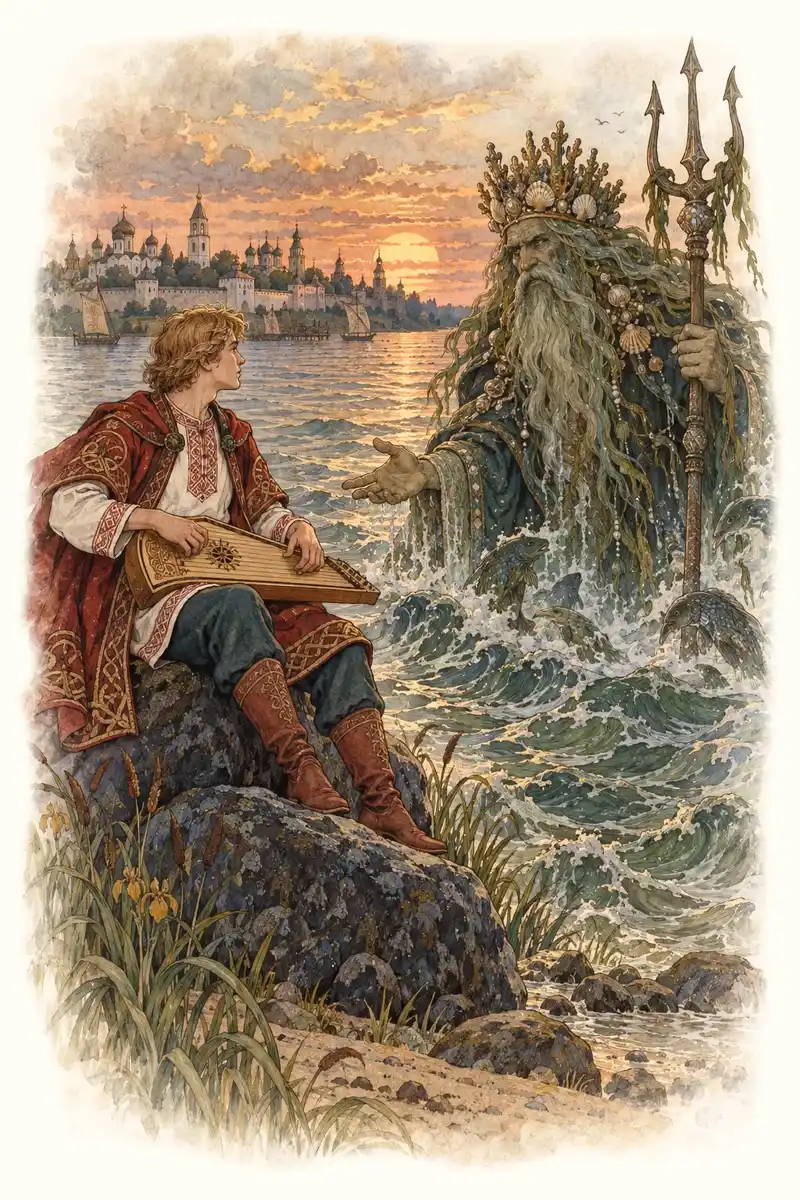
Sadko took his maple gusli and went to Lake Ilmen. He sat on the blue-burning stone at the shore and struck the ringing strings, striking up a rippling melody. He played on the shore from morning until evening. And at the setting of the red sun, Lake Ilmen grew turbulent.
A wave rose like a high mountain, the water mixed with sand, and the Water Spirit himself—the master of Lake Ilmen—came out onto the shore. Terror seized the gusli-player. And the Water Spirit spoke these words:
“Thank you, Sadko the gusli-player of Novgorod! Today I held a feast and celebration, a banquet of honor. You entertained and delighted my guests. And I wish to reward you for it!
Tomorrow you will be called to the foremost merchant to play the gusli and entertain the eminent merchants of Novgorod. The merchants will drink and eat, and begin to boast, each praising himself. One will boast of his countless golden treasury, another of his precious overseas goods, a third will begin to boast of his fine horse and silken garments. The wise man boasts of his father and mother, and the foolish man boasts of his young wife. Then the eminent merchants will ask you, Sadko, what you might boast of. And I will teach you how to answer and how to become rich.”
And the Water Spirit—master of Lake Ilmen—revealed to the orphan gusli-player a wondrous secret.
The next day Sadko was called to the white-stone chambers of an eminent merchant to play the gusli and entertain the guests.
The tables groaned under drinks and dishes. The feast was half-finished, and the guests—the merchants of Novgorod—sat half-drunk. They began to boast before one another: one of his golden treasury and wealth, one of his precious goods, one of his fine horse and silken garments. The wise man praised his father and mother, and the foolish man boasted of his young wife.
Then they began to question Sadko, to pry from the fine youth:
“And you, young gusli-player, what will you boast of?”
To those words Sadko gave answer:
“Ah, you rich merchants of Novgorod! What have I to boast of before you? You yourselves know: I have neither gold nor silver, no shops in the trading rows with precious goods. One thing only can I boast of. I alone know and am aware of a wonder of wonders and a marvel of marvels. In our glorious Lake Ilmen there is a fish with a golden feather. And no one has ever seen that fish. No one has seen it, no one has caught it. And whoever catches that fish with the golden feather and eats its fish-soup will become young from old. Only of that can I boast and brag!”
The eminent merchants began to clamor and argue:
“You boast of emptiness, Sadko. From all ages, no one has ever heard that there is such a fish with a golden feather, and that having eaten fish-soup from that fish, an old man becomes young and mighty!”
Six of the richest Novgorod merchants argued most fiercely:
“There is no such fish as you describe, Sadko. We will make a great wager. We will stake all our shops in the trading rows, all our property and wealth! Only you have nothing to set against our great wager!”
“I undertake to catch the fish with the golden feather! And against your great wager I stake my wild head,” answered Sadko the gusli-player.
On that they struck the bargain and sealed the wager with a handshake.
Soon a silken net was woven. They cast that net into Lake Ilmen the first time—and pulled out a fish with a golden feather. They cast the net a second time—and caught another fish with a golden feather. They cast the net a third time—and caught a third fish with a golden feather.
The Water Spirit—master of Lake Ilmen—kept his word, rewarded Sadko, and granted him his wish. The orphan gusli-player won the great wager, received untold wealth, and became an eminent Novgorod merchant. He conducted great trade in Novgorod, and his stewards traded in other cities, near and far. Sadko’s wealth multiplied not by days but by hours. And soon he became the richest merchant in glorious Great Novgorod. He built white-stone chambers. The rooms in those chambers were wondrous: adorned with precious overseas wood, gold and silver, and crystal. Such rooms had never been seen before, and such chambers had never been heard of.
After that Sadko married, brought a young wife into his house, and held a feast of honor in his new chambers. He gathered to the feast the well-born boyars, all the eminent merchants of Novgorod, and invited the common folk of Novgorod as well. There was a place for everyone in the hospitable master’s mansion. The guests drank and ate, grew merry, began to argue. Some spoke loudly and boasted of this and that. And Sadko paced through the chambers and spoke these words:
“My dear guests: you, well-born boyars; you, rich and eminent merchants; and you, common folk of Novgorod! You have all eaten and drunk at my feast, Sadko’s, and now you argue noisily, boasting. One speaks the truth, and another boasts of emptiness. It seems I too must speak of myself. And what have I to boast of? My wealth has no measure. I have so much golden treasury that I could buy up all the goods of Novgorod, all goods—bad and good. And there would be no goods left at all in Great Glorious Novgorod.”
That arrogant, boastful speech seemed offensive to the whole gathering: to the boyars, to the merchants, and to the common folk of Novgorod. The guests began to clamor and argue:
“Never has it been and never will it be, that one man could buy up all the goods of Novgorod, buy and sell our Great, Glorious Novgorod. And we wager with you a great wager of forty thousand: you cannot overcome Lord Great Novgorod. However rich and mighty one man may be, against a city, against a people, he is a dried-up straw!”
But Sadko stood his ground, would not relent, and wagered the great wager, staking forty thousand… And on that the feasting ended. The guests departed and dispersed.
And the next day Sadko rose very early, washed himself white, woke his druzhina, his faithful helpers, filled them full with golden treasury, and sent them through the trading streets, while Sadko himself went to the trading rows where the shops sold precious goods. All day from morning to evening Sadko, the rich merchant, with his faithful helpers bought up all the goods in all the shops of Great Glorious Novgorod, and by sunset they had bought everything, swept clean as with a broom. Not a penny’s worth of goods remained in Novgorod. And the next day—look and see—the Novgorod shops were bursting with goods; overnight more goods had been brought than before.
With his druzhina and helpers Sadko set about buying goods through all the trading streets and in the trading rows. And by evening, by sunset, not a single penny’s worth of goods remained in Novgorod. They bought everything and carted it to the warehouses of Sadko the rich. On the third day Sadko sent helpers with golden treasury, and himself went to the trading rows and saw: the goods in all the shops were more than before. Overnight, Moscow goods had been brought. Sadko heard reports that wagon trains with goods were coming from Moscow, and from Tver, and from many other cities, and ships were sailing by sea with overseas goods.
Then Sadko fell to thinking and grew sorrowful:
“I cannot overcome Lord Great Novgorod, I cannot buy up the goods of all Russian cities and of all the white world. It seems that however rich I am, Great Glorious Novgorod is richer than I. Better I lose my wager of forty thousand. I cannot overcome the city and the people of Novgorod. I see now that there is no force or might by which one man can stand against a people.”
Sadko gave up his great wager—forty thousand. And he built forty ships. He loaded all the purchased goods onto the ships and sailed to trade in overseas lands. In foreign lands he sold the goods of Novgorod at great profit.
And on the return journey, a great misfortune befell them on the blue sea. All forty ships stood still as if rooted to the spot. The wind bent the masts and tore the rigging, the sea waves beat, but all forty ships stood as if anchored, unable to move.
And Sadko said to the helmsmen and the ship’s crew:
“It seems the Sea Tsar demands tribute and ransom from us. Take, brothers, a barrel of gold and cast the money into the blue sea.”
They cast a barrel of gold into the sea, but the ships still did not move. The waves beat them, the wind tore the rigging.
“The Sea Tsar does not accept our gold,” said Sadko. “It seems he demands a living soul from us.”
And he ordered lots cast. Each man received a linden-wood lot, and Sadko took for himself an oak lot. And on each lot was written the owner’s name. They cast the lots into the blue sea. Whose lot sank, that man must go to the Sea Tsar. The linden lots floated like ducks, rocking on the waves. But Sadko’s oak lot plunged to the bottom like a key. Then Sadko said:
“There is a mistake here: the oak lot is heavier than the linden ones, that is why it sank. Let us cast again.”
Sadko made himself a linden lot, and they cast the lots into the blue sea once more. All the lots floated like ducks, but Sadko’s lot dove to the bottom like a key. Then Sadko said, the rich merchant of Novgorod:
“There is nothing to be done, brothers. It seems the Sea Tsar will accept no other head but demands my wild head.”
He took paper and a goose quill and began to write his testament: how and to whom to leave his property and wealth. He bequeathed money to monasteries for the remembrance of his soul. He rewarded his druzhina, all his helpers and stewards. Much treasury he bequeathed to the poor, to widows, to orphans; much wealth he bequeathed to his young wife. After that he said:
“Lower, my dear druzhina, an oak board over the side. It is frightening for me to descend all at once into the blue sea.”
They lowered a wide, sturdy board onto the sea. Sadko took leave of his faithful druzhina and took his ringing, maple gusli.
“I will play on the board one last time before I accept death!”
And with those words Sadko descended onto the oak raft, and all the ships at once began to move, their silken sails filled with wind, and they sailed on their way as if there had been no stoppage at all.
Sadko was carried on the oak board across the sea-ocean, and he lay there, strumming his gusli, grieving over his fate, remembering his former life. And the sea waves rocked the board, lulling Sadko, and he did not notice how he fell into a doze, and then into a deep sleep.
How long or short that sleep lasted—who can say. Sadko woke on the bottom of the sea-ocean, beside white-stone chambers. A servant ran out of the chambers and led Sadko into the mansion. He was brought into a great hall, and there sat the Sea Tsar himself. On the Tsar’s head was a golden crown. The Sea Tsar spoke:
“Greetings, dear guest, long-awaited! I have heard much of you from my nephew the Water Spirit—master of glorious Lake Ilmen—of your playing on the maple gusli. And I wished to hear you myself. For that I stopped your ships and drowned your named lot twice.”
After that he called a servant:
“Heat the bath hot! Let our guest steam and wash after the road, and afterward rest. Then we will hold a feast. Soon the invited guests will begin to arrive.”
In the evening the Sea Tsar held a feast for the whole world. Tsars and tsareviches from different seas arrived, Water Spirits from different lakes and rivers. The Water Spirit—master of Lake Ilmen—swam in as well. Drinks and dishes at the Sea Tsar’s were plentiful: drink, eat, as much as your soul desires! The guests feasted and grew merry. The host, the Sea Tsar, spoke:
“Well, Sadko, entertain and delight us! And play merrily, so that our legs dance!”
Sadko played boldly and merrily. The guests could not stay at the tables, leaped up from behind them and began to dance, and danced so wildly that a great storm arose on the sea-ocean. And many ships perished that night. A terrible number of people drowned!
The gusli-player played, and the Sea Tsars with their tsareviches and the Water Spirits danced, shouting:
“Oi, burn, speak!”
Then the Water Spirit, master of Lake Ilmen, found himself beside Sadko and whispered into the gusli-player’s ear:
“A bad thing is happening here at my uncle’s. On the sea-ocean this dancing has stirred up such a storm. Ships, people, and goods have perished—countless numbers. Stop playing, and the dancing will end.”
“How can I stop playing? On the bottom of the sea-ocean I have no will of my own. Until your uncle, the Sea Tsar himself, commands it, I cannot stop.”
“Then break the strings and snap the pegs, and say to the Sea Tsar: you have no spares, and here there is nowhere to get spare strings and pegs. And when you stop playing and the feast ends and the guests go home, the Sea Tsar, to keep you in the underwater kingdom, will begin to press you to choose a bride and marry. Agree to that. First they will lead before you three hundred beautiful maidens, then another three hundred—beyond imagining or describing, only to be told in a tale—will pass before you, and you stand and say nothing. Then they will lead before you another three hundred maidens more beautiful than the first. Let them all pass, and point to the last one and say: ‘This is the maiden, Chernavushka, whom I wish to marry.’ She is my own sister; she will rescue you from captivity.”
The Water Spirit—master of Lake Ilmen—spoke these words and mingled with the guests.
And Sadko broke the strings, snapped the pegs, and said to the Sea Tsar:
“I must replace the strings and fit new pegs, and I have no spares.”
“Well, where will I find you strings and pegs now. Tomorrow I will send messengers, but today the feast is already ending.”
The next day the Sea Tsar said:
“You shall be my faithful gusli-player, Sadko. Everyone has taken a liking to your playing. Marry any of the sea maidens, and life in my sea kingdom will be better for you than in Novgorod. Choose your bride!”
The Sea Tsar clapped his hands—and out of nowhere maidens of beauty passed before Sadko, each more beautiful than the last. Thus passed three hundred maidens. After them came another three hundred maidens, so fair that no pen could describe them, only a tale could tell, and Sadko stood and said nothing. After those beauties came another three hundred maidens, far more beautiful than the first. Sadko looked and could not have his fill, and when the last maiden in the row appeared, the gusli-player said to the Sea Tsar:
“I have chosen my bride. This is the maiden I wish to marry.”—he pointed to Chernavushka.
“Ah, well done, Sadko the gusli-player! You have chosen a good bride—she is my niece, the Chernava River. We shall now be kin.”
They began a merry wedding feast. The feasting ended. The young couple was led to a special chamber. And as soon as the doors closed, Chernava said to Sadko:
“Lie down, sleep and rest, do not think of anything. As my brother, the Water Spirit—master of Lake Ilmen—commanded, so it shall be.”
A deep sleep came over Sadko. And when he woke in the morning—he could not believe his eyes: he sat on the steep bank of the Chernava River, where the Chernava flows into the Volkhov River. And along the Volkhov his forty ships were sailing swiftly with his faithful druzhina.
And the druzhina saw Sadko from the ships and marveled:
“We left Sadko on the blue sea-ocean, and Sadko meets us near Novgorod. Is this not a wonder, brothers, is this not a marvel!”
They lowered and sent a small boat for Sadko. Sadko boarded his ship, and soon the ships came to the Novgorod wharf. They unloaded the overseas goods and barrels of gold into the warehouses of Sadko the merchant. Sadko summoned his faithful helpers and druzhina to his white-stone chambers.
And onto the porch ran his young and beautiful wife. She threw herself on Sadko’s breast, embraced him, kissed him:
“But I had a vision, my dear husband, that you would arrive today from overseas lands!”
They drank and ate, and Sadko began to live and prosper in Novgorod with his young wife. And on that my tale of Sadko ends.