
In the days when Kiev was still young and heroes walked the Russian earth, there lived a widow named Mamelfa Timofeevna, just outside the golden city. She had a beloved son—the great bogatyr Dobrynyushka. Throughout all of Kiev, his fame resounded: he was tall and stately, well-read and learned, brave in battle and merry at feasts. He could compose a song, play the gusli, and speak a wise word. And his nature was gentle and kind. He never raised his voice in anger, never wronged a soul without cause. For this, they called him “Dobrynya the Gentle.”
One scorching summer day, Dobrynya longed to cool himself in the river. He went to his mother and asked:
“Give me your blessing, Mother, to ride to the Puchay River and bathe in its cold waters—the summer heat has worn me thin.”
Mamelfa Timofeevna wrung her hands and began to plead:
“My dear son Dobrynyushka, do not go to the Puchay River. That river is fierce and wrathful. From its first stream, fire spurts; from its second, sparks fly; from its third, smoke billows like a pillar.”
“Very well, Mother. Then at least let me ride along the bank and breathe the fresh air.”
Reluctantly, Mamelfa gave her permission.
Dobrynya donned his traveling clothes, covered his head with a tall Greek hat, and took with him his spear, his bow and arrows, his sharp saber, and a leather whip. He mounted his good horse, called his young servant to ride beside him, and set out.
He rode for an hour, then two. The summer sun blazed mercilessly, beating upon his head.
Dobrynya forgot his mother’s warning. He turned his horse toward the Puchay River.
A cool breeze rose from the water.
He leaped from his saddle, tossed the reins to his servant, and commanded: “Wait here. Guard my horse.”
He removed his Greek hat, stripped off his traveling clothes, laid all his weapons upon his horse, and plunged into the river.
He swam in the cool current, marveling: “What was Mother talking about? The Puchay is not fierce at all—it is as gentle as a rain puddle!”
No sooner had the words left his lips than the sky went dark—though there was no cloud. Thunder rolled—though there was no storm. Lightning flashed—though there was no rain.
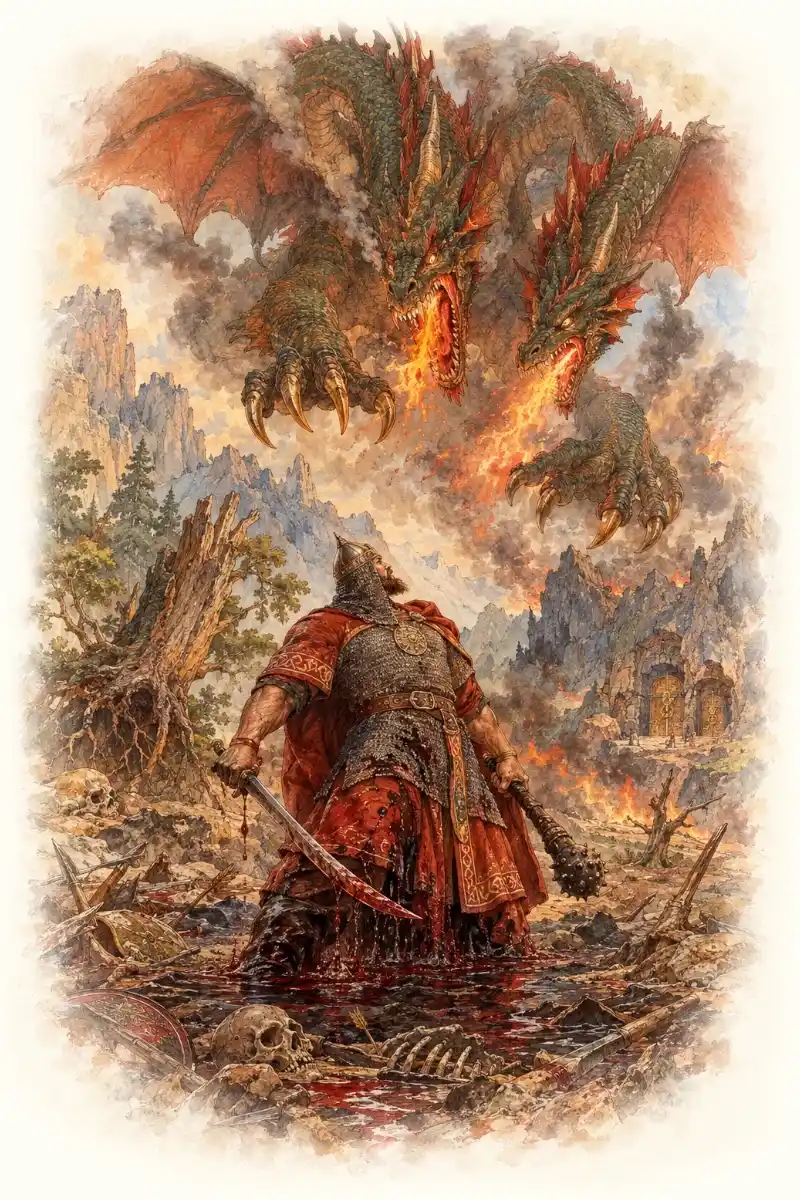
Dobrynya looked up and saw the Serpent Gorynych hurtling toward him—a terrible three-headed dragon, with seven iron claws, flame spewing from its nostrils, smoke pouring from its ears, and copper talons gleaming on its feet.
The Serpent saw Dobrynya and roared like thunder:
“Ah! The old prophets foretold that Dobrynya Nikitich would slay me—and now Dobrynya has fallen into my very claws! I can devour you alive, or carry you to my lair as a prisoner. I have captured many Russians already—I was missing only Dobrynya!”
Dobrynya answered in his quiet voice:
“You cursed snake! First take me—then boast. But I am not yet in your hands.”
Dobrynya was a strong swimmer. He dove to the riverbed, swam beneath the surface, and surfaced at the steep bank. He scrambled ashore and ran for his horse—but the horse was gone. The young servant, terrified by the Serpent’s roar, had leaped into the saddle and fled, taking all of Dobrynya’s weapons with him.
Dobrynya had nothing to fight with.
The Serpent swooped again, showering him with burning sparks that scorched his white body. The bogatyr’s heart trembled.
He looked around the bank—no club, no stone, nothing but yellow sand and his fallen Greek hat.
He snatched the hat, filled it with sand—no more, no less—full five poods—and hurled it at the Serpent’s head with all his might. The blow smashed one head clean off.
He knocked the Serpent to the ground, pinned its chest with his knees, and raised his fist to strike off the other two heads…
But the Serpent Gorynych began to beg:
“Oh, Dobrynyushka! Oh, mighty hero! Do not kill me! Let me fly free, and I will obey you forever! I swear a great oath: I shall never fly to Holy Rus’ again, never take Russian people captive. Just spare me, Dobrynyushka—and do not harm my little serpent-children!”
Dobrynya’s heart softened. He believed the Serpent’s cunning words. He released the cursed beast.
But the moment the Serpent rose into the clouds, he turned straight toward Kiev—toward the garden of Prince Vladimir. At that very hour, the young Princess Zabava Putyatishna—the Prince’s beloved niece—was walking in the garden.
The Serpent saw her, rejoiced, swooped down from the clouds, seized her in his copper claws, and carried her away to the Sorochinskie Mountains.
Meanwhile, Dobrynya had found his servant and was donning his traveling clothes when the sky darkened again and thunder rolled. He looked up—and there flew the Serpent Gorynych, with Zabava Putyatishna clutched in his claws!
Grief struck Dobrynya’s heart. He returned home crestfallen, sat on the bench in silence, and spoke no word.
His mother approached him:
“Why so sad, Dobrynyushka? What troubles you, my light?”
“Nothing troubles me,” he lied. “But I am weary of sitting at home. I will ride to Kiev to Prince Vladimir’s feast.”
“Do not go, my son. My heart senses evil. We can hold a feast here at home.”
But Dobrynya would not listen. He rode to Kiev.
He entered the Prince’s hall. The tables groaned with dishes and sweet mead—but the guests sat in silence, their heads bowed. Prince Vladimir paced the chamber, offering no hospitality. The Princess hid her face behind her veil.
At last, Vladimir spoke:
“Ah, my beloved guests, this is a grim feast! The accursed Serpent Gorynych has carried off my dear niece, Zabava Putyatishna. Who among you will ride to the Sorochinskie Mountains, find the Princess, and free her?”
No one answered. The guests hid behind one another—the great behind the great, the small closing their mouths.
Then young Alyosha Popovich rose from his seat:
“Prince Red Sun, I was in the open field yesterday, near the Puchay River, and I saw Dobrynyushka. He has made peace with the Serpent Gorynych—calls him his sworn brother. Send Dobrynya to the Serpent, and he will beg the Princess back without a fight.”
Vladimir’s face darkened:
“If that is so, Dobrynya, mount your horse! Ride to the Sorochinskie Mountains! Bring me my niece! If you fail, I will have your head!”
Dobrynya lowered his wild head, said nothing, left the feast, and rode home.
His mother met him at the gate and saw the despair on his face.
“What happened, Dobrynyushka? Were you insulted? Denied a cup? Seated in a low place?”
“No one insulted me. My seat was fitting.”
“Then why do you hang your head?”
“Prince Vladimir has commanded me to ride to the Sorochinskie Mountains and bring back Zabava Putyatishna—whom the Serpent Gorynych has carried off.”
Mamelfa shuddered, but she did not weep. She began to think.
“Lie down, Dobrynyushka,” she said. “Sleep and gather your strength. Morning is wiser than evening. Tomorrow, we shall make a plan.”
Dobrynya slept, snoring like a roaring stream. But Mamelfa did not sleep. She sat through the night, weaving a seven-tailed whip from seven silks.
At dawn, she woke him:
“Rise, my son. Dress yourself, go to the old stable. In the third stall, the oak door has not opened in fifteen years—it was beyond our strength. Push it open, my son. There you will find your grandfather’s horse—Burushka. He has stood untended all these years. Groom him, feed him, water him, and bring him to the porch.”
Dobrynya went to the stable, tore the door from its hinges, and led Burushka into the light. He groomed him, bathed him, and saddled him. First a saddle blanket, then a felt pad, then a Cherkassian saddle embroidered with silks and adorned with gold. He tightened twelve girths and bridled him with a golden bit.
His mother appeared and handed him the seven-tailed whip:
“When you reach the Sorochinskie Mountains, the Serpent will be away. Charge into his lair and trample his serpent-children. They will try to wrap around Burushka’s legs. Strike Burushka between the ears with your whip. He will rear and shake them off, trampling every last one.”
A branch broke from the apple tree; an apple rolled away from the bough. So the son rode from his mother’s side to bloody battle.
Day after day passed like falling rain; week after week like a flowing river. Dobrynya rode beneath the red sun and the bright moon until he reached the Sorochinskie Mountains.
At the Serpent’s lair, the ground writhed with serpent-children. They wrapped around Burushka’s legs, gnawing at his hooves. The horse stumbled and fell to his knees.
Dobrynya remembered his mother’s words. He seized the seven-tailed whip and lashed Burushka between the ears, crying:
“Rise, Burushka! Leap and shake them off!”
The whip lent Burushka new strength. He leaped high, kicking the serpents away, crushing them with his hooves and tearing them with his teeth—until every last one lay dead.
Dobrynya dismounted, took his sharp saber in his right hand and his heavy mace in his left, and strode toward the serpent’s caves.
The moment he stepped forward, the sky darkened and thunder roared. The Serpent Gorynych flew overhead, clutching a dead body in his claws. Fire spat from his maw, smoke poured from his ears, copper claws blazing like hot coals.
He saw Dobrynya, dropped the corpse, and bellowed:
“Why, Dobrynya, have you broken our oath? Why have you trampled my children?”
“You cursed serpent! Was it I who broke the oath? You flew to Kiev! You carried off Zabava Putyatishna! Give her back willingly—and I will spare you.”
“I will not give her back! I will devour her—and you too—and take all Russians captive!”
Dobrynya’s rage ignited. He charged.
The battle was terrible. The Sorochinskie Mountains crumbled. The oaks were torn from the earth. The grass sank a full yard into the soil. Three days and three nights they fought—until the Serpent began to overpower Dobrynya, throwing him down, lifting him again…
Then Dobrynya remembered the whip. He seized it and lashed the Serpent between the ears. The Serpent Gorynych fell to his knees. Dobrynya pinned him to the earth with his left hand and beat him with the silk whip until he had subdued him like a beast—then he cut off all his heads.
Black serpent blood gushed forth, spreading east and west, flooding Dobrynya to the waist.
He stood in the black blood for three days. His feet grew cold; the chill crept to his heart. The Russian earth would not drink the serpent’s blood.
Then Dobrynya took his seven-tailed whip and struck the ground, crying:
“Open, Mother Earth! Swallow the serpent’s blood!”
The damp earth opened and drank the black blood. Dobrynya rested, washed himself, cleaned his armor, and entered the serpent’s caves. Each cave was sealed with copper doors, iron bolts, and golden locks.
He broke through the copper doors, tore off the locks and bolts, and entered the first cave. There he found countless prisoners—people from forty lands and forty nations.
He called to them:
“Ho, foreigners! Come out into the free light! Go home to your own lands—and remember the Russian bogatyr who freed you!”
They bowed to the earth, weeping with gratitude, and streamed out into the sunlight.
Dobrynya opened cave after cave, freeing the captives—old men and young women, small children and ancient grandmothers, Russians and foreigners alike. But Zabava Putyatishna was nowhere to be found.
He passed through eleven caves. In the twelfth, he found her. The Princess hung on the damp wall, chained by her wrists to the stone. Dobrynya tore the chains from the wall, lifted her in his arms, and carried her into the light.
She could barely stand. She shielded her eyes from the sun, too weak to look at her rescuer. Dobrynya laid her on the green grass, fed her, gave her water, covered her with his cloak, and rested beside her.
The sun sank toward evening. Dobrynya woke, saddled Burushka, and roused the Princess. He placed her before him on the saddle and rode home.
All around him, the grateful freed people bowed, blessed his name, and made their way home.
Dobrynya rode into the yellow steppe, spurred his horse, and carried Zabava Putyatishna home to Kiev.