
Once there lived an old man and an old woman. They had taken a great liking to the Maslenitsa week—to strolling and merrymaking, to stuffing themselves on pies and pancakes, to feasting and indulging.
They did not want to fast. So they decided to make their own Maslenitsa and feast for another week or two.
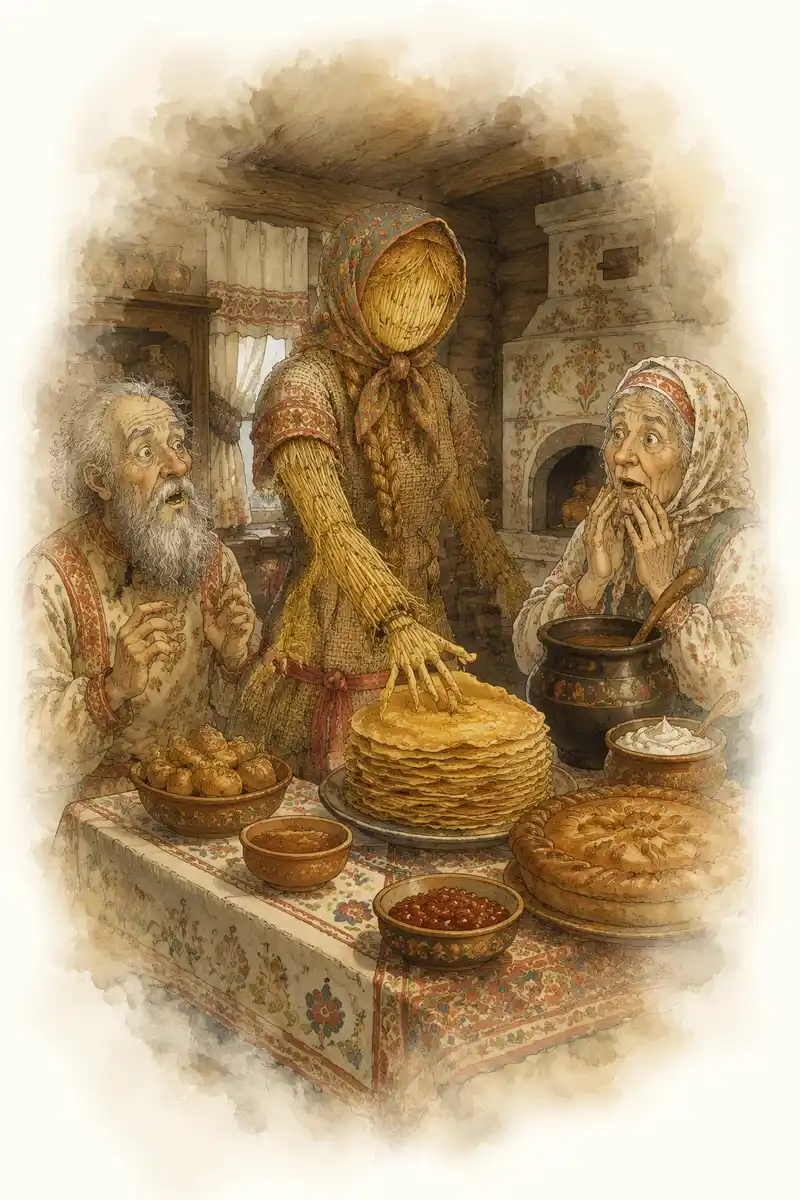
The old man fashioned a Maslenitsa out of straw and wove bast shoes for her feet. The old woman dressed her in coarse sacking, braided a long three-arshin plait from tow and flax, and tied a kerchief on her head. The Maslenitsa came out thin and tall, with a head like a basket, eyes like saucers, and a nose like a potato. The old man and old woman were delighted.
They seated Maslenitsa at the table. The old man said:
“Maslenitsa the glutton, empty belly—eat a pancake!”
And the old woman said:
“Maslenitsa the glutton, empty belly—eat a pie!”
Suddenly Maslenitsa came to life. She stirred, opened her mouth, and swallowed down all the pancakes and pies from the table. She glanced at the old man and old woman and stretched her hands toward them. The old couple grew frightened: the old man scrambled into the cellar, and the old woman into the attic.
Maslenitsa the glutton, empty belly, roamed the hut, seeking something to feast on: she slurped up the cabbage soup, licked the butter, chewed the lard. She caught the cat and wanted to eat it, but the cat broke free and ran into the pantry. Then Maslenitsa saw a pot of porridge simmering in the stove. She clambered into the stove—and her sleeve caught the fire. The straw flared up and burned away.
The old man and old woman returned, looked—and by the stove lay only a handful of coals. Maslenitsa was gone. The old man and old woman rejoiced: though they were left without pancakes and pies, they had at least kept their lives.
Maslenitsa—in Slavic mythology, a figure embodying the fertility of the earth and, at the same time, winter. Maslenitsa was also the name for a straw effigy dressed in women’s clothing, sometimes with a pancake. In folk songs and tales, she is spoken of not only as a pre-spring holiday, but also as a living being.