
Early in the morning, with the first rays of the sun, Volga set out to collect tribute and taxes from the trading towns of Gurchevets and Orekhovets.
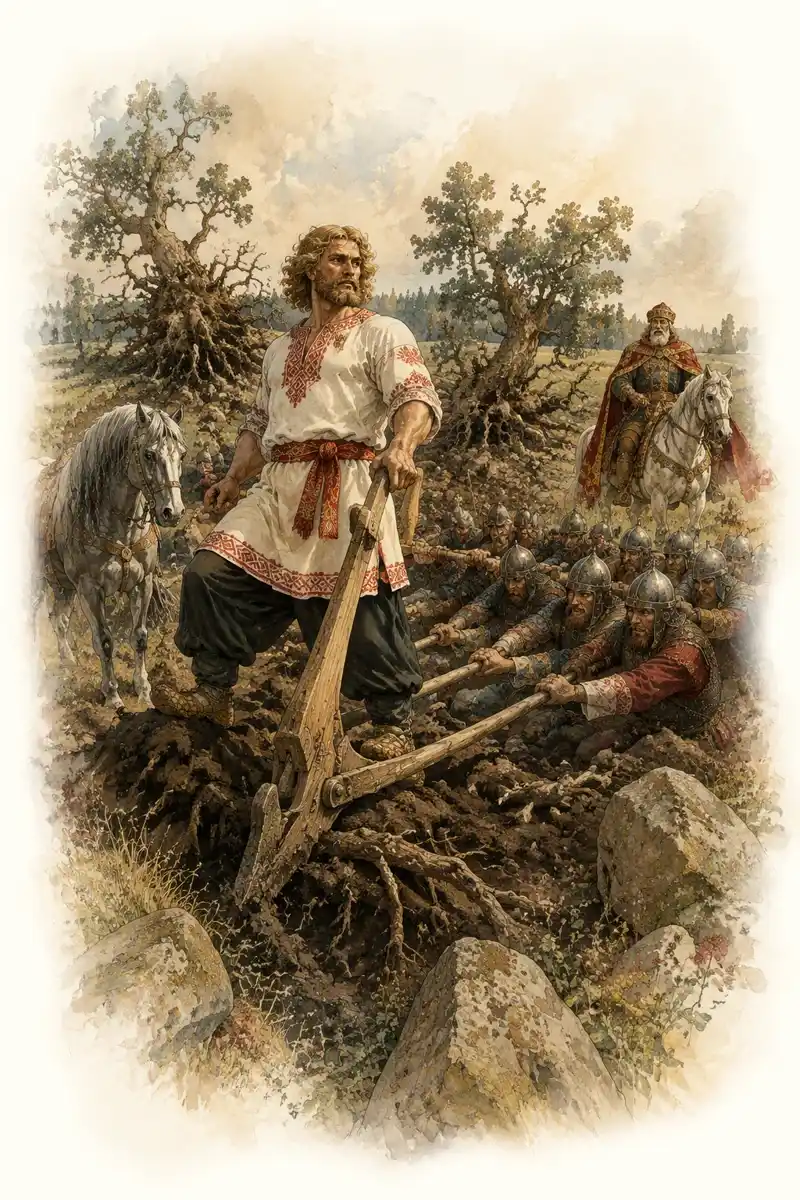
The druzhina mounted their good horses, their dark bay colts, and set off on their journey. The brave warriors rode out into the open field, into the wide expanse, and heard a plowman in the field. The plowman was plowing, whistling as he worked; his plowshares scraped against the pebbles. It seemed as though the plowman were guiding his plow somewhere close by. The warriors rode toward the plowman—they rode a day until evening, but could not reach him. They could hear the plowman whistling, hear the plow creaking, hear the plowshares scraping—but the plowman himself was nowhere to be seen.
The warriors rode a second day until evening. Still the plowman whistled, still the plow creaked, still the plowshares scraped—but the plowman was nowhere.
The third day was drawing toward evening when at last the warriors reached the plowman. He was plowing, urging his mare on, calling to her. He laid furrows deep as ditches, tore oaks from the earth, and cast boulders aside. Only his curls swayed, spilling like silk across his shoulders.
The plowman’s mare was nothing special, his plow was of maple, and his harness of silk. Volga marveled at him and bowed courteously:
“Greetings, good man, laborer of the field!”
“Greetings to you, Volga Vseslavevich. Where are you bound?”
“I am riding to the towns of Gurchevets and Orekhovets to collect tribute and taxes from the merchants.”
“Ah, Volga Vseslavevich, those towns are full of robbers. They flay the skin from the poor plowman and charge tolls for passage on the roads. I went there to buy salt—I bought three sacks, each weighing a hundred poods—and loaded them on my gray mare, then headed home. The merchants surrounded me and began demanding road-money. The more I gave, the more they wanted. I grew angry, I grew furious, and I paid them with my silk whip. Well—those who were standing now sit, and those who were sitting now lie down.”
Volga marveled and bowed to the plowman:
“Ah, you glorious plowman, mighty bogatyr—ride with me as my comrade!”
“Very well, Volga Vseslavevich, I will ride with you. They need to be taught a lesson—not to wrong other peasants.”
The plowman removed the silk harness from his plow, unharnessed his gray mare, mounted her, and set off on the journey.
The brave warriors galloped half the way. Then the plowman said to Volga Vseslavevich:
“Ah, we have done a careless thing—we left the plow in the furrow. Send your young warriors to pull the plow from the furrow, shake the earth from it, and lay it beneath a willow bush.”
Volga sent three warriors.
They turned the plow this way and that, but could not lift it from the earth.
Volga sent ten vityazi. They turned the plow with twenty hands, but could not drag it from its place.
Then Volga rode up with his entire druzhina. Thirty men without exception swarmed around the plow from all sides, strained with all their might, sank knee-deep into the earth—and could not move the plow a hair’s breadth.
Then the plowman himself climbed down from his mare, took hold of the plow with one hand, pulled it from the earth, shook the soil from the plowshares, and cleaned the shares with grass.
Their task done, the bogatyrs rode on along the road.
At last they approached Gurchevets and Orekhovets. But the merchants there were cunning: when they saw the plowman, they cut through the oak beams of the bridge over the Orekhovets River.
The moment the druzhina stepped onto the bridge, the oak beams gave way. The brave warriors began to drown in the river; the brave druzhina began to perish; horses and men began to sink to the bottom.
Volga and Mikula grew angry, grew furious. They lashed their good horses, leaped the river in a single bound, sprang onto the far bank, and began to pay their respects to the villains.
The plowman struck with his whip, saying:
“Ah, you greedy merchant folk! The peasants of the towns feed you bread and give you mead to drink—and you begrudge them salt!”
Volga paid his respects with his mace, avenging his druzhina and his heroic horses.
The people of Gurchevets began to repent:
“Forgive us our villainy, our cunning tricks! Take from us tribute and taxes, and let the plowmen ride for salt—no one will demand a kopeck from them.”
Volga took from them tribute and taxes for twelve years, and the bogatyrs rode home.
Volga Vseslavevich asked the plowman:
“Tell me, Russian bogatyr—what is your name, and what is your patronymic?”
“Ride to my peasant farm, Volga Vseslavevich, and you will learn how the people honor me.”
The bogatyrs rode up to a field. The plowman pulled out his little plow, plowed the wide field, and sowed it with golden grain…
The dawn was still burning, and already the plowman’s field was rustling with grain.
Dark night came—the plowman reaped the wheat. By morning he threshed it, by noon he winnowed it, by dinner he ground the flour and started the pies. By evening he summoned the people to a feast of honor. The people began to eat the pies, drink the mead, and praise the plowman:
“Ah, thank you, Mikula Selyaninovich!”