
Once Prince Vladimir held a great feast, and all the guests were merry, all boasted of something—but one guest sat joyless, drinking no mead, eating no roasted swan.
This was Stavr Godinovich, a merchant from the city of Chernigov.
The Prince approached him:
“Why do you, Stavr Godinovich, neither eat nor drink, sit joyless, and boast of nothing? True, your birth is not illustrious, and you are not famed for feats of arms—what have you to boast of?”
“Your word is true, Great Prince: I have nothing to boast of. My father and mother have long been gone; them I would have praised… To boast of my golden treasury I do not wish; I myself do not know how much I have—I would not finish counting it before death.
To boast of clothing is not worth it: all of you at this feast wear my clothes. Thirty tailors work day and night for me alone. I wear a caftan from morning to night, and then I sell it to you.
Boots are likewise not worth boasting of: every hour I put on new boots, and my worn ones I sell to you.
All my horses are golden-fleeced, all my sheep have golden wool—and those I sell to you as well.
Perhaps I may boast of my young wife, Vasilisa Mikulishna, the eldest daughter of Mikula Selyaninovich. There is no other like her in the world!
Beneath her braid gleams the bright moon; her brows are blacker than sable; her eyes are those of a bright falcon!
And there is no one wiser than her in all Rus’! She will wrap all of you around her little finger—you too, Prince, she will drive out of your mind.”
Hearing such insolent words, all at the feast grew frightened and fell silent… Princess Apraksia took offense and wept. And Prince Vladimir flew into a rage:
“Now then, my faithful servants, seize Stavr, drag him to the cold cellar for his offensive speeches, chain him to the wall. Give him spring water to drink and oat cakes to eat. Let him sit there until he comes to his senses. We shall see how his wife drives us all out of our minds and rescues Stavr from captivity!”
So it was done: Stavr was thrown into the deep cellars. But this was not enough for Prince Vladimir: he ordered guards sent to Chernigov to seal Stavr Godinovich’s wealth and bring his wife in chains to Kiev—to see what kind of clever woman she was!
While the envoys were gathering and saddling their horses, word flew to Chernigov to Vasilisa Mikulishna.
Bitterly Vasilisa fell to thinking:
“How shall I rescue my dear husband? With money I cannot ransom him, with force I cannot take him! Well, if not by force—then by cunning!”
Vasilisa went out into the entryway and cried:
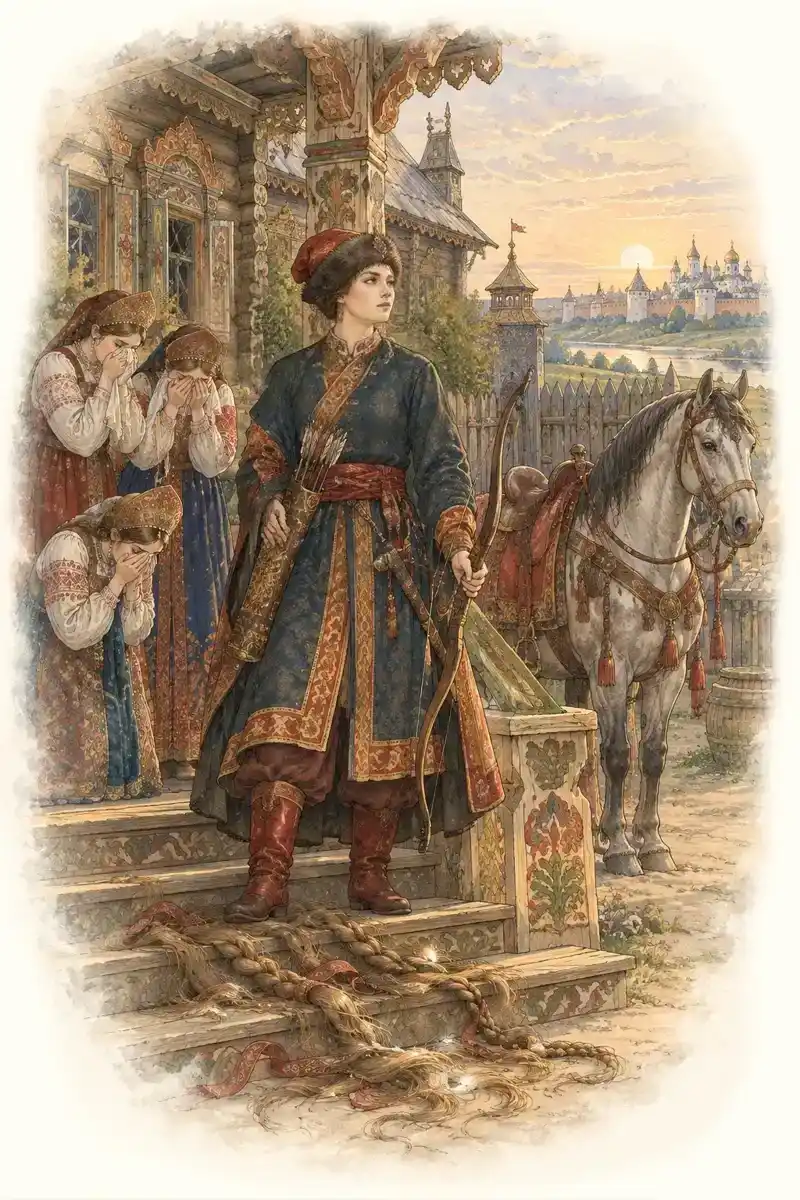
“Hey, my faithful maidservants, saddle me the best horse, bring me men’s Tatar clothing, and cut off my fair braids! I will ride to rescue my dear husband!”
Bitterly the maidens wept as they cut Vasilisa’s fair braids. The long tresses covered the whole floor, and the bright moon fell upon the braids.
Vasilisa donned men’s Tatar clothing, took her bow and arrows, and galloped toward Kiev. No one would believe it was a woman—a young bogatyr galloped across the field.
Halfway there, she met envoys from Kiev:
“Hey, bogatyr, where are you bound?”
“I am riding to Prince Vladimir, an envoy from the terrible Golden Horde, to collect tribute for twelve years. And you, fine fellows, where are you headed?”
“We are riding to Vasilisa Mikulishna, to take her to Kiev and transfer her wealth to the Prince.”
“You are too late, brothers. I have already sent Vasilisa Mikulishna to the Horde, and my warriors have carried off her wealth.”
“Well, if that is so, we have nothing to do in Chernigov. We will gallop back to Kiev.”
The Kiev envoys galloped back to the Prince and told him that an envoy from the terrible Golden Horde was coming to Kiev.
The Prince grew sorrowful: he could not gather tribute for twelve years; he must appease the envoy.
Tables were set, fir branches strewn in the courtyard, watchmen posted on the road—they awaited the messenger from the Golden Horde.
But the envoy, before reaching Kiev, pitched his tent in the open field, left his warriors there, and rode alone to Prince Vladimir.
The envoy was handsome, tall and mighty, not fearsome of face, and courteous. He leaped from his horse, tied it to a golden ring, and entered the hall. He bowed to all four corners, to the Prince and Princess especially. Lowest of all he bowed to Zabava Putyatishna.
The Prince said to the envoy:
“Greetings, terrible envoy from the Golden Horde! Sit at the table, rest, eat and drink after your journey.”
“I have no time to sit idle; the Khan does not favor such envoys as us. Bring me quickly the tribute for twelve years, and give me Zabava Putyatishna in marriage, and I will gallop back to the Horde!”
“Permit me, envoy, to consult with my niece.”
The Prince led Zabava from the hall and asked:
“Will you marry the Horde’s envoy, niece?”
And Zabava said softly:
“What are you thinking, uncle! What have you planned, Prince? Do not make laughter throughout all Rus’—this is not a bogatyr, but a woman.”
The Prince grew angry:
“Your hair is long, but your wit is short: this is the terrible envoy from the Golden Horde, the young bogatyr Vasily.”
“It is not a bogatyr, but a woman! He walks through the hall as if a duck swims, he does not click his heels; he sits on the bench pressing his knees together. His voice is silvery, his hands and feet are small, his fingers are slender, and on his fingers the marks of rings are visible.”
The Prince fell to thinking:
“I must test the envoy!”
He summoned the best Kiev wrestlers: five brothers Pritchenkov and two Khapilovs. He went out to the envoy and asked:
“Would you care, guest, to sport with the wrestlers, to wrestle in the wide courtyard, to stretch your bones after the road?”
“Why not stretch my bones—I have loved wrestling since childhood.”
They all went out into the wide courtyard. The young envoy entered the circle, seized three wrestlers with one hand, three with the other, threw the seventh into the middle, and struck them head against head—and all seven lay on the ground and could not rise.
Prince Vladimir spat and walked away.
“Foolish Zabava, witless! You called such a bogatyr a woman! We have never seen such envoys!”
But Zabava stood her ground:
“It is a woman, not a bogatyr!”
She persuaded Prince Vladimir, and he decided to test the envoy again.
He brought out twelve archers.
“Would you care, envoy, to sport with the archers at the bow?”
Envoy Vasily took the bow and drew the string—”Why not! I have shot with the bow since childhood!” The twelve archers came out and loosed their arrows at a tall oak. The oak swayed as if a whirlwind had passed through the forest.
Envoy Vasily took the bow and drew the string—the silken string sang, the red-hot arrow screamed and flew, and mighty bogatyrs fell to the ground, and Prince Vladimir could not stay on his feet. The arrow struck the oak and shattered it into splinters.
“Ah, I pity the mighty oak,” said the envoy, “but more I pity the red-hot arrow—now it cannot be found anywhere in Rus’!”
Vladimir went to his niece, but she kept saying: a woman, a woman!
“Well,” thought the Prince, “I myself will match wits with him—women do not play foreign chess in Rus’!”
He ordered golden chess brought and said to the envoy:
“Would you care to sport with me, to play foreign chess?”
“Why not—I have beaten all the boys at checkers and chess since childhood! And what shall we play for, Prince?”
“You stake the tribute for twelve years, and I stake all of Kiev.”
“Good, let us play!”
They began to strike the board with the chess pieces. Prince Vladimir played well, but the envoy made one move, then another, and on the tenth—checkmate to the Prince, and the chess pieces flew aside!
The Prince grew sorrowful:
“You have taken Kiev from me—take my head as well, envoy!”
“I do not need your head, Prince, nor Kiev. Give me only your niece, Zabava Putyatishna.”
The Prince rejoiced and in his joy did not even ask Zabava again, but ordered the wedding feast prepared.
They feasted for a day, a second, and a third. The guests made merry, but the bridegroom and bride were joyless. The envoy hung his head below his shoulders.
Vladimir asked him:
“Why are you joyless, Vasilyushka? Is our rich feast not to your liking?”
“Something makes me sorrowful, Prince, not merry: perhaps misfortune has befallen my home, perhaps misfortune awaits me ahead. Order the gusli players summoned—let them cheer me, sing of old years or of present ones.”
The gusli players were called. They sang and rang the strings, but the envoy did not like it.
“These are not gusli players, not singers, Prince… My father told me you have a guest from Chernigov, Stavr Godinovich—he knows how to play and how to sing a song, but these howl like wolves in a field. If only I could hear Stavr!”
What was Prince Vladimir to do? To release Stavr—then Stavr would be lost; not to release Stavr—then to anger the envoy.
Vladimir dared not anger the envoy, for the tribute was not gathered. He ordered Stavr brought.
Stavr was brought, barely standing on his feet.
The envoy leaped from the table, caught Stavr under the arms, seated him beside himself, began to feed and drink him, and asked him to play.
Stavr tuned the gusli and began to play Chernigov songs. All at the table fell silent, listening; and the envoy sat listening, never taking his eyes from Stavr.
Stavr finished.
The envoy said to Prince Vladimir:
“Listen, Prince Vladimir of Kiev—give me Stavr, and I will forgive you the tribute for twelve years and return to the Golden Horde.”
Prince Vladimir did not want to give up Stavr, but there was nothing to be done.
“Take him,” he said, “young envoy.”
The bridegroom did not even wait for the feast’s end. He leaped onto his horse, seated Stavr behind him, and galloped into the field to his tent.
At the tent he asked Stavr:
“Did you not recognize me, Stavr Godinovich? We studied letters together.”
“I have never seen you, Tatar envoy.”
The envoy entered the white tent, leaving Stavr at the threshold. With a swift hand Vasilisa threw off the Tatar clothing, donned women’s garments, adorned herself, and came out of the tent.
“Greetings, Stavr Godinovich. And now—do you not recognize me either?”
Stavr bowed to her:
“Greetings, my beloved wife, my young and clever Vasilisa Mikulishna! Thank you for saving me from captivity! But where are your fair braids?”
“With my fair braids, my beloved husband, I pulled you from the cellar!”
“Let us mount swift horses, wife, and ride to Chernigov.”
“No, Stavr, it is no honor for us to flee in secret. We will go to Prince Vladimir and finish the feast.”
They returned to Kiev and entered the Prince’s hall.
Prince Vladimir was amazed when Stavr entered with his young wife. And Vasilisa Mikulishna asked the Prince:
“Well, Sun Vladimir-Prince, I—the terrible envoy, Stavr’s wife—have returned to finish the wedding. Will you still give your niece to me in marriage?”
Princess Zabava leaped up:
“I told you, uncle! You nearly made laughter throughout all Rus’—you nearly gave a maiden to a woman!”
The Prince hung his head in shame, and the bogatyrs and boyars choked with laughter.
The Prince shook his curls and began to laugh himself:
“Well, Stavr Godinovich, you truly did boast of your young wife! She is clever, and bold, and fair of face. She wrapped everyone around her little finger, and drove me, the Prince, out of my mind! For her, and for the undeserved offense, I will gift you with precious presents.”
And so Stavr Godinovich departed for home with the beautiful Vasilisa Mikulishna. The Prince and Princess came out to see them off, along with the bogatyrs and the Prince’s servants.
They began to live at home, to prosper and fare well.
And of the beautiful Vasilisa they still sing songs and tell tales.