
There lived in this world a Tsar named Peter, called the Great.
One time he went hunting to catch game. And Peter, it must be said, did not like to dress in royal clothing—he mostly wore simple clothes.
So he rode through the forest, farther and farther, and lost his way. Dark night caught him in the forest.
And then—another misfortune!—a bear attacked him and tore apart his hunting dog.
Tsar Peter grew sorrowful.
“Ah,” he thought, “now I am left with nothing!”
And Peter wandered through the dark forest.
He wandered all night, but the forest had no end.
Peter rode out onto a small clearing and suddenly saw: a soldier sitting on a stump.
“Aha,” thought Peter, “this soldier is mine!”
Peter glanced at his overcoat with one eye and already knew what regiment he was from.
And this soldier was a deserter, hiding in the forest.
“Greetings, soldier,” Peter said to him.
“Greetings, I do not know who you are,” answered the soldier.
“And I am from the Tsar’s retinue. I rode out with the Tsar to hunt and fell behind, lost my way. And where are you from? Where are you bound?”
“What business is it of yours where I am from and where I am going?” said the soldier.
“I ask in simplicity,” said Peter. “Perhaps you can show me the road.”
“I have lost my way myself,” said the soldier. “I was going home on leave and got lost in this forest.”
“Well, let us go and seek the road together,” said Peter. “Perhaps we will find our way out.”
And off they went. Peter on horseback, and the soldier on foot.
“What is your name?” asked the Tsar.
“Peter,” answered the soldier. “And yours?”
“And I am Petrusha,” said the Tsar.
“And your patronymic?” asked the soldier.
“And my patronymic is Alekseich,” answered the Tsar.
“And mine is Alekseich,” said the soldier. “So we are complete namesakes.”
“And where are you from?” asked the Tsar.
“From there.”
“Well, so am I. So we are not only namesakes, but also countrymen. And what, countryman,” Tsar Peter said to him, “how is your service in the regiment?”
“The service is nothing,” said the soldier, “but the colonel is terribly wicked: if anything is not to his liking—he beats you at once. I lost a button, and he tormented me to death over that button. He beat me every day. You could weep. You could run away.”
“And you probably did run away?” said the Tsar.
The soldier confessed then that he was a deserter.
“Do not be afraid—the Tsar may forgive you,” said Peter.
And then he asked:
“And who is your colonel, who is your company commander?”
The soldier reported everything properly: who was the company commander, who was the colonel.
“And how, soldier, is the food in your regiment?” asked Peter. “How much beef do they boil? Do they put it in the cauldron according to regulations?”
“The regulations are only in name,” said the soldier, “but the beef swims past.”
Peter only shook his head.
“And do they cook thick porridge?” he asked again.
“What thick porridge?” said the soldier. “A grain from a grain a verst apart—you cannot catch one on a spoon.”
“Yes, your life is bad,” said Peter. “I myself would run away from such a life!”
Whether long or short they wandered through the forest, and they saw a huge pine tree.
“Now then, namesake,” Peter said to the soldier, “hold my horse, and I will climb higher and see if there is a light anywhere.”
Peter climbed to the very top and looked this way and that: darkness impenetrable all around, only in one direction, far, far away, a little light was shining—perhaps in a village or in a forester’s hut.
Peter climbed down to the ground, leaped onto his horse, and said:
“Sit down, soldier—my strong horse will carry two.”
But the soldier refused.
“No,” he said, “I would rather walk.”
So they set off on their way—one mounted, one on foot—two comrades.
Whether long or short—they came out to the light.
They saw: a house stood there. All the windows were dark, but one—above—was lit.
The house was surrounded by a high fence, with no entrance or exit anywhere.
They knocked. They stood and waited. No one answered the knock.
The soldier pounded on the gates with hands and feet, but still no one came out to the knock, no one opened. Only the little light in the upper window went out.
“Oh, this is an evil place,” thought the soldier.
And then he said to the Tsar:
“Listen, namesake, boost me up. I will climb over the fence.”
So they did. The soldier climbed over the fence and opened the gates.
“Please,” he said to Peter, “come eat bread and salt, warm yourself in the warmth.”
And he himself ran up onto the porch and began pounding on the oak door.
“Hey, who is here?” he shouted.
They heard—someone stirred in the house.
An old woman came out to them with a lantern in her hands.
“Why, old woman, do you not open to good people?” the soldier shouted at her.
“Ah, my dears!” said the old woman. “You frightened me. I am alone in the whole house. The master is away, gone hunting. And this place is wild, as you see—all sorts of dark folk wander about, so I keep locked up.”
“Enough, enough, do not weave tales,” said the soldier. “Where do I put the horse?”
“Put it, my dears, under the shed—there are both a manger and hay there.”
The soldier tied the horse, gave it feed, and went into the hut without asking. Peter followed.
“Now, old woman,” commanded the soldier, “bring out whatever you have for me and my friend Alekseich.”
The old woman saw that he was pressing her hard and did not argue. She gathered the remnants from the pots and cauldrons—and onto the table. The soldier’s appetite only grew.
“You are not very generous with your guests!”
And the old woman said pitifully:
“My dears, I have nothing. What I cooked, the master took with him, and I have been sitting on empty cabbage soup all day.”
“You are lying, old woman,” said the soldier, “and I do not believe you. Maybe you can fool my friend Alekseich, but I did not serve in the army for nothing—you will not deceive me. Right now I will look myself at what you have.”
He opened the stove and took out a roasted goose on a frying pan.
“Ah, you old hag!” shouted the soldier. And he raised his fists at the old woman.
“Leave her alone!” said Peter. “Why bother with an old woman!”
“Eh, Alekseich,” said the soldier, “you will perish with your meekness.”
Then he went to the cupboard, opened it, and began taking down from the shelves wine and pies and white bread.
They sat at the table and began to feast. They ate and drank everything that the old woman had cooked and roasted—they ate it all.
“Now, old woman, prepare a place to sleep,” said the soldier. “Do you not see my friend Alekseich wants to sleep?”
“Go, dear guests, to the attic, to the hayloft,” the old woman said to them. “There you will be both warm and soft.”
“What, is there not even a corner in the house for guests?” said the soldier. “And what is in the other room?” And he pointed at the door.
“Various junk is piled there, my dear, various junk,” said the old woman, and she closed the door to the neighboring room more tightly.
The soldier thought: “The old witch is up to something. Let me look at what is behind that door.”
And he peeked imperceptibly through the crack. And he went cold!
On the walls of the room hung sabers and muskets, and in the corner was a whole mountain of human skulls and bones.
Then the soldier understood that they had fallen straight into a robbers’ nest, into their very lair.
He stepped quietly away from the door and gave no sign.
“Well,” he said, “let us go to the hayloft, it is even better to sleep there.”
The old woman was glad that the guests would at least be out of sight. She threw them some hay and shone her little lantern while they climbed up.
The soldier spread the hay in the attic and said to Peter:
“Lie down, Alekseich, rest.”
“And why do you not lie down?” asked Peter.
“And who will keep watch?” answered the soldier. “That is a soldier’s business. You sleep, sleep. And I will sit by the little window and admire how the sun rises.”
Peter slept, and the soldier sat by the window, watching with both eyes. “How can I not miss my death,” he thought.
Suddenly—clatter, knock, bells ringing, hooves pounding—with whoops and whistles, robbers rode into the yard.
The soldier counted them—five robbers in all: four young, and the fifth an old man, the leader over them all.
The old woman ran out onto the porch, waving her arms at them:
“Quiet, quiet! Two little birds have fallen into my snare. One, it seems, is an important bird—his clothes have golden braid, his horn is silver. And the other, though simple, is so desperate! In a word—a soldier.”
“Well, sons,” said the elder to his robber sons, “look—the prey comes into our hands by itself!”
They laughed:
“Of course—the beast runs to the hunter!”
They unharnessed the horses, gave them feed, and went into the house. They tossed sacks of gold onto the benches and said:
“Come, hostess, give us food and drink.”
The old woman gathered various remnants and set them on the table.
“Why, old woman, do you not give us goose or pies?” asked the elder.
“There is nothing left,” answered the old woman. “Everything there was, the lodgers ate and drank.”
“Very well,” said the robbers, “we will settle accounts with them for bread and salt. Where are they, your guests?”
“In the attic, in the hayloft,” said the old woman. “Snoring at the top of their lungs.”
“Shall we take them down?” said one little robber.
“Go, do not hurry,” ordered the ataman. “Let them sleep for now.”
And the soldier heard everything and began to snore more loudly.
“I will not wake Alekseich,” he thought. “I will deal with the robbers alone.”
He prepared his tesak and waited for what would come.
Meanwhile the old woman lit the stove and began to cook dinner.
The robbers ate and drank, and the old man said to his eldest son:
“Now, Savateika, you are my first, so you begin. Go and take the little cockerels from their perch.”
Savateika took a knife and climbed up. But the soldier was not dozing. The moment the robber thrust his head into the attic, the soldier swung his tesak—and Savateika fell dead from the ladder.
The father and brothers wondered: why was Savateika gone so long?
“Go and see what he is doing there,” said the old man to his second son.
He went into the entryway and saw: Savateika lay under the ladder.
“He must have drunk too much,” thought the robber.
And he himself climbed the ladder to the attic.
The soldier met him the same way.
After the second brother, the third went, after the third—the fourth. And with all of them the soldier had one conversation: he swung his tesak, and the robber fell.
The old robber waited and waited for his sons and went himself.
He approached the ladder and saw: his sons all lay in a heap.
The old man cursed:
“Idlers, parasites, could not do their father’s work.”
And he climbed the ladder.
The moment the old man thrust his head into the attic, the soldier swung his tesak—once!
“Go, leader, to your pack!”
And he took his head off.
Then he began to wake Peter:
“Get up, namesake. Enough sleeping! What a sleepyhead you are, I see!”
Peter woke, rubbed his eyes, and asked:
“What, is it dawn already?”
“Dawn or not,” said the soldier, “but we must get out of here. We have landed in a robbers’ nest. They, the robbers, thought they had caught easy prey—but they themselves fell into the snare. Look, they all lie there.”
Peter looked—and indeed, five dead bodies lay in the entryway, five robbers.
“Why did you not wake me?” asked Peter.
“You were sleeping too sweetly,” said the soldier, “I pitied waking you. For a tired man, sleep is the first thing.”
They began to descend the ladder.
The old woman thought it was the robbers and ran out with her lantern into the entryway to see what prey they were bringing.
Then the soldier fell upon her.
“So this is what you do, old hag! Come, confess—whom else do you hide here?”
And he waved his tesak over her head.
Peter laughed, and the old woman wept.
“Oh, soldier, I hide no one else! Oh, soldier, do not destroy me!”
The soldier did not want to listen to her—he had worked himself up so that he could not be calmed.
“Open,” he shouted, “all the secret cellars! We will bring you all to light, we will pull out all the weeds!”
The old woman opened all the cellars and vaults for him, all the secret storerooms—and there lay gold in mountains.
“Now then, namesake,” the Tsar said to the soldier, “pour yourself as much treasure as you want.”
The soldier stuffed both pockets with gold coins, and thrust a handful into each boot-top, and into his bosom—he covered himself all around with money.
“Take some too, Petrusha!” he said.
“I do not need it, soldier!” answered Peter. “But you have truly earned this gold.”
For fun, Tsar Peter took just one little coin, and that was all.
They climbed out of the cellar. The soldier again pressed the old woman:
“Show us the road, old hag!”
Well, she led them out of the forest.
They came out onto the highway. Then Peter said:
“Now then, namesake, let us bid farewell. I will ride on ahead alone. And you, when you come to the capital, do me the favor—come to visit.”
“Where will I find you?” said the soldier. “And they will catch me there!”
“Do not doubt—no one will touch you,” said Peter. “Go straight to the palace and ask for Petrusha. Everyone there knows me.” And he galloped ahead on his horse.
Peter rode up to his capital and at every checkpoint ordered the guards that such-and-such a passing soldier be given all honor and allowed into the city.
And the deserter soldier walked and trudged, not hurrying. He approached the first checkpoint. What a wonder! The guards presented arms and gave him honor—just like the Tsar himself.
He donated a handful of gold to them and thought: “Ah, Petrusha, so that is what you did! It is not for nothing that they give me honor! They know I have money with me!”
He reached another checkpoint—and there the same. The guards, as soon as they saw him, stood at attention.
“What are you, brothers,” said the soldier, “have you drunk too much, I see? Taking a private for an officer! Well, if so—respect for respect!”
He thrust his hand into his pocket, took out a handful of gold, and distributed it to the guards.
“Drink to my health!”
At last he came to the capital.
“Well,” he thought, “I will go to the palace and see Alekseich.”
He approached the palace and asked the gatekeeper:
“How can I see Alekseich, Petrusha? He serves in the Tsar’s retinue, as a hunter.”
“Certainly,” he said, “I will escort you.”
And he led him straight into the Tsar’s chambers.
“Well,” thought the soldier, “I am done for!”
Meanwhile Peter took off his royal clothing, put on hunting clothes, and came out to the soldier:
“Greetings, namesake!”
And the soldier’s tongue would not move. He said softly:
“Greetings, Petrusha!”
And then he said:
“What have you done to me, Petrusha? You have betrayed me to the Tsar! Now my head is lost!”
“Do not doubt,” Peter said to him. “The Tsar promised me! And he himself will tell you.”
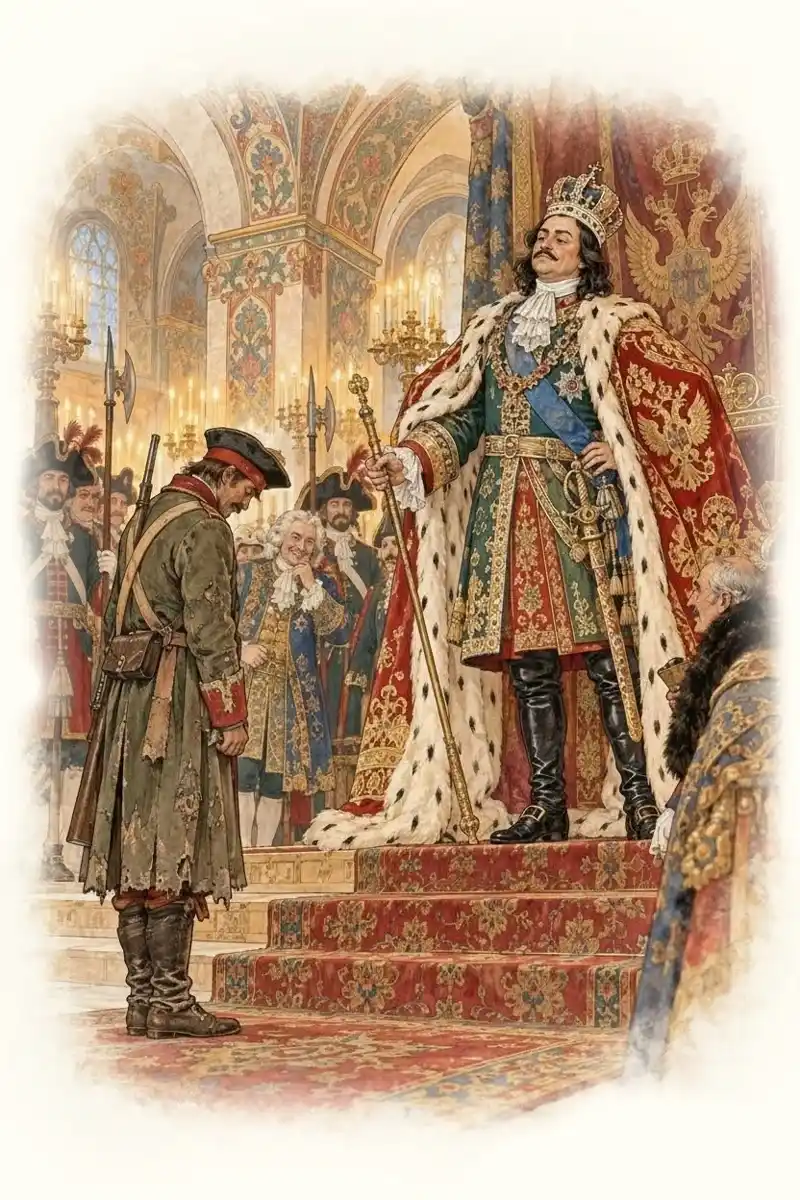
And at once he went behind the partition, put on his royal clothing, and came out again to the soldier.
“Greetings, soldier!”
The soldier gave honor, stood at attention, neither alive nor dead from fear.
“I wish you health!” he answered.
Though he was not of a timid sort, here he lost his nerve. He looked at the Tsar as regulations require, but saw nothing.
The Tsar began to question him:
“Whose are you, from where?”
Well, there was nothing to be done—he had to confess.
“I am a deserter,” he said.
“I have heard,” said the Tsar. And then he asked: “Do you know my Petrusha?”
“I know him a little,” answered the soldier. “We suffered together in the forest.”
“So it was you who saved him from death?”
The little soldier was silent.
“I saved him,” he thought, “and he has destroyed me.”
“And tell me, soldier,” the Tsar asked again, “is it true what they say—that this Petrusha looks like me?”
The soldier looked and could not believe his own eyes—the very same face! Before him stood his yesterday’s friend Alekseich.
“He resembles you a little,” answered the soldier.
Then the Tsar took from his pocket the gold coin he had taken from the robbers, twirled it, tossed it from hand to hand, and seemed to wink at the soldier.
“So then,” he said, “it is well known to me that you saved Petrusha from death. And so he has saved you today. Do you know what is prescribed by regulations for desertion? Well, what is there to say! Go to your regiment and serve as you served—with faith and truth. You will take the colonel’s place, and let the colonel serve in your place—he will unlearn stealing, no doubt.”
The Tsar handed him a letter written in his own hand, and the soldier set off for his regiment. And his friend Alekseich he never met again. Whomever he asked—no one knew anything of such a man.