
A young hunter remained to winter on Grumant. Every evening he would lie down in his fishing hut and play his gusli, and as soon as he began to play, he could hear someone dancing invisibly before him—only the rustle of a dress could be heard.
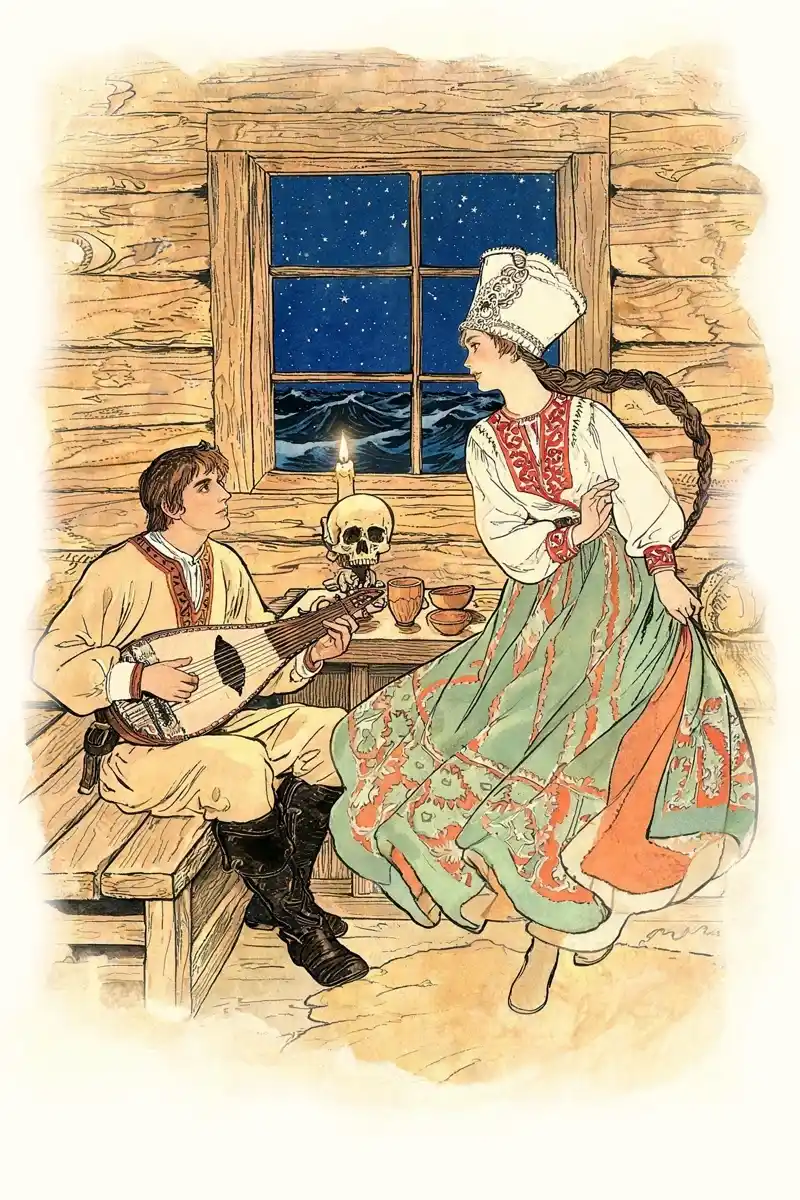
He longed to see who was dancing. Yet whatever he did, however he contrived—all in vain!
He told his companion about this wonder.
“Eh, friend!” said his companion. “Take a tallow candle, light it, and cover it with a potsherd. Then lie down on your bunk and play your gusli. If the invisible one begins to dance again—open the candle that very moment. Then you will see who is dancing!”
The lad thanked his companion for the advice. In the evening he went to the hut and did as he was told: he took a candle, lit it, and covered it with a potsherd, then began to play his gusli. He listened—again someone was dancing to his music, only the dress rustled! He uncovered the light—and before him stood a maiden of indescribable beauty.
“Well, good youth,” she said, “you have managed to spy on me. I shall love you truly.”
From that very time she began to come to him every evening, and they lived in love for three whole years.
At the end of the third year, the maiden said to the lad:
“Well, dear friend, we have not long left to live in love together. The time is coming for us to part forever…”
“Why so?”
“You see, they are marrying me off to Petersburg, beneath the kalinov bridge, to a devil.”
“What do you mean, to a devil! What business have you with unclean powers—or are you yourself such a deviless?”
“No, I was born in a great and glorious city. My father was a rich merchant. But I fell into the hands of the unclean ones because my father cursed me. When I was small, I was handing him a glass of mead on a hot day, and I accidentally dropped the glass on the floor. My father grew angry and shouted at me: ‘What a clumsy fool! If only the devil would take you!’ No sooner had he uttered that word than in that same moment I found myself in the depths of the sea, in a stone house, under the command of devils.”
The fair maiden took leave of the lad and gave him an embroidered kerchief.
“Take this,” she said, “I embroidered it myself. When you begin to miss me and great sorrow and longing come upon you, just look at this kerchief—and you will feel merrier!”
The good youth was left alone, and whenever thoughts of his former love came to him, he felt so heavy that he could have laid hands on himself! He would take the kerchief, glance at it—and the longing would pass.
About a year went by. He told his companion about the kerchief, and the companion stole it.
From that time the lad began to grieve and, in his sorrow, to drink heavily, until he drank himself into ruin.
“I will go,” he said, “to Petersburg, to the kalinov bridge, and throw myself into the water. I might as well perish!”
He came to the kalinov bridge and threw himself into the water.
In that very moment he found himself in an underwater kingdom: all around were green fields, gardens, and groves. He walked on—a great stone house stood there. The merchant’s daughter looked out the window, saw him, and cried:
“Hey, dear one! Come this way—I live here.”
She ran out to meet him:
“Greetings, my dove! I have not seen you for so long—I never thought I would see you again!”
She began to kiss and caress him, to treat him to all sorts of dishes and drinks. Then she hid him in a special chamber and said:
“My husband will come soon and cry out in a loud voice: ‘Russak! Why have you come?’ The first time—say nothing. The second time—say nothing again. But when he cries out a third time, answer him: ‘What is in your cradle is mine!’ He will offer you a hundred rubles for the child—say nothing. He will offer two hundred—still say nothing. And when he cries out in anger: ‘What, Russak, are you silent? Take three hundred rubles!’—then you say: ‘If only I had a sack of hot coals—I would take that!'”
No sooner had they finished their conversation than the unclean one came in and cried out loudly:
“Russak! Why have you come?”
The lad was silent. The unclean one cried out a second time, even louder—the lad still said nothing. And at the third demand, he spoke:
“What is in your cradle is mine! I want to take it with me.”
“Do not take it, brother—take a hundred rubles.”
The Russak was silent.
“Take two hundred!”
Again he was silent. The unclean one grew angry:
“Why are you silent? Do you want three hundred rubles?”
“No, I do not want it. If only I had a sack of hot coals—I would take that, and even then only on the condition that you carry me and that sack back to Rus’.”
The devil immediately dragged up a sack of hot coals, seated the lad on his shoulder, and said to him:
“Close your eyes!”
The lad closed his eyes, and the unclean one carried him like a whirlwind back to Holy Rus’. The good youth found himself again on the kalinov bridge, and beside him lay a sack of gold. Thus he grew rich, married a good maiden, and lived happily. But had he been tempted by money—the devil would surely have deceived him: instead of money, he would have poured out horse dung and all manner of filth.