
Once, in a northern tribe of Russians living on the shore of the White Sea, a strange man appeared. He was no longer young, gray-haired, but strong and sturdy.
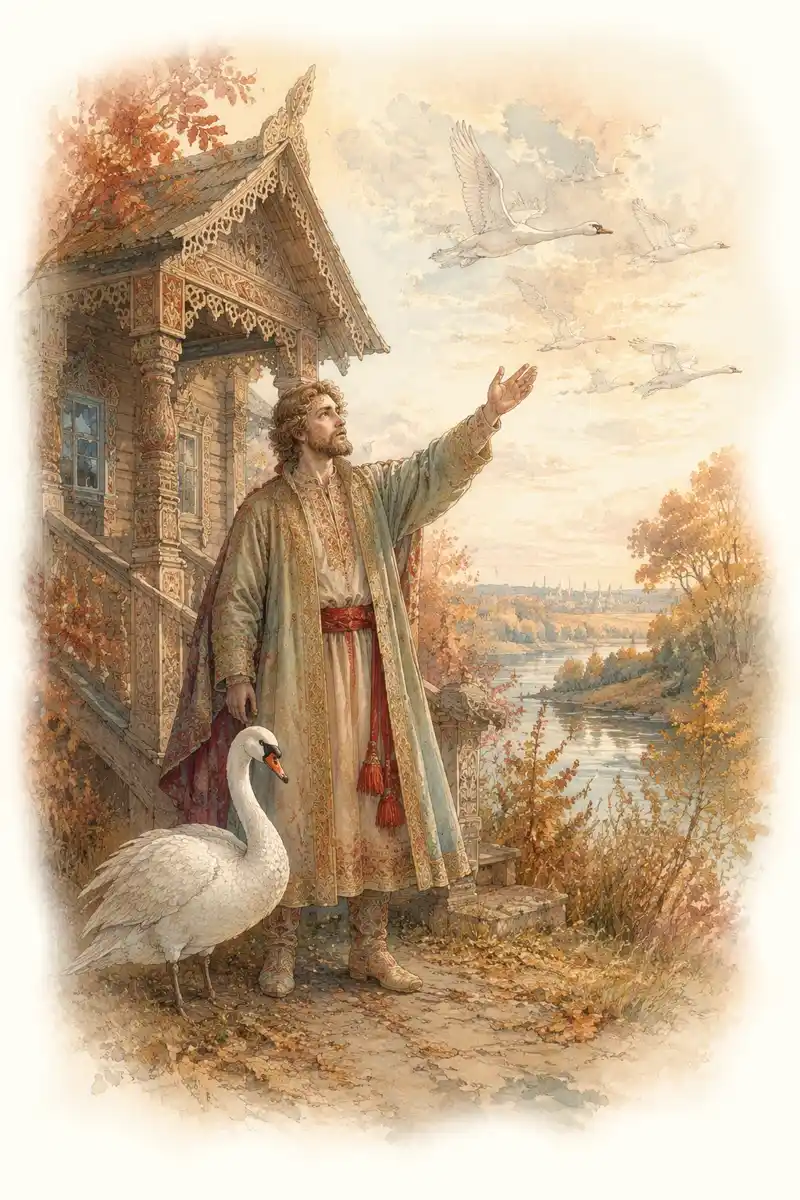
Coming to the village, he asked to settle on its outskirts. They offered him an old abandoned house that no one needed. The local community gave him a cow, a dog, and a cat. The unusual man began to live by himself, speaking to no one and forming no friendships. In spring he plowed the earth, in summer he mowed hay for his cow and went hunting with his dog. All the household work he did himself: cleaned the house, cooked dinner, baked bread, and milked his Brownie. The maidens cast glances at him, tried to attract his attention, but the gray-haired settler looked at no one; he needed no one. At first people shrugged, marveling at such behavior, then they waved their hands and let it be. Thus two years passed.
And then one day the local priest came to him and said:
“By the law of hospitality, we have tolerated you for two years, but now it is important that you answer: why do you separate yourself from the community, and who are you? If you are a Christian, then be gone. But if you are one of us and serve the Heavenly Rod, then why are you absent from our festivals? You have not appeared at a single celebration in honor of the white light, as if you had no need of it.”
Bowing his head, the strange man looked at the volkhv and said:
“What business is it of yours? I live by myself, I feed myself. I wrong no one, I do harm to no one. Why do you pester me? Well, if you must know who I am, I will answer that I am no Christian, but the same as you. And so that you may believe me and have no doubt—at the winter Kolyada I will certainly come with everyone else.”
The priest was reassured and understood that this man was one of their own and not from the distant west.
Winter came, and at last the feast of Kolyada arrived. The gray-haired man appeared at the gathering, but instead of joining the games, he began doing what old men and women usually do. He helped carry dishes, set up tables, and haul firewood. Seeing this, the young men began to taunt him and laugh at him constantly:
“You haul wood and food like an old woman. There are wrestlers and archers performing, fistfights and stick fights, long-distance races, horsemen flying on their steeds—but you take part in nothing!”
He cast a sorrowful glance at them, took a stick, and with a calm, firm stride entered the contest circle. He beat them all, leaving bumps and bruises, then threw the stick aside and sighed:
“That will teach you not to pester me!”
This amazed the people—he had easily defeated their best fighters! They wanted to reward him, but the gray-haired man refused.
Then the priest approached the unusual man and spread his hands:
“You are a boyar, a warrior! We have good fighters, glorious ones, but you are above them all!”
“What business is it of yours? What difference does it make to you what class I am? I harm no one. Please, leave me in peace,” the man asked the volkhv dryly.
The priest stepped away from the warrior. He understood that something weighed upon the man’s soul and that he needed help—but what kind, he did not know. Meanwhile, the festival continued. And the hour came when the maidens began to choose husbands.
The young men lined up in two rows, one facing the other, and sang a hymn to Lada, while the maidens, to their songs, began a figure-eight round dance. One of the maidens would approach a young man, her Lado, slap him on the shoulder, and run away. If the young man did not accept the maiden, he could not catch her. If the feeling was mutual, he would surely overtake her. The beloved herself allowed herself to be caught, running freely without tricks or cunning. The ritual proceeded easily and beautifully. All relationships were harmonious, and everything had been agreed upon beforehand. And suddenly one of the beauties, separating from the round dance, went straight toward the spectators and slapped the gray-haired man on the shoulder! There was nowhere to go—he rushed after her… But immediately, stumbling, he fell into the snow amid laughter and hooting. The maiden stood beside the strange man, but he did not even extend his hand to her. She was not dear to him, then.
The boyar came home, fed the cat and dog, milked the cow, gave out feed, and sat by the window. He began to think about how to live on, and at that moment the priest appeared again on the threshold of the house:
“I do not know who you are, but today you caused great grief to the beauty who chose you. She is the best of our maidens, and at festivals she was chosen as Lada. With her heart, the beauty understood and felt your soul. That is why she came to love you. But for some reason you rejected her. Your act is grave, for to a young maiden it is an insult.”
The strange man shrugged:
“You do not understand that I need no one—even if the maiden were a goddess herself, I do not need her!”
The priest, shaking his head, sighed and said:
“Do you know the law? If you do not accept the communal order, if you live as you please, then we are obliged to expel you.”
The gray-haired warrior looked at him with indifferent eyes and said:
“I have been expelled more than once—so I will not be surprised.”
“Well, for now we will not drive you out. I understand that you need help and support. But next time, do not make such harsh mistakes. Understand: if someone chooses you, do not act as you did with this maiden,” the volkhv lowered his head. “Now she is needed by no one. She chose you, and you refused to extend her a hand. She is unlikely to choose anyone now. We understand that you have survived something terrible. Forget the past, leave all misfortunes far behind. If someone chooses you, you must begin a new life!” the priest looked at the strange man with emotion.
The boyar was silent for a while, then answered:
“It is not memories that weigh upon me,” he sighed. “I have nothing to forget. You cannot understand the misfortune that torments me.”
The priest rose and, leaving the warrior, said in parting:
“The Komoeditsy will come—the farewell to winter. Come! I will help as I can. I understand you have no time for us, but you are not yet an old man, and so you must live fully.”
The gray-haired warrior bowed to the volkhv and remained sitting, gazing out the window.
Spring came. And on the days of the spring equinox, the whole village gathered again, and people came from neighboring villages for the festivities. Festive bonfires blazed! Round dances whirled, merry songs rang out! They set up the fearsome effigy of Mara, goddess of winter and death, and burned it on the fire. Again, between four great blazing bonfires, the festival of choosing husbands was held; again the maidens sought their fate.
Of course, among the young men there was no strange gray-haired man. He stood aside, among the spectators, and his soul was troubled, because he did not see in the ranks of maidens the very one who had chosen him at the winter festival. Suddenly that beauty appeared in splendid festive attire right before him and again slapped him on the shoulder! There was nowhere to go; the surrounding people watched with emotion to see how he would act. The warrior rushed after her, thinking what to devise. But then, unexpectedly for all, the maiden herself fell at his feet! The strange man lifted her, took the beauty by the hand, and led her to his home.
They entered the house. The warrior seated the maiden opposite him and began to speak with her:
“What do you want from me? You are beautiful as a goddess! You have a lovely face, hair the color of gold, eyes blue as the sky—but I do not need you, and I need no one! I am not like others. I am worse than you can imagine! Now I will tell you my whole life. Then you will leave me and soon forget. But first of all, tell me your name, so that I may remember you all the rest of my life.”
“My parents named me Daryushka,” the maiden answered the boyar.
“So then, Daryushka, know that I was once a prince. Somewhere far from you, beyond mountains and rivers, on the shore of the sea stands my city, my principality. And my fate is such that you would not wish it on a bitter enemy. It happened that my grandfather angered the goddess of death herself—Mara. And you know how mighty and vengeful that goddess is. And to punish my grandfather, Mara sent him a maiden—so good, intelligent, honest, and virtuous that my grandfather could not help but fall in love. He fell in love with the beauty and renounced everything. My grandfather abandoned everything: the governance of the state and his other wives. None of it brought him joy. Only his beloved did he gaze upon day and night; only her did he admire. She eclipsed the whole world for him with her beauty. But one day the maiden vanished. She left the house, and my grandfather never saw her again. He began to grieve. A year he grieved, a second he suffered. He could not endure it. He went to the high cliff of death and leaped into the sea onto the sharp rocks. The prince could not survive the loss. But in parting, he commanded my father to bear a son or daughter from the women well known to him, and never to become involved with anyone from outside. My father gave his word to fulfill the promise. I was born. But still my parent violated the command. He met the woman of his death. They began to live together. And just as my grandfather had, my father abandoned all his affairs. He forgot me, and did not favor his other children—he left everything. He thought only of his beauty, was only beside her.
But after three years, that woman vanished, just as the beautiful wife of my grandfather had. My father began to grieve. He summoned me and said:
‘My son! I must go to the cliff of death. My heart is too tormented by loss. Give me an oath that no woman shall appear in our house—not even the one you have known since childhood. She will break you, for Mara’s vengeance is terrible.’
My father bade farewell to all and departed to his ancestors. Years passed. Whatever maidens I saw, I let not one into my heart or my home. Firmly I kept the oath I gave my father. I governed my state; affairs went well; I ended all wars, and my principality flourished.
But an anchutka prompted me to go hunting in a neighboring forest with my friends. And during the chase after a deer, I heard a woman’s cry. I galloped in that direction and saw a young maiden lying on the ground, wounded by a boar. Beside her lay a basket of mushrooms. Seeing the wounded girl, I forgot the oath I had given my parent and ordered her carried to my home. When I looked into the room where she lay, I fell in love with her at once. Her extraordinary beauty intoxicated me, and I understood that I loved this maiden more than life. And when she recovered, with her consent I named her my wife. The first year we lived well, but in the second year, relations began to worsen. Everything became displeasing to my young wife in my house, and then she vanished altogether. Where she went, I could never find out. The sun darkened for me; life became worthless. Three months I lay in my chambers, gazing at the empty walls, calling for death. But suddenly my wife appeared. As if nothing had happened, she embraced me, caressed me, and brought me back to life. A year passed, and again my darling beauty vanished. Again I began to grieve; the sun went out for me; I lost all peace. And suddenly she appeared again and smiled at me as if nothing had happened. I asked her then:
‘Where were you? Why do you leave me so suddenly?’
‘I was with my mother. Is it forbidden to visit one’s parents?’
I was afraid to ask anything more, because I feared that my beloved wife, angered, would leave me again.
And then one day, during a great thunderstorm, a rider galloped to my house. It was my best friend. He flew into my room, embraced me, and asked:
‘My dear prince! Do you know who your wife is? Whom you have sheltered in your house?’
‘I do not know,’ I honestly admitted. ‘She does not say, and I do not ask.’
‘Then know this. Riding across the steppe, I saw a lonely house, and when a terrible thunderstorm began, I galloped there to shelter from the wind and downpour. Tying my horse, I entered the yard and saw your wife standing there. She stood and looked at the clouds in the dark sky. Suddenly lightning struck the earth nearby, and from the lightning rose the goddess Mara herself. Water churned around, the downpour lashed me, but I heard their conversation clearly.
“Why do you return to him each time? Why do you not let him go to the cliff of death?” the goddess asked sternly.
“Mother, I am a good and diligent daughter. I want him to go mad with longing for me, to wander as a beggar through foreign lands, searching for me, and for all people to laugh and point their fingers at him. Such will be my vengeance for you upon his entire line!”
Mara laughed then:
“You are clever! You have devised something even better than I. Continue, and if you achieve what you have planned, you are a worthy daughter of your mother.”
And then, looking at my faithful friend, I understood that only one road remained for me—to the cliff of death. Better to die, falling upon the sharp rocks, than to wander the white world as a madman. And, putting on clean garments, I set off for the sea. But then, on the road, a volkhv appeared before me. The priest of Rod stood all in white and looked at me with reproach:
‘Listen, prince. I know it is hard for you now, but we must teach Mara a lesson. We must ensure that she cannot send you to the other world and drive you mad. Follow me; I will help you.’
I could not resist—the will of a priest is law even for a prince. I entered the temple of Rod and lay upon the altar. Meanwhile, the priest took a wax heart and, heating a sword, cut it upon my chest. After that, I rose from the altar calm, confident, and all the longing left my soul—love vanished. But now I felt no feelings toward women or people at all. Then I understood that I could not be a ruler. For only he who loves his people and is not indifferent to their problems can govern them. I was indifferent to everything. Leaving my nephew in my place, I went wandering wherever my eyes led. I traversed many lands, and everywhere the same demand was made: that I live like everyone else, marry, and raise children. Thus expelled from communities, wandering from one village to another, I came to you. And now, Daryushka, you sit here, beside me. Yes, you chose me, but I will never be able to love you. Because I live and await death, which will someday come and free me from suffering.”
Daryushka sighed, approached, and kissed the former prince:
“Now I know everything and understand, and I blame you for nothing. What you have told me is terrible. I will leave, and you will not suffer looking at me,” the maiden said, rising.
Daryushka returned to her parents’ home, and at night she told her father, mother, and the volkhv everything:
“He is very kind, honest, and just! There is so much good in him. I loved him for his nobility, for his bright soul. I will walk across Rus’, I will seek the one who can help him.”
Taking leave of her parents, Dasha put on new boots, took a small bundle, and set off on the road across the white world. She walked from one principality to another, questioning all people and volkhvy. She saw and felt that they knew how to help the grief, but they told her nothing and looked away. Long she wandered in search of the truth. Snow fell upon her, rains drenched her, but there were kind people who gave her shelter and a crust of bread.
And then one day Daryushka wandered into a terrible dark oak forest. And in a clearing she found a hut where a black sorceress lived. The maiden, unafraid, entered.
“Ha-ha!” laughed the sorceress. “You are that very wanderer who seeks how to help her enchanted prince? Unfortunate one! Do you know why no one told you the truth? Everyone pities you, fool, but I do not pity you! So listen: the prince’s heart will awaken and become like all people’s hearts only in one case—if three times, when choosing between life and death, he does not renounce his love for an animal. Are you ready to become a horse, a bird, a dog, or someone else? For such a deed one must love, and oh, how strongly love!”
Daryushka looked at the starry sky, at the tall oaks around her, and answered:
“I agree to anything for the prince! I will not spare my life!”
“You agree? Well then, so be it!”
And then one day in the north, in the month of November, a blizzard swept across the village, and gusts of wind bent centuries-old pines to the ground. And from distant islands, a flock of swans flew south. The hurricane would not let them beat their wings evenly or spread them. Their journey was hard.
And suddenly a man standing on the porch of his house saw one of the swans, losing strength, strike the top of a tree and fall to the ground. This man was the prince. He rushed to find the bird and, finding it, carried it into his house.
“Well then, little swan, since you could not fly away, we shall winter together,” he said, carrying the wounded bird in his strong hands.
The prince built a box, poured feed for the swan, and filled a bowl with water. The gray-haired man marveled that the cat was not afraid of the swan, and the dog wagged its tail in greeting. And the little swan began to settle into the house, walking everywhere after the prince. He chopped wood—she was beside him. He milked the cow—and there she was. She looked into his eyes and nuzzled his hand. And the prince stroked her and murmured:
“We will survive the winter, your swans will come, and you will fly away with them to distant islands, to hatch your chicks…”
The polar night came. The prince conversed much with the swan, the cat, and the dog, fed them all, cared for them. And he lived in peace. One day the prince met the priest and asked:
“Where is Daryushka? I have not seen her for two years now.”
The priest shook his head:
“Foolish man. She left us—left to seek help for you. We all think of her.”
The prince returned home and told his animals everything:
“I acted wrongly. Perhaps Daryushka is no longer alive.”
Then the little swan approached the prince, wrapped her neck around his hand, and looked into his eyes. And for a moment it seemed to the man that these were not the eyes of a swan, but as if Daryushka were looking at him.
Thus winter passed, and spring came after it. Streams rang, a warm wind blew, and swans appeared in the sky. The little swan went outside, spread her wings, and made as if to fly. The prince sighed and waved his hand in farewell:
“Well, fly, dear one, on a good journey!”
Long the swans circled over the village, and at last hid beyond the horizon. The man brushed a tear from his cheek and went into the house. But suddenly he heard a knock at the door. He opened it—and there was his little swan. The prince was amazed, then, recollecting himself, took a stick and began to drive her out:
“Fly to your own! Why have you returned?”
But his hand dropped, and tears ran from his eyes:
“Then I wept that you had flown away—and now I weep that you have stayed…”
There was nothing to be done. They began to live together again. The prince expected that autumn would come, and then the little swan would surely return to her own. But the bird was always beside him, never leaving his side. She pattered after him through the village, and people watched and marveled.
Summer passed, and autumn after it. And the little swan, however much the prince scolded, never flew away…
At last came the longest night of the year—the time of Mara. The gray-haired man sat by the stove, recalling how he had gone to the festival that day and watched them honor the cold goddess. And suddenly the little swan started, grew frightened, and pressed close to the prince. And looking around, he saw that the doors of his house, the walls, and the ceiling had vanished, and above his head shone the stars. And then before him appeared in all her majesty the goddess Mara herself.
“Greetings, prince! I have come to visit you! Today is my festival—do you hear? They honor me throughout all Rus’! Give me what I desire!”
“Take whatever you wish—nothing is dear to me. Here are my clothes, here is my sword. I have nothing more,” the master of the house bowed to the goddess.
“No, you say?! And what of your little swan? Give her to me!”
“You see, great Mara, I respect you, but I cannot do this! I love her!” the prince objected.
“Ah, you love her?! In that case, you shall die now!”
Suddenly, from nowhere, two warriors appeared, clad in armor. They raised their damask swords against the prince.
“You will remain alive if you give up the bird!” the goddess threatened.
The warriors rushed at the prince, but the defender of the swan drew his sword. And one after another, the warriors fell slain at his feet.
“You are no simple man!” laughed Mara. “Do you really intend to oppose me? Give up your little swan, and I will spare you!”
And then four vityazi stood before the prince.
“No, I will not give up my little swan!” the gray-haired warrior looked at Mara. “Because I love her!”
“Kill him!” ordered Mara to her servants.
But a moment later, all four armed assassins of Mara lay cut down on the floor of the little house.
“You are naive!” the goddess flashed her eyes. “Do you really hope to overcome all my host? Give up the little swan and remain alive!”
“I will not give up willingly what you ask,” the prince said calmly. “You will take her only when I am no longer alive.”
And then six strong vityazi surrounded the defender of the swan. Desperately the prince fought Mara’s warriors. He received several wounds, but still he overcame them all.
And to his amazement, Mara, seeing his victory, smiled at the prince with a kind, welcoming smile.
“You are a true man, of whom there are very few in the world. And you have proven it with your love. Therefore I lift the curse from your line! Be happy, warrior-prince. I bless you for a long life. Farewell.”
And the goddess vanished. In that same moment, the doors, walls, and ceiling of the house returned to their former appearance. Exhausted, the wounded warrior fell onto the bed and closed his eyes.
Coming to himself, he felt on his face the touch of someone’s light and tender hand. With amazement he looked at the one bending over him. And then the prince saw the familiar smiling face of Daryushka, who looked at him with the loving eyes of a swan.