
Discover “The Don Steppe Legend,” a hauntingly beautiful tale of loyalty, sacrifice, and unrequited love set against the wild backdrop of the Russian southern plains. When a herd of wild Don tarpan horses is pursued by a ravenous wolf pack through the bitter winter snow, the young mare Zvyozdochka and her devoted companion Gnedoy struggle to keep pace. While the proud stallion Volny Vetr races ahead with the herd leader, Gnedoy refuses to abandon the exhausted Zvyozdochka—even when she collapses and the wolves close in. In a desperate last stand, the brave stallion fights off the entire wolf pack, sacrificing his own life to protect the mare he loves. This moving legend explores the contrast between shallow vanity and true devotion, reminding us that heroism is not measured by beauty or bravado, but by the courage to stand by those we love. Perfect for fans of animal folklore, emotional storytelling, and tales of the wild steppe, this story will linger in your heart like the wind across the endless plains. Beautifully translated and vividly told, “The Don Steppe Legend” is a timeless tribute to loyalty, courage, and the quiet power of an unbreakable bond.
One radiant day, beneath the vast and endless sky of the southern steppe1, a herd of wild Don tarpan2 horses thundered across the grasslands like a living river. Among them ran a young mare3 — beautiful and fiery, with a coat of burnished copper and a mane of flowing gold. Upon her broad forehead gleamed a single white star, and for that mark she was called Zvyozdochka4 — Little Star.
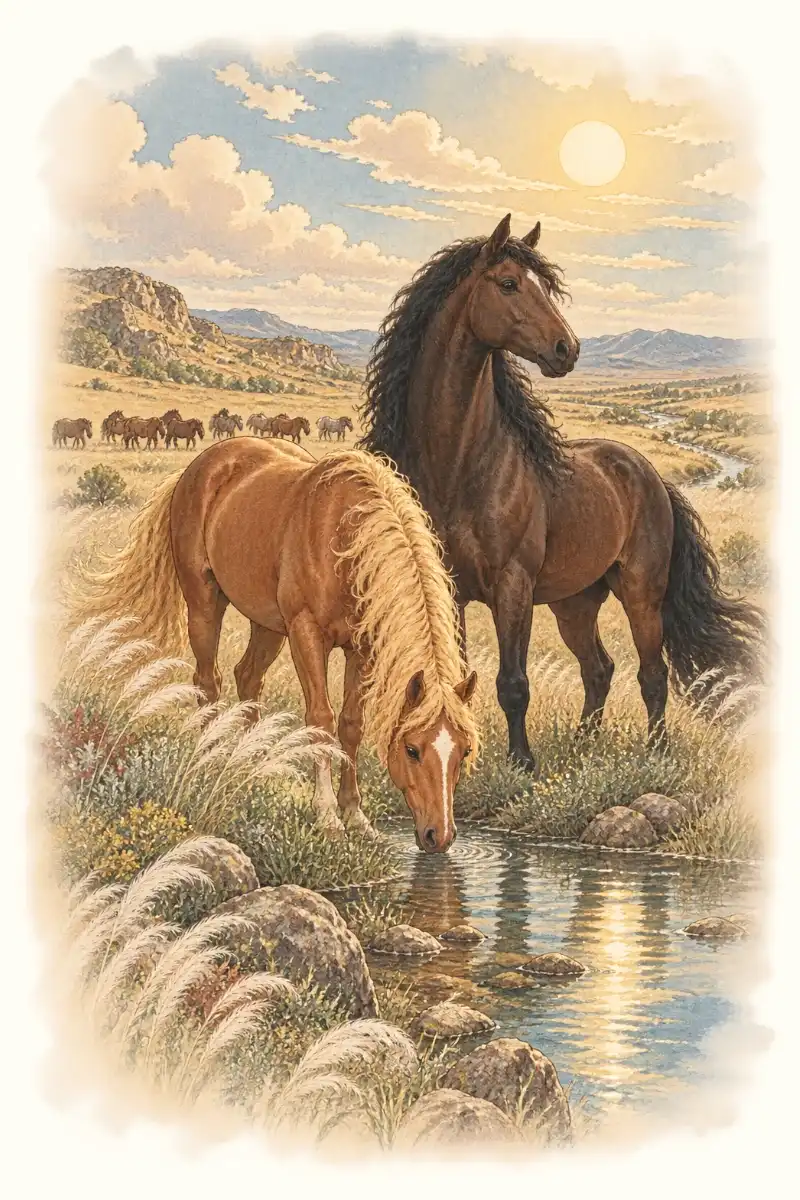
At her side ran a stallion5 named Gnedoy6. He was not as handsome as she, nor as flashy — but he was enduring, strong, and fearless. His greatest joy was to protect and cherish the companion of his youth. When the herd paused at a stream, he found the coolest, clearest water for her. On the pasture, he sought the greenest grass. At rest, he chose the softest ground. On bitter nights, he shielded her from the howling winds with his own body.
But Zvyozdochka did not love Gnedoy. She accepted all he gave with gratitude, yet her gaze always wandered to another stallion — Volny Vetr7, the Free Wind. To her, he was the most magnificent horse in all the herd: sleek and strong, with a long flowing mane and powerful legs. He knew how to show himself — his proud stance, his broad chest, his mighty haunches. And Zvyozdochka pleased him. He would show off for her, racing with blinding speed, leaping over obstacles with effortless grace, and sometimes bringing her wildflowers clutched in his teeth.
Summer gave way to autumn, and autumn yielded to the bitter winter winds. The herd pressed on across the steppe, pawing through the snow for scraps of dried grass. But the cold deepened, and the blizzards howled. Food grew scarce.
In that time of hunger, the wolves began to gather. Their scattered packs merged into one great grey avalanche — a ravenous horde8 that devoured everything in its path. And that savage host set its sights on the wild horse herd.
The lead stallion — the wise and mighty chieftain9 of the herd — made a desperate choice. He would lead his kin north, where deep snow would slow the wolves and give the horses a chance to escape. Day and night, they galloped without rest. Those who could not keep pace fell to the snow, and the wolves fell upon them with terrible speed.
At the head of the herd ran the great chieftain. Beside him, never lagging, ran Volny Vetr — pressing close, afraid to fall behind. Somewhere in the rear, Zvyozdochka and Gnedoy struggled to keep up. The young mare was spent, her strength nearly gone — but she forced herself onward, her eyes fixed on her beloved stallion running with the leader. Gnedoy ran beside her, lending her his strength, urging her forward with gentle nudges.
But with every stride, her legs grew heavier, her breath more ragged. She was failing. Gnedoy, knowing that if she fell, the wolves would tear her apart, seized her mane in his teeth and dragged her onward — refusing to let her collapse.
At last, Zvyozdochka could bear no more. She crumpled to the frozen earth like a felled tree and gave her farewell call to the herd. Only the great chieftain answered — and to save the rest, he led them onward, northward into the blinding white.
But Gnedoy — who had saved his strength — stayed behind with the dying mare. And in that moment, the wolf pack closed in around them.
Gnedoy was strong and fierce. He could easily have burst through the encircling wolves and rejoined the herd — but he did not. Instead, he became a whirlwind of fury, spinning around the fallen Zvyozdochka, his hooves smashing wolf skulls, his hind legs lashing out with lightning speed, his body crushing those who dared to leap upon him. He fought like a demon, breaking bones and scattering the pack — but there were too many. The wolves swarmed him from all sides, and at last, beneath their weight, the brave stallion fell beside his dying star.
A year passed. From the distant north, the great chieftain brought the herd back to those southern plains. He wandered, searching, his head low — seeking the bones of Zvyozdochka and Gnedoy. When he found the place of the stallion’s heroic death, he raised his head and neighed — a long, mournful cry, a hymn to horse’s glory, echoing across the empty steppe.
And in that same moment, Volny Vetr was prancing before a new young mare — a pretty, foolish filly10 — showing off his speed, tearing wildflowers with his teeth, and telling the world with his proud whinny what a hero he was, what a beauty, what a magnificent creature.
But the steppe remembered. And the wind carried a different story — a story of a golden-maned star and the iron-hearted stallion who gave everything for love, and asked for nothing in return.
- Steppe — a vast, treeless grassland of southeastern Europe and Siberia; the story is set “beneath the vast and endless sky of the southern steppe.” ↩︎
- Don tarpan — an extinct type of wild horse that once roamed the Don steppes in southern Russia; in the passage, the herd is described as “wild Don tarpan horses.” ↩︎
- Mare — an adult female horse; Zvyozdochka is called “a young mare.” ↩︎
- Zvyozdochka — Russian for “Little Star”; the mare is named for “a single white star” on her forehead. ↩︎
- Stallion — an adult male horse; Gnedoy and Volny Vetr are both stallions. ↩︎
- Gnedoy — Russian for “bay” or “dark bay” (a horse coat colour); the stallion is “not as handsome as she, nor as flashy — but he was enduring, strong, and fearless.” ↩︎
- Volny Vetr — Russian for “Free Wind”; the proud stallion that Zvyozdochka admires. ↩︎
- Horde — a large, moving group or swarm; in the passage, the wolves merge into “one great grey avalanche — a ravenous horde.” ↩︎
- Chieftain — the leader of the herd; in the passage, “the wise and mighty chieftain of the herd” leads the horses north. ↩︎
- Filly — a young female horse; at the end, Volny Vetr prances before “a pretty, foolish filly.” ↩︎