
Discover the charming Russian folk tale of “The Grain Grandfather,” a tiny guardian of the harvest with a long green beard and a fierce love for his golden field. When a greedy hamster stuffs its cheeks with stolen grain, the Grain Grandfather stamps his feet and threatens the little thief—but the hamster refuses to give back its bounty. After three warnings and a great show of fury, the frightened hamster finally opens its mouth to explain, only to spill every stolen kernel back onto the earth. Defeated and empty-pouched, the hamster slinks away, and the field falls quiet once more. When the reapers arrive with their singing sickles, the Grain Grandfather watches from the shadows, then curls up beneath a tussock and sleeps until the next summer. This whimsical tale celebrates the cycle of harvest, the spirit of the fields, and the joy of simple folk wisdom. Perfect for readers of all ages, this beautifully translated story will delight anyone who loves nature, folklore, and the magic of the countryside.
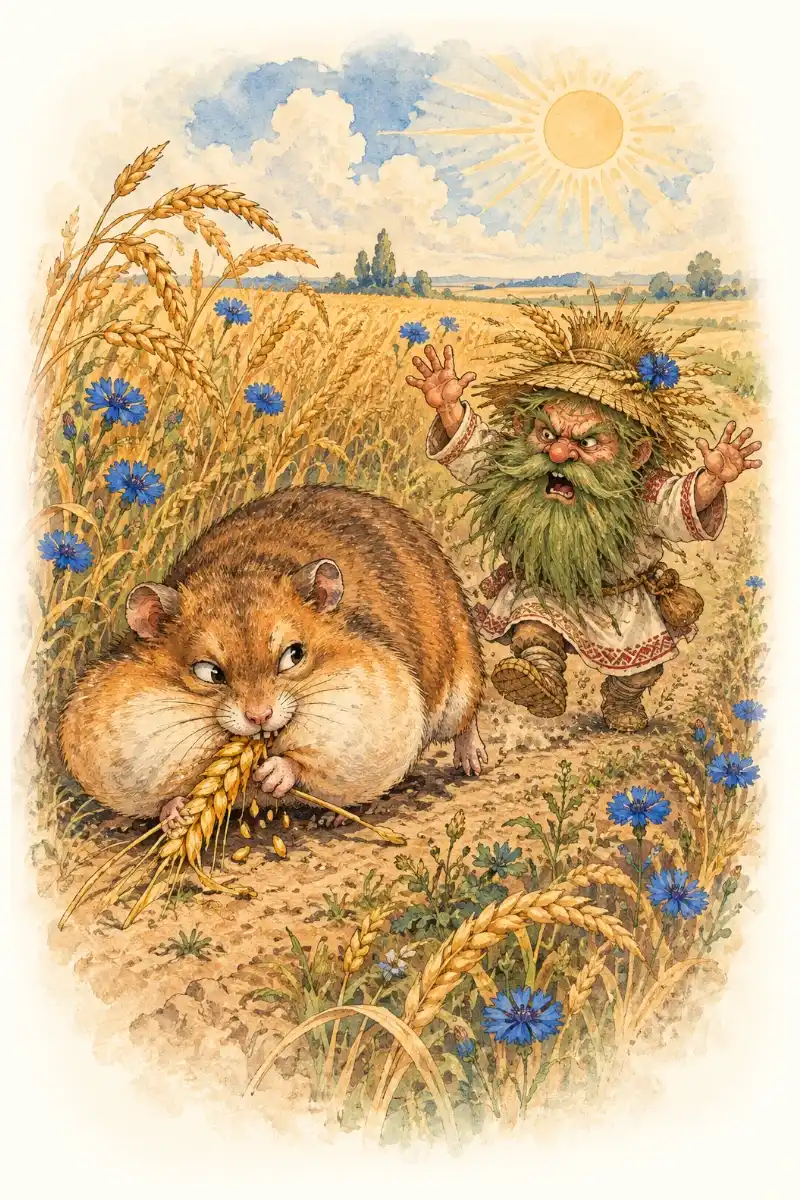
Once upon a time, in the middle of a golden grain field, there lived the Grain Grandfather1. He was small as an ear of wheat, with a head round as a little bun, a green beard three arshins2 long, and a shock of straw bristles upon his crown. He sat upon the boundary mound3, admiring his own beard with great satisfaction:
“Ah, what a beard — all twined with cornflowers!”
Suddenly, he spotted a hamster4 scurrying across the field. Its mouth went smack-smack as it stuffed its cheeks full of grain. Its pouches bulged so full they dragged upon the ground.
The Grain Grandfather grew angry. He stamped his feet, waved his arms, shook his beard, tossed his head, and shouted:
“Beware, hamster! Do not steal the grain! Or your back shall be beaten with a straw!”
The hamster was frightened and dove behind a tussock5.
The Grain Grandfather waited for the hamster to return the stolen grain. But the hamster did not give it back. The Grandfather was amazed — then furious. He stamped his feet, waved his arms, shook his beard, tossed his head, and cried:
“If you do not return the grain, hamster — your back shall be beaten!”
The hamster grew even more terrified. It did not know what to do.
The Grain Grandfather was puzzled that the hamster remained silent. His anger grew. He stamped his feet, waved his arms, shook his beard, tossed his head, and bellowed:
“Answer me, hamster! Why do you need the grain?! Or your back shall be beaten!”
At last, the hamster crept out from behind the tussock. It bowed low to the ground, scraping and pleading. It opened its mouth to defend itself — and the moment it did, all the grain came pouring out from its cheeks, tumbling to the earth. Not a single kernel remained in its mouth.
The hamster slunk away from the grain field, empty-pouched6 and defeated.
But the field did not sleep for long. The reapers7 came, their sickles8 flashing in the sun. The field rang with the music of their blades — clink-clank, clink-clank — as the golden sheaves fell in rows and covered the earth. The Grain Grandfather scurried along the boundary mounds and little hillocks, hiding now behind a sheaf9, now behind a small stack. At last, he crept beneath a tussock, stretched out his tiny limbs, laid his head upon his long green beard, and fell fast asleep — to dream of golden summers until the next harvest came.
- Grain Grandfather — a small field spirit or creature living in the grain; in the passage, he is “small as an ear of wheat,” with a green beard and straw bristles on his head. ↩︎
- Arshin — an old Russian measure of length, about 0.71 m (16 vershoks); his beard is “three arshins long.” ↩︎
- Boundary mound — a raised strip of earth marking the edge of a field; he sits “upon the boundary mound.” ↩︎
- Hamster — a small rodent with large cheek pouches for carrying grain; in the passage, it stuffs its cheeks “full of grain,” and the pouches “bulged so full they dragged upon the ground.” ↩︎
- Tussock — a small clump or tuft of grass; the hamster dives “behind a tussock,” and later the Grain Grandfather creeps “beneath a tussock.” ↩︎
- Empty-pouched — with empty cheek pouches; the hamster slinks away “empty-pouched and defeated.” ↩︎
- Reapers — those who cut and gather the grain harvest. ↩︎
- Sickle — a curved blade for cutting grain; “their sickles flashing in the sun.” ↩︎
- Sheaf — a bundle of cut grain stalks tied together; the reapers’ “golden sheaves fell in rows.” ↩︎