
Discover the powerful legend of the Temple of Svarog, a sacred sanctuary of the Slavic fire god that stood near Smolensk until the Christian crusades of Prince Vladimir. When a twenty-thousand-strong army of Danes, Swedes, Moravians, and Poles besieges the temple, its three hundred immortal guardians are joined by warriors from fallen cities and the temple’s own priests, women, and children. After three days of relentless assault, the voivode Putyata demands the surrender of the idols—especially the silver statue of Rus’, which he vows to desecrate and melt down. The defenders refuse, sending out their women and children before launching a desperate counterattack, while the temple erupts in heavenly fire and wild beasts destroy those who flee. When dawn breaks, the Christian army is annihilated—and the statue of Svarog stands unharmed amid the ashes, holding the silver Rus’ in his arm. The supreme priest Dobrosvet declares this a sign that Svarog will one day carry Holy Rus’ to victory and divine justice. Perfect for fans of Slavic mythology, epic last stands, and prophetic legends, this beautifully translated story will inspire readers for generations.
Once, not far from Smolensk, in the upper reaches of the Sozh River, upon a high hill amidst an oak grove, stood the temple of Svarog. It was a four-sided structure built of hewn logs from the sacred tree of the gods – the oak. The sanctuary itself was two stories tall, crowned by a pyramidal roof, with four small corner pyramids at its edges, each topped by a cupola. These golden cupolas were symbols of fire, adorned with double patterns.
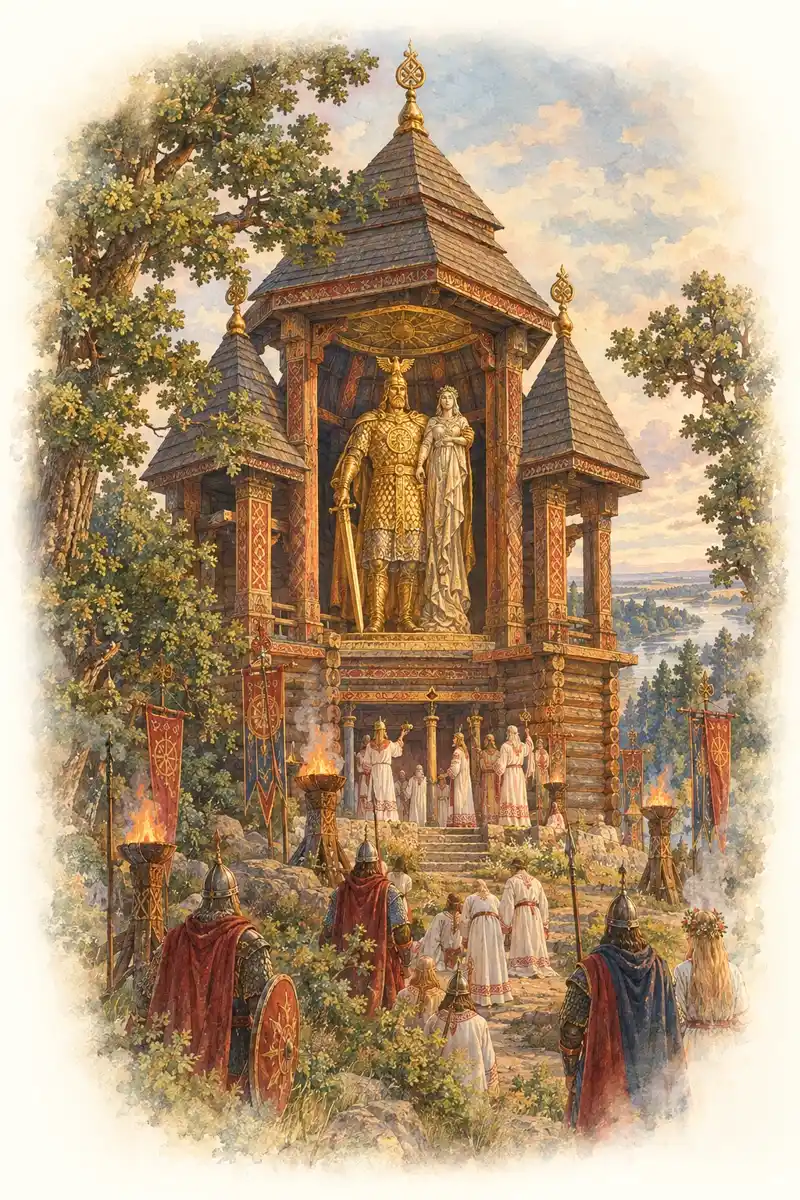
Within, on the first floor, was a library. On the second, beneath the dome, stood a five-meter gilded statue of Svarog himself. Upon his head was a gilded helmet, and atop its crest sat an eagle – the symbol of inevitable, furious victory. His body was covered in chainmail with damask gold-embossed elbow guards, and over it a scale-armor cuirass, in the center of which, upon a steel mirror, shimmered double patterns. On his legs were chainmail trousers with gilded knee guards and boots with gold inlay.
Thus stood the idol in warrior’s armor. In his right hand was a huge, keenly sharpened damask sword. On his bent left arm stood a statuette – a silver beauty with golden braids, wearing a pearl kokoshnik and an embroidered Russian linen sarafan. She smiled and reached her hands toward the winged spirit of Great Rod hovering beneath the dome. She was the embodiment of dear and beautiful Rus’.
Such was the temple until its final day, when tragic events came to pass.
After the pogroms in Smolensk, the hired Christian army of Vladimir the Red Sun approached the temple of Svarog. It was a force of twenty thousand, composed mainly of Danes, Swedes, Moravians, and Poles. At its head was the voivode Putyata, who knew that the temple complex was defended by no more than three hundred warrior-martyrs – but each was worth ten of his army. This did not trouble him; he saw the numerical advantage and trusted in his warriors’ superior armament.
Approaching the temple, Putyata demanded that the priests and the vityazi – the “guardians of the god” – open the gates of their wooden fortress. They refused. And so the voivode decided to take the temple by force and ordered an assault on the sanctuary. How great was his astonishment when, upon the walls, he saw not three hundred warriors as expected, but more than a thousand. By the feathers and pennants on the spires of their steel battle helmets, Putyata recognized warriors from blood-soaked, unconquered cities: Kiev, Polotsk, Smolensk, Novgorod, and others where the Equal-to-the-Apostles Prince Vladimir had already been.
The voivode moved his army forward. Arrows flew from the temple, and each found its mark. Hundreds of scaling ladders were hurled down from the fortress walls; hundreds of warriors fell into the deep moat below. Not one defender of the temple flinched before the vast army. A heavy battering ram struck the temple gates, but the bolts held firm. With bristling spears, the knights tried to reach the light and agile warriors – but they dodged and, with strikes of their damask swords, pierced their heavy armor. With axes and poleaxes, they split the helmets of the attackers. Horses collapsed from exhaustion, unable to bear the strain, yet the army pressed on. Thus the assault continued for three days and nights, and no one knew rest.
Toward evening of the third day, the besiegers saw upon the fortress walls the volkhvy themselves, in pure white festive garments, gripping the hilts of swords and axes – and with them, children and women, weapons in hand.
The Christians shuddered at the sight. They understood that these “pagans” went to death as to a festival. And then Putyata halted the assault and addressed the supreme priest of Svarog – Dobrosvet.
He offered to surrender all the idols from the temple, including the statue of Svarog himself clad in warrior’s armor, as well as the books and the golden ornaments crowning the temple, so that they might be burned. He especially demanded the silver image of the young beauty Rus’, upon which he wished to commit separate desecration – to strip from her the garments bearing solar symbols amid Christian prayers, and then to melt her down, naked and defenseless, into silver grivnas, the symbol of the new Christian Rus’. For such obedience and complicity, the Prince’s voivode promised the temple’s defenders forgiveness for all the killings of Christian warriors, and the preservation of their lives and freedom.
Silently, the volkhvy and vityazi listened to his proposal. They looked sternly upon their enemies and proposed: first, that the Christians allow all women and children to leave the fortress. Putyata agreed to this condition. And then, down the ladders from the walls, descended the children and pregnant women. And as soon as they vanished into the oak grove, the gates of the fortress opened. And from them, into the center of the Christian army, struck a wedge of warriors clad in impenetrable steel, covered by blue shields, bristling with spears, singing a hymn to Svarog the Victorious. At the head of this force was Dobrosvet himself, working two swords with lightning speed, cutting through the ranks of the Christian army as he advanced.
The evening sun sank behind a dark storm cloud. And as soon as darkness fell, suddenly all seven structures of the sanctuary, led by the temple, burst into flame; the towers of the surrounding fortress caught fire as well. Thunder rolled, lightning flashed, and a fierce wind rose, fanning the flames and lifting them toward the sky. And by that light – the light of the burning temple – a terrible and savage battle raged in the Christian camp. The Prince’s mercenaries – Danes, Moravians, Swedes – were seized with horror at the sight of such natural fury. Many threw down their weapons and, despite their commanders, rushed toward the oak grove – but from there, wolves, bears, and lynxes came out to meet them. These enraged beasts destroyed all who tried to flee and save themselves in the forest. The battle lasted all night.
By morning, the Christian army had ceased to exist. Then the surviving defenders, having bandaged and given drink to the wounded, set out under the leadership of the volkhvy and Dobrosvet toward the ruins of the temple-fortress. Exhausted, bloodied warriors, removing their helmets and leaning on their swords, climbed to the place where the majestic temple of Svarog – lord of heavenly fire – had so recently stood. And approaching the ashes, they could not believe their eyes. Upon them, in smoke-darkened, armored steel, carefully holding in one hand the beauty Rus’, gazed the statue of Svarog himself.
Approaching the tarnished but unharmed idol of the god, the supreme priest Dobrosvet bowed low to him and, turning to the warriors and priests frozen in amazement, said:
“Look, brothers – behold the fate of the Rus’ so dear to our hearts. This is a great sign. Look and remember it forever. Let your children tell their children what their warrior fathers saw, and their children tell their grandchildren. Let it be passed down for thousands of years! In the flame of future times, Svarog himself will carry Holy Rus’, protecting and preserving her! And his sword will turn aside the weapons of the dark forces! After the victory of the light forces over the dark, Rus’ will enter an age of justice and will walk under the protection of Svarog himself, upon his mighty hands!”
And when the priest finished his speech, over the ruins of the temple, loud and threatening, rang out across all the surrounding land:
“Glory to Svarog! Glory! Glory! Glory!”
After this, the warriors and volkhvy carefully lowered the idol to the ground, removed his battle armor, and dressed him in traveling clothes. Then they laid him on a cart, and beside the statue, the miraculously preserved beauty Rus’. Gathering all the wounded and tending to them, the warriors honorably farewelled the fallen defenders of the temple, consigning them to fire.
Having equipped all the people and taken the sacred books from the underground chambers, the volkhvy, leading the procession, left the land of the Krivichi forever. They went north to the European Rus’, where in one of the hiding places they concealed two statues. One – carved from bog oak, huge and mighty – belongs to the god Svarog. Beside it lies weaponry, submerged in oil. And the second – wrapped in a bloodstained warrior’s cloak and awaiting its hour – the silver statuette with golden braids, symbolizing the long-suffering but unconquered Rus’. As long as she remains on our land and is preserved by the Russian people, there are no forces that could destroy her.
And even now, as an echo of those distant and terrible events, a belief endures in the land of the former Great Novgorod. Someday the earth will open, and from it, to meet the sun and the light, Svarog himself will emerge – the mighty fiery god – and upon his palm, higher than the heavens, he will raise the golden-haired Rus’, and divine justice will reign over the Russian land, and all other lands as well.