
Once, Tsar Peter decided to visit one of his generals. As soon as this became known, a commotion broke out in the general’s palace.
Of course! The Tsar himself would be a guest! How to entertain the Tsar? What to serve him? One must not fall flat on one’s face, must not disgrace oneself, must not receive him worse than others do!
However, the general was not especially worried about the food. He loved to eat, knew his dishes, and kept excellent cooks from various kingdoms in his kitchen.
The general loved to boast before other princes and generals: look at me—whatever dishes I want, I eat—whether the most exotic, from the farthest kingdoms!
On the eve of the Tsar’s arrival, the fattest cook, who was considered the chief, came to the general and said:
“In the kitchen, Your Excellency, we cooks cannot manage alone. Who will haul and turn the cauldrons, stoke and light the stoves, chop and carry firewood?”
“Drive peasants to the kitchen at once!” ordered the general to his servants. “And watch them, so they do not eat a crumb while they are tramping around the cauldrons and braziers!”
The servants rushed to the village, rounded up the peasants, and drove them to the estate.
A retired soldier also ended up in the general’s kitchen. He had served and fought faithfully in the Tsar’s army for twenty-five years.
He had returned to his native village—as he had left: with nothing. Yet he lived without grieving, for he was clever at every kind of invention.
The Tsar was not expected until evening, but the peasants had been driven to the kitchen early in the morning—they had not even managed to eat at home. However accustomed the peasants were to hunger, by midday their stomachs began to rumble from hunger.
And the general’s servants and cooks watched over them, making sure no one remained without work. All one could hear was:
“Faster! Turn! Move! Do not dare eat—that is not for your honor! Quick!”
“You are our only hope,” the peasants said to the soldier. “Think of how to get at least a crust of bread here. Such misers all around—a man could die of hunger, and they would not give him a crumb! Save us, soldier!”
“You get it yourself—and you will be full!” smirked the soldier. “We will bow to no one, but we will take what is ours. Give me time—I will feed you all!”
The closer it came to evening, the more provisions were fried and steamed, stewed and baked in the kitchen. The Tsar would arrive at any moment.
The general himself, His Excellency, came down to the cooks; he looked into every frying pan and cauldron, inspected every brazier and pot.
“Do not disgrace me!” he threatened the cooks. “Invent such-and-such so that Father Tsar is amazed by your cooking! Otherwise I will take not only your caps—but your heads!”
The soldier stood as befits a soldier, at attention, holding the poker like a musket, and addressed the general:
“Your Excellency! Permit the peasants to cook some porridge, or they will soon fall off their feet from hunger!”
“Porridge?!” laughed the general. “What kind of porridge? From what? We have no peasant food here! You are not great boyars—you will go hungry a day!”
“Your Excellency!” said the soldier. “We do not need gentleman’s porridge. Permit me to cook porridge from an axe!”
“What? From an axe?” the general even opened his mouth in amazement. “That cannot be!”
“Exactly so, Your Excellency, it can!” answered the soldier. “You will see for yourself!”
The foreign cooks clutched their bellies, laughing.
“Very well,” said the general, “give him an axe. Let him cook. But if the porridge does not turn out—blame yourself, soldier. I will flog you! Hey, servants, do not forget to take the axe back from him afterward!”
And he left. The soldier chose a cauldron and took a bigger axe.
“This one, perhaps, will be more nourishing!” he winked at the cooks.
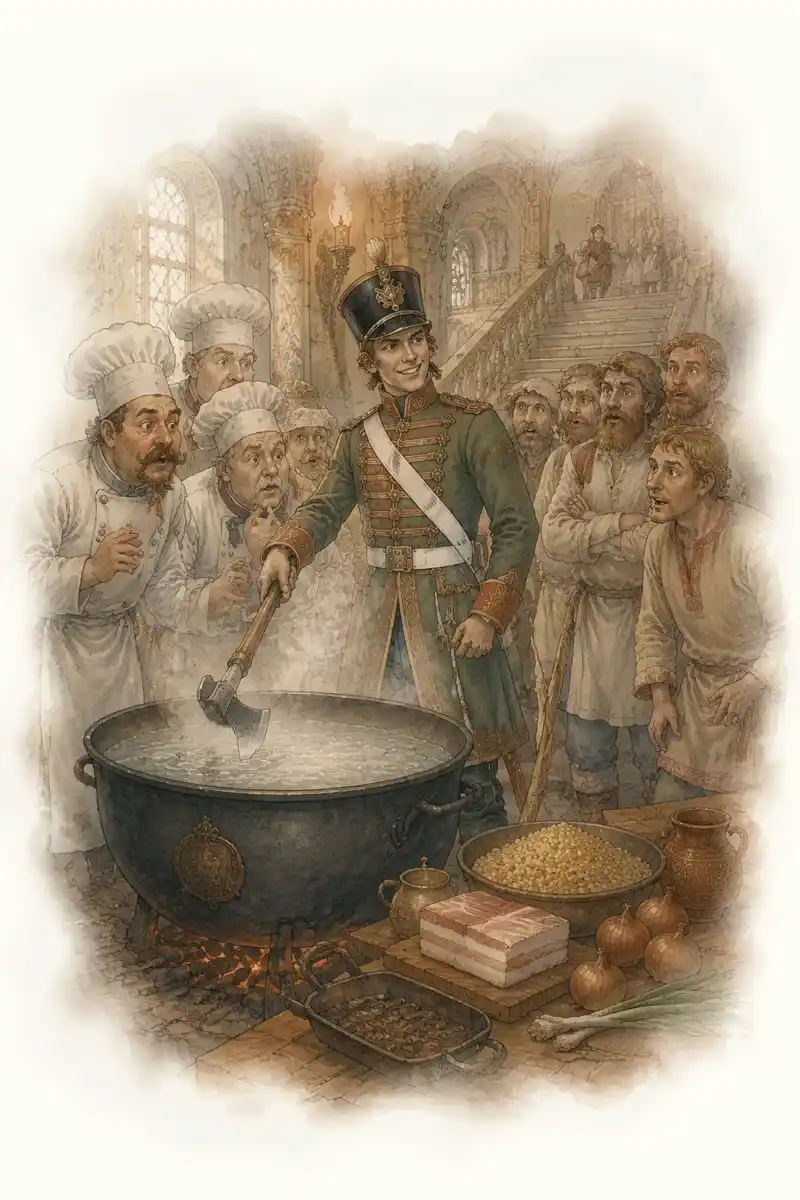
He put the axe in the cauldron and filled it with water.
“If you stint on water—you will not see porridge!”
The cooks were no longer laughing. They watched with all their eyes—an unprecedented axe porridge was beginning to cook!
“And did you not know that an axe can be boiled, fried, smoked, steamed?” laughed the soldier. “Eh, you foreign cooks! An axe can also be soaked, stewed, salted, and made into an infusion! Just now it will boil down for me—a joy to behold. Go, go about your business for now—I will call you when the porridge is ready!”
And the soldier drove the cooks away.
When the water in the cauldron with the axe began to bubble and foam, the soldier approached the fattest, chief cook and said:
“The axe broth has turned out well! But for taste, a little millet groats should be added.”
The fat man ordered millet given to the soldier—as much as needed. The foreign cook very much wanted to taste porridge from an axe!
The millet cooked quickly. The porridge swelled; the cauldron’s lid began to breathe, to stir, as if alive.
The soldier again approached the fat cook:
“The porridge is good in every way, but it smells a bit of iron from the axe—an old axe, it seems, tough. Some pieces of lard would be needed. Have you heard how we say in Rus’: you cannot spoil porridge with lard!”
Glancing at the cauldron of porridge, the cook asked:
“How much lard do you need?”
“I need nothing for myself!” smirked the soldier. “The porridge itself demands lard! If this brazier is heated—that will be just enough!”
They put lard on the brazier and set it on the fire. The lard sizzled and sputtered.
“Axe porridge greatly respects onion,” said the soldier, as if incidentally, taking an onion lying near the fat cook. “A dozen onions for me… these here… will do! And chop them finer… like this…”
The soldier threw the chopped onion into the brazier with lard. The onion fried, turned golden. Then the soldier tipped the whole brazier into the cauldron of porridge. Such an inviting, sweet smell rose from the cauldron that the starving peasants’ knees trembled, and all the cooks, as if on command, turned their noses toward the soldier.
The soldier stirred the porridge with lard and onion with a ladle, winked at his fellow villagers:
“Unbelt yourselves—we will eat our peasant porridge from an axe!”
The foreign cooks crowded around: a marvel!
They tasted—delicious!
“How is an axe chosen for porridge?” the fat cook asked the soldier with respect. “Which axe boils down better, and which worse? Does the wood from which the axe handle is made matter or not? Is a young, that is a new, axe juicier than an old one?”
The soldier only smirked—he could not answer, gobbling the porridge with both cheeks. After all, he had not had a crumb in his mouth since morning!
And the peasants did not lag behind him—they fell upon the porridge so eagerly that the axe lying at the bottom of the cauldron soon appeared.
Good porridge it turned out! And from above, from the general’s chambers, servants came running, waving their arms, shouting:
“Father Tsar is about to come to the kitchen! Let everything be quiet! Let there be order! Otherwise…”
Before the peasants could wipe the porridge from their mustaches and beards, there was a noise on the stairs, a rustle, a clinking—Tsar Peter himself was descending from the grand chambers. And behind him—princes, counts, and many others. And on every chest—orders, stars, medals, multicolored ribbons.
Tsar Peter looked over the kitchen and asked:
“They told me that some soldier here cooked porridge from an axe?”
“Exactly so, Your Imperial Majesty!” reported the soldier. “I cooked it. Here, at the bottom, on the axe itself, a little remains.”
“I wish to take a sample!” said Tsar Peter and approached the cauldron.
A long ladle was immediately handed to him. The Tsar scooped porridge from the bottom and tasted it.
Silence fell in the kitchen. The princes, counts, and all the others watched the Tsar’s mouth: did he like it or not?
“A good kulesh turned out from the axe!” said Tsar Peter merrily. “Ah, what a soldier, ah, what a fine fellow! I praise you!”
After the Tsar, everyone began to taste the porridge and praise it. They even licked the axe clean.
“He cooked it from my axe, Your Imperial Majesty!” said the general. “And this soldier himself is my peasant, from my village!”
“Well, soldier, how did you cook the porridge?” asked Tsar Peter.
The soldier told him, and the foreign cooks nodded their heads, confirming his words.
The Tsar laughed so hard that for a long time he could not utter a word.
Looking at him, the princes, counts, and others burst out laughing.
“That is what a Russian soldier is like!” Tsar Peter finally said. “He outwitted all the foreign cooks! I praise you for your cleverness! How shall I reward you, soldier?”
The Tsar looked around, snatched an axe from the hands of some count—an axe on which not a single grain of porridge remained—and handed it to the soldier.
“Here, soldier, I gift you an axe!”
The princes, counts, and others shouted:
“Vivat to Tsar Peter!”
The soldier took the axe and bowed:
“Thank you for the Tsar’s gift, Your Imperial Majesty!”
Then the general began to fuss and bow:
“Father Tsar, roasted swans are being brought to the table—they must be eaten hot, or they lose much in taste…”
Tsar Peter turned and strode toward the stairs, and after him went the princes, the counts, and all the others to feast.
And the general’s servants shouted at the peasants:
“Faster! Turn! Move! Quick!”
The soldier tucked the Tsar’s gift into his belt and went to turn the cauldrons.