
When the soldier left the Tsar’s service, he settled in his own village. He traded his boots for bast shoes. He began to live a free life, taking neither wife nor household—in short, living in his own penniless pleasure.
But when Tsar Peter the Great died, life in Rus’ grew much worse. Nobles and boyars fought for power, wove intrigues, and undermined one another. Peasants and serfs suffered more than before from these quarrels, cursed their masters, and squabbled among themselves at every opportunity.
It grew sorrowful for the merry soldier to watch this.
“What sort of people have come to be—worse than wild beasts, snapping at each other!”
He waved his hand at them all and set off into the forest—perhaps there he could rest his soul from human vileness.
He walked at a soldier’s stride along the forest road. Just as he was about to turn into the thicket, he saw a tall stone standing in the middle of the road, with writing on it. The letters were Russian, but our soldier could not read at all—there had been no time to learn letters in military service.
“What, soldier—no doubt you would like to know what is written here?”
The soldier turned around—and behind him sat a gray-bearded old man on a little horse.
“How could I not want to, grandfather—I am going to live among wild beasts, and here perhaps there is useful advice on how to get along with them better!”
“There is no advice here,” said the old man, “but what is usually written on such pillars: ‘If you go left—you will not return; if you stay in place—you will sink into the earth; if you turn right—you will lose what is dearest.'”
“Well,” reasoned the soldier, “I do not intend to turn back for now; I only ever stood in place on guard duty; and as for what is dearest—I never had anything dearer than a broken penny… But why does this stone say nothing about the straight path?”
“Why speak of it when it is already known—the straight road is harder and more dangerous than all others.”
“Well, that is exactly why I set out straight into the forest.”
“And if so, then know—the beasts do not have a paradise either, especially in these latter times. As with people, so with them. The wolves and goats are in charge in the forest now. The chief wolf is a fierce robber, commander over all predators, who gnaws everyone without distinction—and he is charmed by witches against bullets. And the supreme goat is in league with unclean powers, and they feed him free food, and he only satisfies his belly, and by his well-fed and idle existence sets a foul example for all the other beasts and cattle. So our forest is now, as it were, enchanted.”
“Ah, misfortune,” grieved our soldier. “Perhaps I should go to the sea instead?”
“At the sea,” said the old man, “a bad law has likewise been established. The whales and gulls have no freedom anymore—the same unclean power has placed a giant in human form over them. He does not let the whales gulp their fill of air—at the slightest thing he drives them into the depths. And he shoos the gulls like pigeons or crows, not letting them peck their fill of fish on the waves. And he has been given a flying horse for that villainous service, to race over the seas and hold all sea creatures in fear.”
“How do all the other beasts tolerate such abuse?” the soldier was indignant.
“There is a merry trio here—the cat-singer, the bear-dancer, and the falcon-crier,” answered the old man. “They know the means to destroy those enemies…”
“Where can I find them?”
“No need to seek them—just call, and they will come at once. Without human help, they cannot overcome the unclean power…”
“And what about you?”
“And what about me—I am just an old forest spirit,” chuckled the old man, and melted into the air together with his little horse.
“Ho,” the soldier realized, “no doubt some demonic illusion is fooling me. Let me call, just to test, the one who is healthier—the bear-dancer!”
And he called.
No, the old man did not deceive him! In that same moment a bear appeared before the soldier—a funny cap on his head, and he looked sad.
“Now then, Toptygin, tell me—how can the local wolf-butcher be overcome, if he is charmed against every bullet?”
“Charmed, but not against every one,” answered the bear. “He will be taken by such a bullet as is prepared for a traitor—and never fired.”
“Good heavens!” the soldier gasped inwardly. “I have just such a bullet saved from the Battle of Poltava! I kept it for Mazepa the traitor, but never had time to use it—the accursed hetman fled to the Turks with the Swedish Charles…”
He loaded his musket without delay with the treasured bullet—and into the forest. And the bear followed him, pushing through the bushes, hiding behind the trees.
Whether long or short—he met that very wolf. The soldier raised his musket.
“What, you fool,” grinned the beast, “do you not know that I am charmed against bullets?”
“And do you not know that I have a bullet for your charm that strikes down every traitor? For you are a traitor to your own kind: instead of hunting only the weak and sick, as your brothers do, you, impious one, cut down everyone in robber fashion!”
The wolf howled, reared up—but too late. The Mazepa bullet struck him squarely in the chest, and the gray robber fell backward.
“A fine beginning!” thought the soldier. “Now I will call the one who is lighter.” And he called the falcon-crier.
The feathered one flew in.
“What sort of butting goat has appeared here?” the soldier asked him. “And what is the means against him, when unclean power is on his side?”
“No force, no cunning can take him!” screeched the falcon. “Only one thing, they say, he cannot endure—the reflection of his own appearance. But where can one find a mirror in the forest?”
“A mirror, perhaps, I do not have either,” the soldier scratched the back of his head. “But I can think of something. Now, lead me to this glutton.”
The falcon flew, and the soldier followed, polishing his helmet as he went. As they walked, he buffed it so brightly that sunbeams danced across the trees.
Soon they saw—a hut in a clearing, a table in the hut, and at the table—the goat, and from the stove flatbreads and pancakes floated through the air straight into his mouth.
Without a word, the soldier thrust his mirrored helmet into the open door. The goat saw the reflection of his vile mug, choked on a pancake, and crashed dead to the floor.
“It seems one’s own vileness truly stings even the unclean one’s eyes,” smirked the soldier. “Well, now it is the cat-singer’s turn!”
At once a little cat appeared in a hat and boots.
“Now, tell me, whiskers,” ordered the soldier, “how can the giant overseer be brought down, so he stops tormenting the underwater and above-water creatures?”
“Oh, that is no easy task,” meowed the cat. “Nothing can bring that idol down. One means—knock out his teeth. Without them he will lose his strength and his power over the flying horse. Only you cannot reach his teeth and cannot approach him at night—he always sleeps with one eye open.”
“Yes, that is tricky,” the soldier twirled his mustache. “Here only cunning will do… Does that giant like to crack nuts?”
“How could he not,” answered the cat. “He is very proud of his teeth and constantly cracks nuts.”
“Then do not be shy,” the soldier rubbed his hands. “Take a basket and let us go to the sea. Along the way we will put treats in it.”
They came to the sea, and the soldier began picking up round stones and putting them in the basket. He had just gathered a dozen—when the giant rose before them as if from the earth.
“Who are you?” he thundered in a voice of thunder.
“Whoever we may be,” the soldier answered without blinking, “we wish to treat Your Highness to some nuts. Do not refuse, do us the favor!”
“Well, we very much respect nuts,” nodded the giant.
He seized a whole handful and bit down—the crunch rolled across the whole sea. And the giant’s teeth rained down on the shore like a bony shower. All fell out, only one remained—no doubt for pain.
The lanky fool sat down on the ground, unable to move hand or foot.
Then the flying horse leaped up to the soldier, neighing with joy—no more unclean power over him!
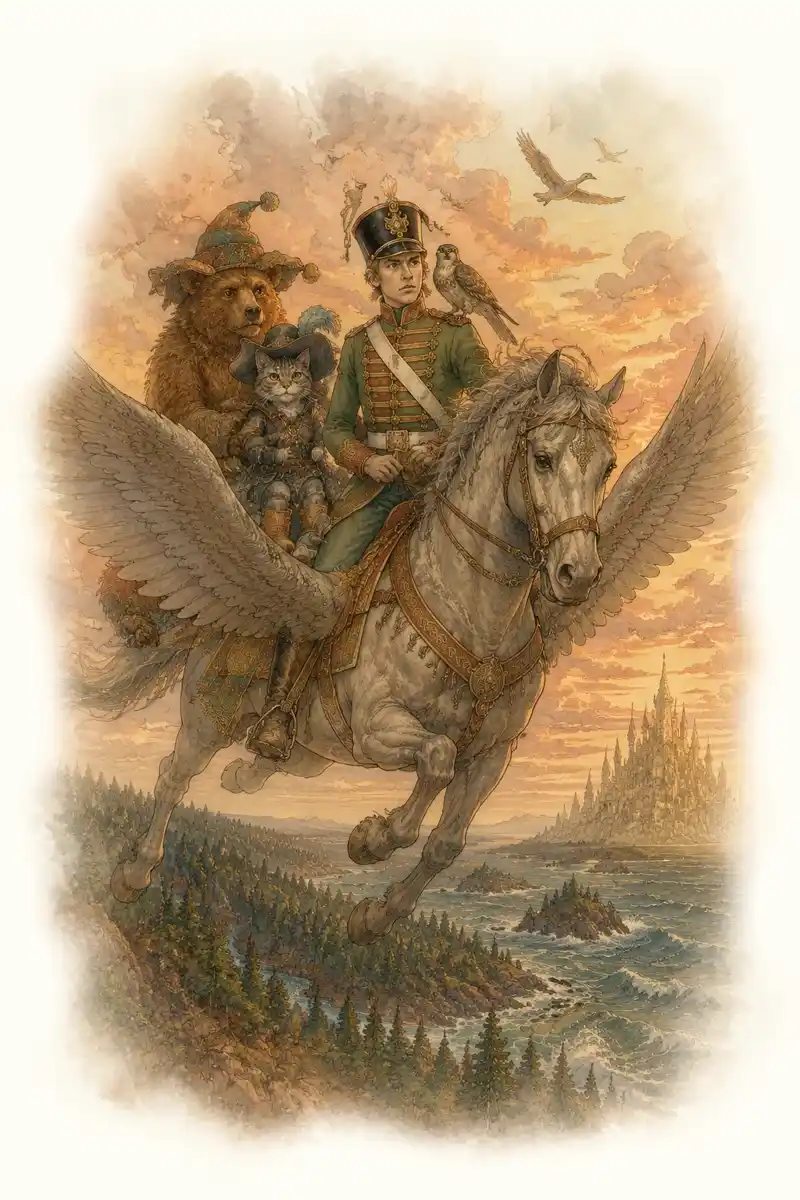
The soldier and the cat saddled him and raced back.
They flew to the forest—and there the merrymaking was already in full swing. Everyone was dancing and singing, and the soldier joined the beasts in the dance.
And then, out of nowhere, the same gray old man on his little horse appeared.
“Well, soldier, you have dealt with the forest and sea unclean powers. And now, will you not try to do battle with someone stronger?”
“Why not,” answered the soldier. “I have acquired helpers—three of them. So tell me, grandfather, who else has need of our help?”
The old man answered:
“In the forest thicket stands a forgotten kingdom-state from time immemorial. Five centuries ago, an unknown sorcerer enchanted its subjects for their laziness and dissolution. And he enchanted them strangely—as if he let the insides out of them, leaving only a shell.”
“Where is this kingdom?”
“Go straight, then turn where the bushes are most prickly. You will come to a dry oak; behind it you will see a clearing. There stands the enchanted kingdom.”
The soldier set off. He walked as the old man told him, scratched himself considerably on the prickly bushes, but at last reached the dry oak. He saw—and indeed, in the middle of the clearing rose a transparent city-kingdom.
The soldier walked through the city, marveling at everything. The streets had not been swept in years, the windows in the houses had not been cleaned. The soldier reached the royal palace—no one guarded the doors, no one came out to meet him.
He looked inside—all the royal servants lay along the walls—some sleeping, barely breathing; some chewing, barely moving their lips. The soldier felt his own eyes glazing over and his legs growing like cotton.
Then he shook his head, jumped in place, stretched, and called just in case the cat, the bear, and the falcon to keep him from falling asleep—and moved toward the royal bedchamber. And there the poor sovereign sat on a bench, staring before him.
“What has happened here?” asked the soldier.
In a weak voice the Tsar answered:
“In ancient times a rich foreign guest came to us and taught us a simple wisdom: ‘Better to walk than to run, to stand than to walk, to sit than to stand, to lie than to sit.’ From that very time we abandoned all our affairs, stopped sweeping in our homes and streets, forgot about washing, and began to eat whatever came to hand… And once a sorcerer passed by. He saw such disgrace—and laid a magic seal upon us: we all became as if empty inside, and transparent outside, so that the emptiness could be better seen.”
“And did the sorcerer not say how to remove the spell?”
“It seems removing it is no great trick,” sighed the Tsar. “All that is needed is to cheer and delight my glassy idlers, so that they take up their affairs with their former zeal and forget the lazy wisdom. Only there is no one to do it…”
“How is there no one?” the soldier was indignant. “I have such merrymakers that they will make even the dead dance!”
As the four of them—with the cat, the bear, and the falcon—began to sing, dance, and play, the whole enchanted kingdom stirred—before an hour had passed, every single one was at work: some mowing, some carrying, some spinning, some sweeping—and all with merriment, all with song!
And just before midnight, the sorcerer’s punishment ended: people, animals, and houses—everything bloomed, filled with life. And everyone, until morning, by lights and bonfires, cleaned the streets and burned the rubbish, and afterward celebrated their deliverance.
They danced and celebrated, and toward morning the soldier said:
“Well then, we have set order in the forest and at the sea and disenchanted the glassy kingdom. Is it not time to do the same in my own parts?”
And he set off home.
And there—in the villages and towns—everything was as before: fighting for power, squabbling among themselves! And as of old—the rich oppress the poor, the noble harry the lowborn, the fool teaches the wise… And there was no end in sight to that disgrace.
The soldier looked at all this, sighed, and said:
“Yes, brothers, with people it will be harder than with beasts. Very well,” he said, “I will not run back to the forest. I will, as I can—within my strength—set life in order.”
No sooner said than done. The soldier built a house, established a household, married, and had children with his wife. And he raised them so that they would grow up neither as vicious wolves, nor as insatiable goats, nor as proud giants, nor as useless idlers.
And what came of it—we do not know.