
A soldier was walking home—returning from the army. He strode along merrily, singing a song—an old soldier does not like to walk without a song.
The road led through a forest. The soldier saw an overturned cart loaded with firewood. The horse had become tangled in its traces and could not get back onto the road. A little old peasant was tugging at the reins, but to no avail.
“Bad luck has befallen you, grandfather!” chuckled the soldier. “Have you been stuck here long?”
“A long time, sonny, a long time, soldier,” answered the little old peasant. “A cart has already passed by, and two carriages, and boyar servants walked past—they all just laughed, and no one wanted to help.”
“You will never get back onto the road alone, grandfather!” said the soldier. He walked up to the cart, braced his shoulder against it—one, two, three!—and set it back on its wheels. Then he pushed the cart—one, two, heave!—and shoved it onto the road.
He helped the little old peasant gather the firewood and load it onto the cart.
“A pity we are not going the same way,” sighed the soldier. “Otherwise you could have given me a ride, grandfather, at least a little way!”
“Thank you, soldier!” bowed the little old peasant. “You have a kind soul!”
“And thank you for the kind word!” answered the soldier. “A Russian warrior never passes by another’s misfortune. You have heard our commandment: guard your native land, destroy the enemy, help the young and the old!”
“In Rus’, good is answered with good,” said the little old peasant. “I want to give you one piece of advice, soldier. If it happens that you reach the capital and suddenly please the Tsar in some way, and he says to you: ‘Ask of me whatever you wish’—then ask him for the old soldier’s knapsack that lies in the royal treasury. And whatever the Tsar offers you—take nothing else in exchange.”
The little old peasant spoke these words and melted away, vanished—as if neither he, nor the cart of firewood, nor the horse had ever been there.
“Clever!” the soldier shook his head. “However many wonders I have seen in the world, I am still amazed every time! Clever!”
And he walked on.
Just at that time, various foreign kings and princes had come to visit the Tsar. They feasted for a day, then a second, and on the third a dispute arose among them: who was stronger than whom!
It was not fitting for kings and princes themselves to measure strength against one another—it was not a noble, not a royal matter. For such occasions, each of them brought a strongman with him. And that strongman wrestled in place of the king or prince, displaying his strength and skill.
Since that was the custom, the Tsar also issued a call: all who firmly believed in their own strength were to appear at the palace immediately!
The soldier heard this and twirled his mustache:
“What Russian does not believe in his strength?”
And he went to the capital, straight to the Tsar’s palace.
The strongmen gathered and began to wrestle one another. Whoever was pinned to both shoulder blades went off to drink mead. And whoever prevailed began to wrestle the next strongman.
And so it happened that the soldier, in the end, defeated them all—both those who boasted of their strength and those who kept silent. Some he overcame by cunning, some by agility, and some he simply threw over his head and pinned to the ground with his knee! He proved the strongest of all!
The Tsar embraced him and said:
“Well done! You have not shamed Russian strength! Now wrestle with me! If you pin me, ask whatever you wish! Now, hold on, soldier!”
They grappled each other so fiercely that their bones cracked. The foreign guests crowded around—they had never seen such sport.
The soldier did not want to defeat his own Tsar in front of foreigners. He decided to yield, loosened his grip—and the Tsar immediately pinned him to both shoulder blades.
“Vivat!” everyone shouted. “Vivat to the Tsar-bogatyr!”
But the Tsar grew angry, bristled his mustache, and said to the soldier:
“Do not play tricks before me, or instead of a reward I will give you a thrashing! You will not deceive me! We will wrestle again!”
They grappled again. And again the soldier yielded—he very much did not want to shame the Tsar before the guests.
The Tsar’s temper flared even more.
“Do you take me for your commander?” shouted the Tsar.
“Exactly so, Your Imperial Majesty!” answered the soldier. “You are my very first commander!”
And he added quietly:
“Tsar-sovereign, the foreign guests are here… what will they tell about you later?”
“Let them say what they will!” shouted the Tsar. “They cannot wrestle as I can anyway! And I command you: wrestle with all your strength! Honestly, without deception!”
“It shall be done, Your Imperial Majesty!” reported the soldier.
Well, an order is an order—it must be carried out. No sooner had the wrestling begun than the soldier maneuvered, spun the Tsar so sharply that he immediately pinned him to both shoulder blades.
“Well done!” said the Tsar, rising and dusting himself off. “A bargain is dearer than money—ask whatever you wish!”
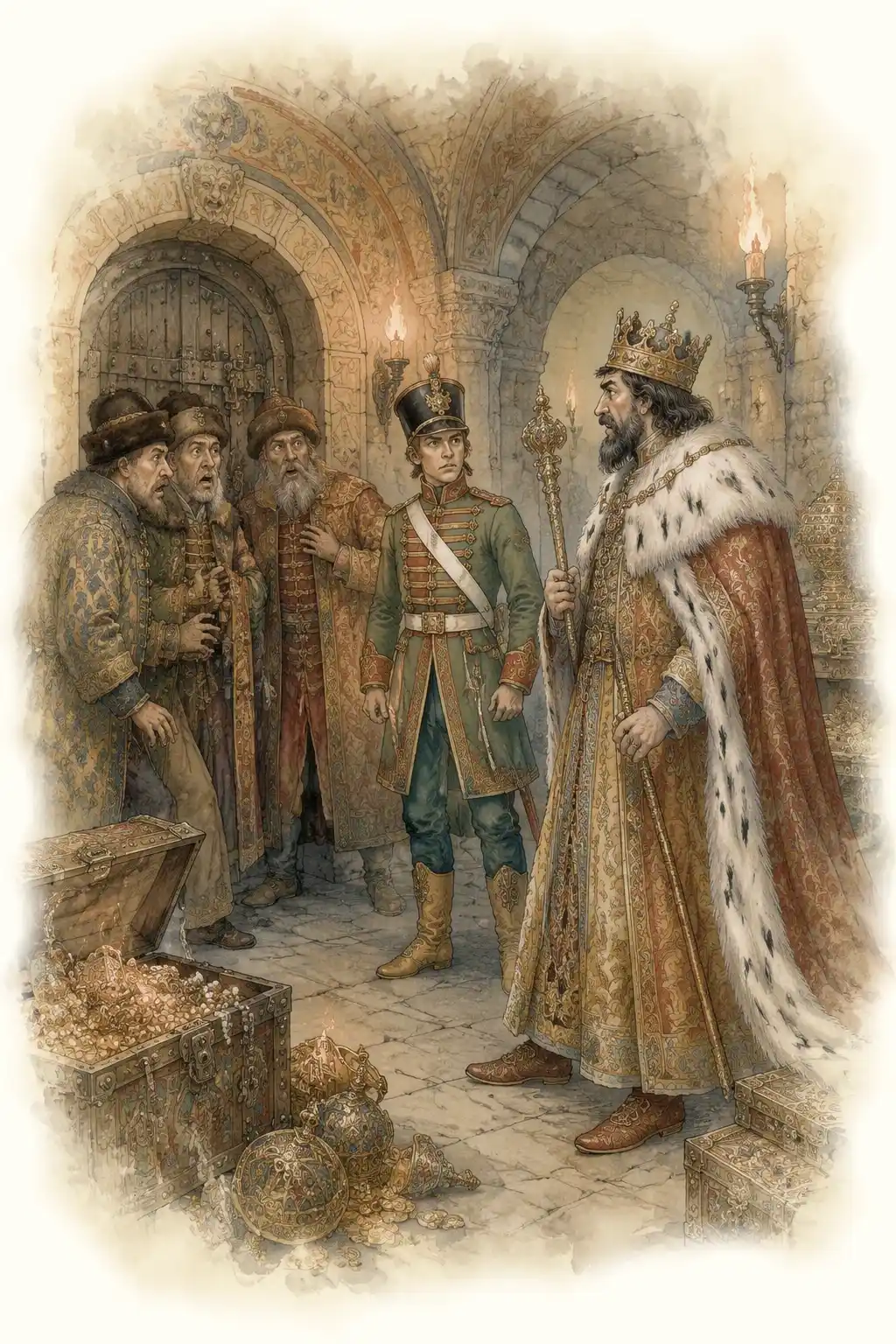
“I need nothing but the old soldier’s knapsack from your treasury,” answered the soldier.
“Oh, you are cunning, soldier!” smirked the Tsar. “I would never have given that knapsack to anyone, but I cannot break my royal word! Hey, generals, bring me the knapsack!”
The soldier received the knapsack, and the Tsar said:
“I am taking you into my service, soldier. You will guard my treasury. It seems to me that thieves have been visiting it. You will stand guard at night and rest by day!”
And so it went: by day the soldier rested, by night he guarded the Tsar’s treasures.
He walked with his musket near the royal treasury and wondered:
“Why was this knapsack lying in the treasury beside precious stones and red gold? The knapsack is old, empty inside—what good is it?”
The soldier examined it from all sides, turned it this way and that—saw nothing. He fell into thought and tapped his fingers on the knapsack—as if beating a drum roll.
And immediately, out of nowhere, two young fellows appeared before him.
“We are the two from the knapsack!” they said. “We serve the one who owns the knapsack!”
“Clever!” laughed the soldier. “I have seen many wonders in my life, and still—every time I am amazed!”
“What do you command?” asked the fellows.
“I do not think I have any orders yet,” answered the soldier. “When I need you, I will call.”
Now, in the palace courtyard, among the various other servants, there lived three boyars. They were the ones who had taken to visiting the Tsar’s treasury. They had learned all the secret doors and picked keys for them. The Tsar had much gold—one would not immediately notice if someone stole some.
This time, in the deadest hour of the night, the boyars came out of the secret passage—and the soldier was standing at his post! There was nothing to be done—the thieves turned back.
“We will have no peace from this soldier!” said one boyar.
“If we do not destroy him, we will never see the Tsar’s goods!” said another.
And the third slapped his forehead:
“I know how to get rid of the soldier! Let us go to the Tsar and say that the soldier walks about the city, boasting on every corner that he pinned the Tsar himself to both shoulder blades! That our Tsar-sovereign is, so to speak, weak!”
And so the boyars did. The next day they bowed to the Tsar:
“Do not order us executed, Father Tsar, but order us to speak the truth!”
“I so order it!” said the Tsar.
“We alone, the boyars, know the worth of your kind word, Father Tsar!” said one boyar. “But peasants and soldiers—the kinder you are to them, the more they turn up their noses!”
“What is this leading to?” asked the Tsar.
“It is leading to this: the soldier walks about the city slandering you!” said the second boyar. “Saying our Tsar is weak, stands poorly on his feet, anyone can defeat him!”
“He shames you, our sovereign, shames you with the worst words!” shouted the third boyar. “Better to go deaf than to hear a soldier’s words! ‘I pinned the Tsar to both shoulder blades,’ he says, ‘and held him down with my knee!'”
The Tsar grew furious and flared up:
“Where has it ever been seen that they mock me, the Tsar?! I command: put the soldier in wooden stocks at once and throw him in the guardhouse! So that next time he will not be so quick to wag his tongue!”
The servants ran, seized the soldier, put wooden stocks on his hands and feet, and threw him in the guardhouse.
“No great misfortune!” smirked the soldier. “If only I could reach my knapsack!”
He slipped the knapsack from his shoulders and drummed his fingers on it. The two young fellows stood before the soldier.
“What do you command?” they asked.
“Take off these stocks—my arms and legs are tired from them!” ordered the soldier, and in that same moment the wooden stocks fell apart. “And now go to the palace, find out why I was put under arrest!”
The fellows vanished, and the soldier put the knapsack under his head and fell asleep.
The fellows returned by evening and told him everything, how it had been.
“It is none other than that I have stood in these boyars’ way,” guessed the soldier. “It seems they have planned some foul deed!”
“Command us—we will guard the treasury,” said the fellows. “Neither beast nor bird will come near it!”
“No, a soldier must carry out his orders himself, not shift them onto others! You, fellows, deliver me to my post from here—it is time for me to take up my watch!”
Before the soldier could twirl his mustache, he was at his post beside the Tsar’s treasury.
The boyars had just begun to unlock the secret door when the soldier was right there:
“Halt! Who goes there?”
The boyars took fright and ran off as fast as their legs could carry them. They ran so hard they could not catch their breath all night.
“Where did this soldier come from?” asked the first boyar when he finally caught his breath.
“The guard at the guardhouse must be poor!” said the second boyar.
“And how did he get the stocks off his hands and feet?” scratched the back of his head the third boyar. “No, something is not right here… We must go to the Tsar—let him throw the soldier into a pit. From there he will not escape!”
They went to the Tsar. They bowed.
“Father Tsar, where has it ever been seen that your decrees are not carried out?” asked the first boyar.
“What happened?”
“The soldier escaped from under arrest, walked about the city all night—we saw him ourselves!” said the second boyar.
“And again he boasted of his strength and of your weakness, Father Tsar!” added the third boyar. “Throw him, Father Tsar, into the deepest pit, so that he cannot even see the sky! And put iron fetters on his hands and feet—heavier ones!”
The Tsar flared up more than before:
“What is this? Prisoners strolling about at liberty?! Throw the soldier into the pit! Put him on a chain!”
But the soldier had returned from his post to the guardhouse, put the knapsack under his head, and fallen asleep.
So they chained him while he slept and threw him into the pit.
“Oh, how these thieving boyars fear me, to blacken me so before the Tsar!” the soldier realized. “But they will not get me with this—I know my duty.”
And as soon as evening came, the soldier drummed on the knapsack—and the fellows appeared before him.
“What do you command?”
“Free me and deliver me to my post!” ordered the soldier.
Immediately the chain fell away, and the soldier found himself at the Tsar’s treasury.
Just past midnight, the boyars approached the secret door. Boldly, without hiding—whom should they fear? The soldier was sitting in the pit!
They jingled their keys and began to unlock the locks. But the soldier came closer and bellowed:
“Caught, you fat-bellied ones! Tie up the thieves!”
The boyars nearly lost their lives from fear right there, without moving from the spot. They could not move—their knees gave way beneath them.
The soldier, looking at the boyars, laughed so hard that tears ran from his eyes. Only then did the thieves come to their senses and take to their heels—only their heels flashed.
When dawn broke, the soldier summoned the fellows from the knapsack and ordered:
“Take me back to the pit! And put the chain on—otherwise the guard might notice something amiss.”
He settled more comfortably in the pit, put the knapsack under his head, and fell asleep.
And the boyars sat in their stone chambers until morning and could not even speak to each other—they trembled with fear, their teeth chattering.
The sun had already risen when one of the boyars finally managed to speak:
“How did that accursed soldier get out of the pit, free himself from the chain?”
“We must find out from the guard!” said the second boyar.
“Something is not right here, mark my word!” scratched the back of his head the third boyar.
The boyars went to the pit. They began to scold the guards:
“Do you know what happens for violating the Tsar’s decree? Eh?”
“Why does the soldier come out of the pit?”
“You, you gaping fools, should be thrown into the pit together with the soldier!”
The guard swore and vowed that the soldier had not shown even his nose from the pit—and how could he, when it was as deep as a well?
The boyars fell into thought.
“How can this be? The soldier did not leave the pit—yet he stood at his post?” marveled one boyar.
“Wonders!” said the second. “Magic power, nothing else!”
“It is all because of the knapsack the Tsar gave the soldier,” whispered the third. “That knapsack is magic—nothing else! It fulfills all the soldier’s wishes! Until we take the knapsack from the soldier, we cannot overcome him!”
The guard opened the lid, and a boyar shouted down to the soldier:
“You are now a state criminal, not a soldier! And the soldier’s knapsack is not for you! Hand it over!”
“How can I hand it to you? I cannot toss it from here! Lower a rope!” answered the soldier from below.
The boyars sent a guard for a rope.
Meanwhile, the soldier summoned the fellows from the knapsack and ordered:
“Bring me a soldier’s knapsack, so it looks like mine!”
Before the guards had lowered the rope even halfway into the pit, the fellows appeared with an old soldier’s knapsack.
“Like two drops of water!” smirked the soldier, comparing the knapsacks. “Tie the knapsack they brought to the rope, and tie it tight! Hey, pull it up!”
The boyars pulled up the rope, seized the soldier’s knapsack, and carried it to their chambers. Whatever they did with it, they noticed no magic.
“That is no matter!” they said. “The main thing is—the soldier is now without the knapsack! And tonight we will go about our business without hindrance!”
By evening the soldier was again delivered to his post.
Just past midnight, the soldier heard—the thieves were coming.
They approached the secret door and began to unlock the locks.
“Ah, it seems the Tsar himself cannot guess why the boyars want to destroy me!” thought the soldier. “I should show him these thieves!”
“Bring the Tsar here at once!” ordered the soldier to the fellows from the knapsack.
The boyars had not managed to unlock the first three locks when the Tsar found himself beside the soldier. He stood there, rubbing his eyes, unable to understand in his sleepiness—where was he?
He saw the soldier, and his mustache bristled with anger:
“So it is true, what my faithful servants told me—that you leave the pit at night and stroll about the city?”
“The truth, Tsar-sovereign!” answered the soldier. “But do not be angry without cause—hear me out first…”
And the soldier told the Tsar everything as it had been—about the thieving boyars, about the fellows from the knapsack.
“Do you hear, Your Imperial Majesty?” said the soldier. “Right now the villains are opening the secret door, intending to rob your treasury!”
“I want to see them!” said the Tsar, and stepped forward.
And the boyar-thieves were rejoicing that no one was hindering them. They had already removed the last lock from the door. They had just begun to open the door when the Tsar shouted:
“There you are, my faithful servants!”
The boyars, the moment they heard the Tsar’s voice, fell to the ground and died of fright.
“A pity!” said the Tsar. “I would have thrown them into the pit instead of you! Well, soldier, for faithful service receive your reward! I grant you all that these thieving boyars owned. Live to your heart’s content!”
“Thank you, Tsar-sovereign, for the kind word!” said the soldier. “But a well-fed boyar’s lot is not to my liking! Let me go home, to the village, and order that no taxes or tributes be taken from me!”
“That, soldier, is an impossible request!” laughed the Tsar. “In my kingdom, only one man does not pay taxes—I myself! And there cannot be two Tsars at once! Here is a caftan from my royal shoulder—and go to all four corners! And leave the knapsack with me! Now these fellows will guard the treasury in your place!”
“And for that, thank you, Father Tsar,” bowed the soldier. He gave back the knapsack, put on the royal caftan, began to sing a song, and set off home.