
Once, in the presence of Tsar Peter himself, an admiral and a general fell into an argument—whose clothing was better?
The general praised his clothing, the admiral praised his.
“My fur coat fears no frost, no storm matters to it, no bullet can pierce it!” boasted the general.
“And my coat,” shouted the admiral, “is such that in heat it is cool, and in frost—warm! In rain it does not get wet, and in battle cannonballs bounce off it like nuts!”
Tsar Peter listened to this argument, listened, and it struck him as funny.
“You have been waving your tongues like sabers—sparks are flying!” he said. “Let us better ask the soldier: whose clothing is better—the general’s or the admiral’s? As he says—so it shall be!”
One cannot argue with the Tsar: the admiral and the general bowed to him—meaning, we agree.
“Soldier, to me!” ordered Tsar Peter.
The soldier shouldered his musket and—with a crisp step—went to the Tsar.
“Tell me, whose clothing is better—the general’s or the admiral’s?” asked the Tsar. “Answer, do not deceive!”
“In my understanding, Your Imperial Majesty, the best of all is my soldier’s caftan!” answered the soldier. “It fears neither heat nor frost, and wind even less!”
Tsar Peter burst out laughing, and the general and admiral puffed up with spite.
“Well then, the argument is now among you three!” said Tsar Peter. “If the general wins—he shall be a field marshal. If the admiral—he shall command the fleet. If the soldier proves his case—I will make him a general, and demote you both to soldiers!”
“And how shall we decide the argument?” asked the admiral and general.
“Like this,” answered Tsar Peter. “First we shall ask Brother Frost to turn up the cold, and then His Radiance the Sun to burn hotter. Whoever endures the cold and the heat—he wins the argument! Tomorrow morning we shall begin!”
The general rode to his palace, sat down to think—how could he overcome the admiral and the soldier? He summoned his faithful servant and ordered:
“Here is a purse of gold. Ride to Frost, bow low to His Radiance, and beg him not to freeze me too hard tomorrow. But the admiral and the soldier—let him turn them into icicles!”
The servant took the gold and rode off.
“Since both of them will freeze, the argument will end there,” decided the general.
The admiral rode to his palace, also began to think—how could he gain the upper hand in the argument? He summoned his faithful servant and ordered:
“Ride to His Radiance the Sun, deliver this casket of precious stones. Beg it not to scorch me tomorrow, but to turn the general and the soldier into cinders!”
The general’s messenger visited Frost, galloped back, and reassured his master:
“His Radiance thanks you for the purse and promised to fulfill Your Excellency’s request precisely!”
The general cheered up at once—he already saw himself as field marshal!
The admiral’s messenger delivered the casket to the Sun, returned home, and reported:
“His Radiance sends you greetings and promised to fulfill your request!”
The admiral glowed with joy: from tomorrow he would command the fleet!
And the soldier sat in his barracks, putting patches on his old caftan and darning holes.
In the morning, the admiral, the general, and the soldier came to Tsar Peter.
“With what shall we begin?” asked the Tsar. “With the cold or with the heat?”
“With the heat, the heat!” shouted the admiral.
“With the cold, the cold!” shouted the general even louder.
“And it is all the same to me!” said the soldier. “I will carry out any order!”
“Very well, let it be cold! Brother Frost, begin!” ordered the Tsar.
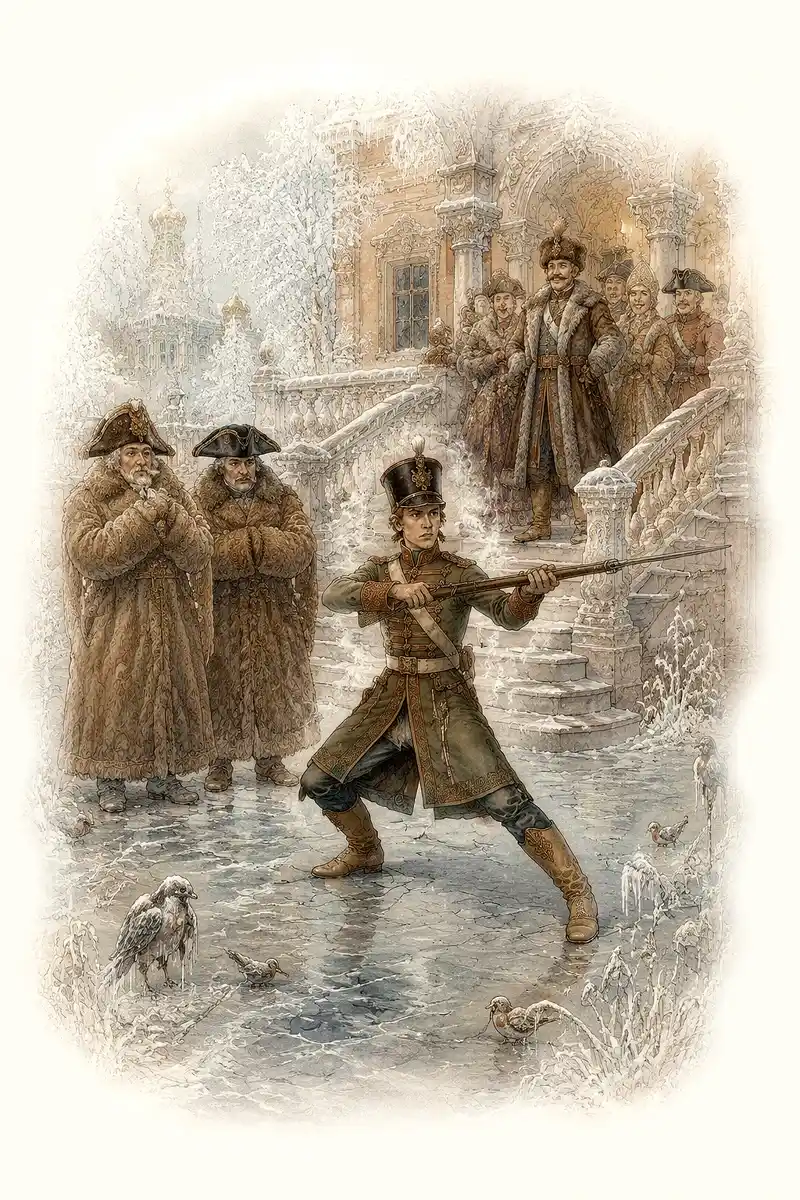
Scarcely had the Tsar with the Tsarina and all his retinue managed to hide in the palace when such cold came as had never been seen. Stones began to crack from the cold; everything living turned to ice.
The admiral and the general stood in their fur coats of three furs—from a distance, just like haystacks—you could not tell them apart.
The soldier tightened his belt, stamped his feet, slapped his sides with his hands. Now he would squat, now stand, now squat, now stand. He rubbed his ears, nose, and cheeks, ran back and forth, began to squat again. Then he began to perform rifle drills. He commanded himself:
“Thrust! Strike! Thrust! Strike!”
Such steam rose from the soldier that he looked as if he had just come from the bathhouse.
The fiercer the frost grew, the faster the soldier ran. The cold could do nothing to him!
“Well, enough!” said Tsar Peter. “Thank you, Brother Frost! Let us see who is still alive!”
At once it grew warmer, the birds sang again, the leaves on the trees turned green.
The Tsar with the Tsarina and all their retinue came out of the palace.
They looked: the soldier stood at attention before the general, and the general was berating him—because when the soldier performed rifle drills in the cold, he had made two mistakes: he held the butt too high and thrust too shallowly.
“And why does the admiral not come out of his fur coat?” asked Tsar Peter.
“No doubt he has frozen to death in there, Father Tsar,” the general answered joyfully.
They approached the fur coat and opened it—and there, instead of the admiral, was an icicle in a uniform!
“His clothing turned out to be poor,” said the Tsar. “But your argument is not finished. Now let us see how you endure the heat!”
“Why do you wrong me, Father Tsar?” pleaded the general. “I argued with the admiral, not with the soldier. I won my argument, and I cannot be on equal footing with a soldier! I am a general!”
“If you are a true general—then what have you to fear?” laughed Tsar Peter. “And if the soldier wins the argument against you—then what kind of general will you be after that? Sun, Your Radiance, begin!”
Scarcely had the Tsar with the Tsarina and all their retinue hidden in the palace when such heat came as had never been. Everything around turned black. Streams and rivers dried up and turned to clouds. Bears in the dense forests threw off their skins.
The general stuck out his tongue, rolled his eyes—he could neither breathe in nor breathe out. And the soldier, as if nothing had happened, walked back and forth, playing with his musket.
The sun burned ever more fiercely with all its might. The general had already begun to dry up, shriveled, turned black.
“Eh, sun,” said the soldier, twirling his mustache, “you have seen Russian soldiers in battles and fights! Such heat occurred there as cannot compare with this! And nothing—we survived! Why are you trying in vain? Look, do not burn yourself!”
Evidently the sun itself could not bear it any longer—the heat began to subside.
The Tsar with the Tsarina and all their retinue came out of the palace.
They looked: the soldier, as if nothing had happened, walked back and forth, playing with his musket.
And in the general’s uniform—a charred log.
“So the general’s clothing is no good either!” said Peter. “The soldier’s caftan has defeated all! From now on, soldier, you shall be a general!”
“And may a general walk in a soldier’s caftan?” asked the soldier.
“No, that is improper!” answered Tsar Peter.
“But if the general’s uniform is worse than the soldier’s caftan, then why should I exchange good for bad?” smirked the soldier. “No, I would rather remain a soldier. But can you fulfill one request of mine, Your Imperial Majesty?”
“If I can—I will. Speak.”
“The request is this: that I, to the end of my days, give honor to no one but you, Tsar-Sovereign—neither to generals, nor admirals, nor field marshals!”
Tsar Peter merrily surveyed his retinue—princes, counts, generals, admirals—and said:
“Though it is not proper, very well, let it be as you say! You may not give honor to generals and admirals—you defeated them in fair argument. But field marshals, if you please, you shall greet as the military regulations prescribe!”
The Tsar laughed and said:
“But if there is an occasion, and you, soldier, win an argument against a field marshal—then that is another matter!”