
In one of the bloody battles, Yarosvet crushed the hostile army of the Alans and Goths. It was a hard-won victory; many great warriors perished in that fight.
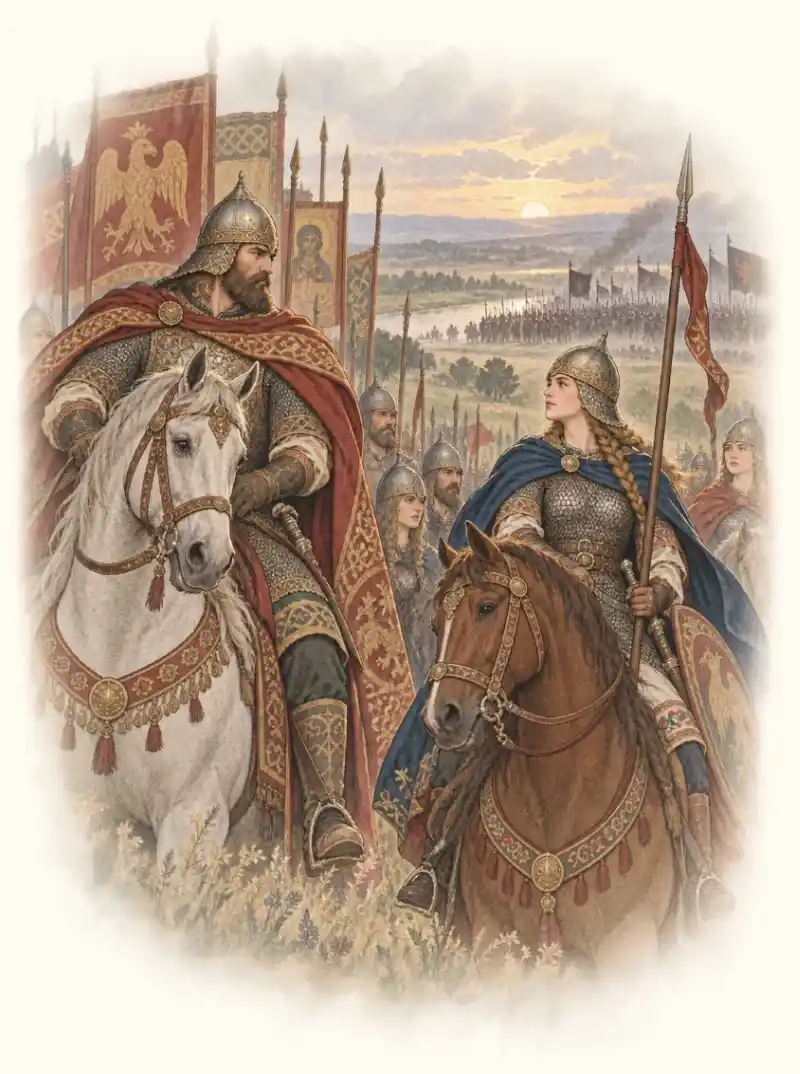
At night, as soon as the army withdrew from the field of battle, maidens and young warriors went out to gather the surviving Russian soldiers. The wounded they found were carried to tents, where they were stitched and bandaged with herbs.
One maiden named Lyubavushka discovered and managed to pull a boyar from beneath a heap of bodies. He wore mighty armor and a cuirass, pierced in several places. The warrior had lost much blood and was unconscious. Together with her friend, Lyubavushka carried the body to a tent. Examining the boyar, the friends realized he was on the brink of life and death. The warrior was already advanced in years. He had a gray mustache, and white hair covered his head, but the vityaz was handsome and strong. The boyar lay without once opening his eyes. The maidens removed his armor, washed and stitched his wounds, but he still did not regain consciousness. The warrior was slowly dying. And then Lyubavushka did the last thing she could—she decided to give him her life energy. At night, the maiden would lie down beside the boyar and, pressing her body to his, place her hands upon his life-springs. Rising in the morning, Lyubavushka could barely stand, pale and exhausted. The women were starving; there was almost nothing to eat, since all the food was given to the warriors.
Several weeks passed. All this time Bograd—for that was the boyar’s name—lay with open eyes, neither recovering nor dying. Her friend, seeing what was happening, pleaded:
“Lyubavushka, you will kill yourself! You are giving all your life force to one who lies on the brink, who does not even see what you are doing for him! Let the gods take him rather than keep him thus between heaven and earth. You torment both yourself and him!”
And then the maidens, glancing at Bograd, were amazed. They saw the boyar’s conscious gaze and understood that he had heard everything.
Her friend felt ashamed; she understood that Lyubavushka was right. The warrior began to recover; now the strength need not be given.
The maidens rejoiced, ran for food, and fed the boyar. Bograd began to rise a little, to turn, but his strength was very small, and so he almost immediately lost consciousness. And then Lyubavushka and her friend decided to send a letter to the warrior’s native city—so that people would find his wife and she could take Bograd home.
Some time passed, and the boyarynya arrived at the camp. She stood, looked at her half-dead husband, waved her hand, and said:
“Do with him whatever you wish; my own household is full of cares. I have no one to nurse him.”
She left a few silver coins for his care and departed. And Bograd at that time lay almost without consciousness and did not understand what had happened.
Days passed. At last the boyar fully came to himself, began to rise, to move, and began to think of returning home. Her friend, seeing this, told Bograd that his wife had come and, abandoning him, had left, leaving a few silver grivnas at parting. Lyubavushka had kept this money, not spending a single coin, and now returned it to him. The friends insisted that he himself return this money to his wife. The boyar gathered his things and wanted to take leave of Lyubavushka, to thank her for all she had done for him—but the maiden had vanished. She vanished after giving him the coins. No one knew where to find her.
Bograd returned home. He entered his spacious chamber and, seeing his wife, flung the silver grivnas before her on the table:
“Why did you not take me? Am I truly of no use to you? Am I so bad that you would abandon me to my fate?”
The wife wept and wailed that she had known nothing. She rushed to him—but the traitor was no longer needed by her husband.
Bograd gathered his household and, with his people, departed for Yarosvet’s army. As soon as the boyar arrived at the new place, he began to search for Lyubavushka. He asked after her throughout all Southern Rus’, but no one had heard anything of her.
Meanwhile, the enemy army of the Alans, having seized several Russian cities, again moved toward the Don. Once more it was necessary to defend the southern borders of Rus’. Yarosvet began to gather his army. Throughout the army walked Bograd, asking everyone he could about Lyubavushka. Many people came to the army, including women. They, like the men, had horses, armor, and weapons: spears, bows, sabers, and swords. Men were scarce; the struggle was very hard, and Rus’ was growing exhausted. But no one could tell Bograd anything about the maiden.
Once, chance brought the boyar together with Lyubavushka’s friend. As he was forming his thousand before the battle, he saw her familiar face and understood that this was she—the very one who had nursed him.
And he immediately rode up to her and began to ask:
“Tell me, where is Lyubavushka? Where is the one who saved my life?”
“She is here. There—do you see her helmet, and she herself on horseback. We, the young maidens, have come to help our army and will take part in the coming battle.”
At that moment, before the Russians stood the Alan army—heavy cavalry, covered in armor, bristling with spears. The Alan host was preparing to attack. And so Bograd hurried to his thousand and could not meet Lyubavushka; he only glimpsed her clothing and cloak.
Before he could gallop to his warriors, he heard the roar of the enemy cavalry’s trumpets, and at that moment the Alans hurled themselves in a cavalry avalanche upon the Russian army. Thousands of arrows cut through the dust and air. Bograd led his thousand into the very center of the Alan column. With his long spear, the boyar hurled first one, then another Alan horseman to the ground. He strained toward where the fierce slaughter boiled, where he saw Lyubavushka’s cloak and helmet, where young Russian maidens stood to the death alongside hardened warriors. But then a mighty Alan rose before the boyar, then another, and a third. And Bograd was forced to delay, and when he had dealt with his enemies, it was already too late. He did not manage to cover his beloved maiden with his shield from the blow of an enemy spear. The sharp Alan spear struck Lyubavushka’s chainmail. The chainmail could not withstand it, and the maiden fell into the arms of the boyar who rushed to her.
Bograd caught the maiden, turned his horse, and began to make his way out of the battle, signaling to the warriors to continue the advance. No one stopped him. The people understood that something was amiss. Meanwhile, Bograd galloped into the field, where he carefully lifted Lyubavushka from the horse and laid her on the ground. Removing her helmet, the boyar saw her pale face and understood that she was already dying.
The only thing Bograd could say to Lyubavushka was that he loved her very much and that she had saved his life. That he would not betray her even after death.
The maiden smiled at him and asked:
“Kiss me one last time. I am very sorry that I am leaving. Remember that I will surely return soon—return to our world, because Rus’ is on the brink of destruction.”
Bograd tenderly embraced Lyubavushka and kissed her.
After several hours of fighting, the Alans were routed. Turning their horses, they hastily rushed south to hide in their mountain fortresses.
Yarosvet galloped up to the boyar and asked:
“We have won—but why do you not rejoice? Why are there tears in your eyes?”
“I found the one I sought for so long,” the boyar showed the prince Lyubavushka lying in the grass. “But Mara took her from me the moment I met her.”
“So it is thanks to her that you remained alive, my friend? I understand you. Tomorrow she will be buried on a funeral pyre with honors.”
Yarosvet left Bograd alone with his grief and galloped back to the camp.
And so the maidens, together with the young warriors, again began to gather the wounded and slain from the field of battle. The living they carefully carried to the tents, and the fallen they bore to a pyramid, laying it with dry firewood.
Meanwhile, Bograd removed Lyubavushka’s armor, carried her body to the clean waters of the river, washed her with his own hands, and dressed her in the finest and most beautiful gown he had brought her as a gift. The boyar himself changed into a clean red shirt, blue trousers, and girded himself with a golden belt.
And when the moment of parting came and the whole Russian army gathered around the brotherly funeral pyre, Bograd took the maiden in his arms and went to carry her to the summit of the pyramid of the dead.
When he climbed onto the pyre and laid Lyubavushka in her place, he bowed to Mother Earth, stretched his hands to the blue sky and bowed to the Russian army, and then calmly and firmly drew a damask knife from his boot and plunged it into his own heart.
The warriors gasped; the princes and boyars were agitated:
“What has he done!” some exclaimed indignantly. “Years of war lie ahead, and he has abandoned the army for a girl!”
But then Yarosvet rose from his place. The prince raised his hand, and when the voices of the army fell silent, he addressed them and said:
“There is no loss or bereavement here. The war with the enemies of the Russian land will continue for more than one century. And the boyar will come with this maiden to our land when he is most needed by it. Therefore do not grieve and do not condemn Bograd. Light the fires!”
From the torches brought, a bright flame blazed up and engulfed the whole pyramid. And at its summit lay Bograd and Lyubavushka, who were departing together to their ancestors, to return again and stand in defense of their Motherland—the Russian land, their mother.